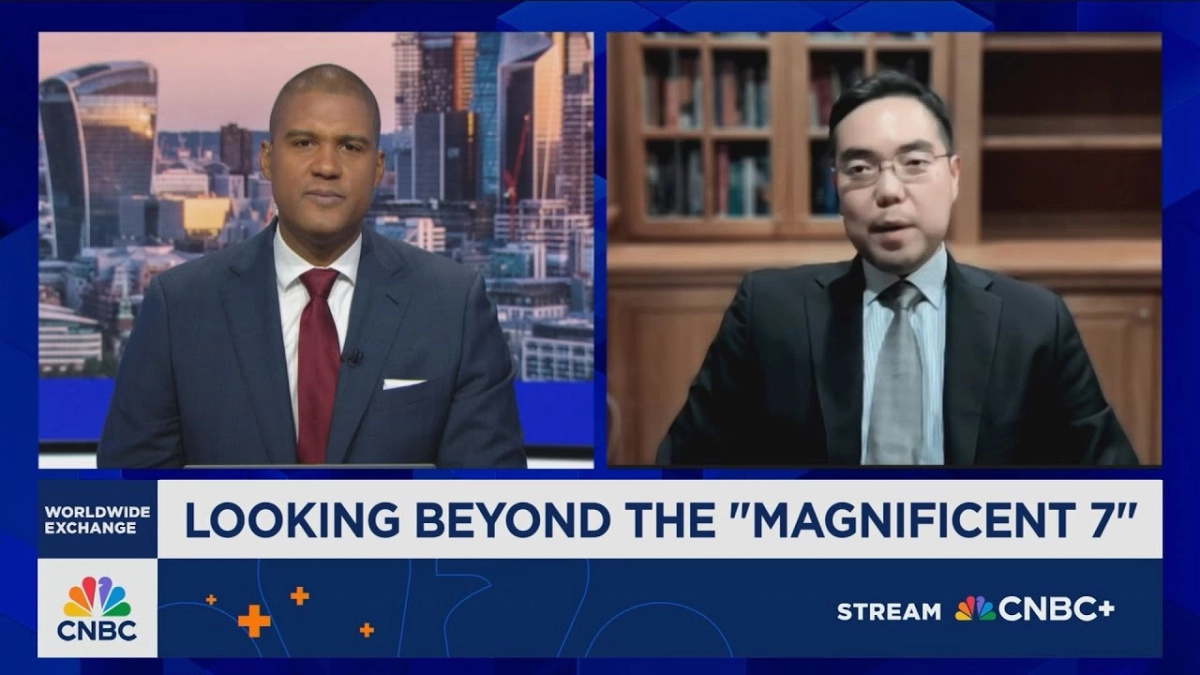
The current fervor around artificial intelligence has led to unprecedented market concentration, particularly within the "Magnificent 7" tech giants. Yet, as Daniel Kim, Portfolio Manager of the Saturna International Fund, recently articulated on CNBC's Worldwide Exchange, the most compelling opportunities in AI may lie precisely where fewer eyes are looking. Kim, speaking with interviewer Frank Holland, made a compelling case for investors to seek profits outside the mega-cap tech names, arguing that the intense focus on these few players creates mispriced opportunities in the broader AI ecosystem.
Kim’s central premise hinges on the idea that the sheer volume of attention directed at the Mag 7 stocks leads to an efficient, perhaps even overvalued, market for these prominent names. "There's just too many eyeballs hyper-analyzing the Mag 7 stocks right now," Kim stated, acknowledging that he, too, engages in this intense scrutiny. This collective focus, while validating the transformative power of AI, paradoxically diminishes the potential for outsized, idiosyncratic returns for new capital. For founders and VCs, this suggests that the competitive landscape for investment and innovation in direct Mag 7 competitors is extremely crowded, pushing them to identify the next layer of enabling technologies and infrastructure.

Instead of chasing the obvious, Kim champions a strategy of identifying "blue-chip compounding companies with better idiosyncratic growth profiles, better valuations without looking at the Mag 7." This approach underscores a critical insight for the startup ecosystem: true innovation and value creation often occur in the foundational layers, or in adjacent markets, that enable the headline-grabbing AI applications. These are the unsung heroes whose technologies are indispensable but whose market valuations have yet to fully reflect their future importance.
One such company Kim highlighted is Broadcom. While a large and well-followed entity, Kim suggests the market harbors a "misperception within investor expectations" regarding its full potential. He points out that if one considers the statements of CEO Hock Tan and "back that out of estimates," Broadcom's non-AI portfolio—which includes its VMware software and the broader semiconductor segment—is "being estimated to grow by virtually 0% next year." This overlooks a significant growth driver, as this segment is "just really in the beginning stages of a nice recovery." This analysis offers a nuanced perspective for tech insiders: even established giants can possess undervalued components that are quietly poised for substantial growth, particularly when the market narrative is singularly focused on a different aspect of their business. It serves as a reminder that a company’s full value proposition often extends beyond its most visible, hyped offerings.
The strategic acquisition of VMware by Broadcom, for example, positions it as a critical enabler for hybrid cloud environments, which are becoming increasingly vital for deploying and scaling complex AI workloads. As enterprises grapple with data sovereignty, security, and performance requirements, on-premise and hybrid cloud solutions, powered by Broadcom's integrated software and hardware, will be indispensable. The market's current underestimation of this synergy, particularly in the context of burgeoning AI demand, represents a significant blind spot.
Another compelling example from Kim's "Anti-Mag 7" growth portfolio is Fujikura, a Japanese-listed company. This firm operates as "silently the world's dominant leader in terms of ultra-high-density optical fiber cables," controlling an impressive 40% of the market. Prior to the AI boom, such fiber was considered merely "a nice to have within a cloud data center." However, with the advent of "highly densely concentrated GPU clusters" driving AI, Fujikura's product has become "an essential part of the data center."
Related Reading
- AI Investment Cycle: Early Innings, Driven by Fundamentals
- Alphabet's AI Investments Drive Record Revenue, Defying Cannibalization Fears
- Microsoft's Profitable AI Play: A Strategic Masterclass
This evolution highlights a profound shift in infrastructure priorities. The immense computational demands of large language models and other advanced AI applications necessitate not just powerful GPUs, but also the high-bandwidth, low-latency interconnects that allow these GPUs to communicate efficiently. Without ultra-high-density optical fiber, the performance of these clusters would be severely constrained, creating a critical bottleneck. Fujikura, despite its foundational role, is currently experiencing "this low level of expectations in probably one of the biggest bottlenecks within this data center build-out cycle." This presents an almost textbook case of an undervalued infrastructural play, offering "reasonable valuations" and "a pretty good setup to beat expectations" as the AI infrastructure scales globally.
For founders and VCs, Kim's commentary serves as a potent reminder to look beyond the immediate application layer and consider the deeper technological stacks required to power the AI revolution. Identifying and investing in companies that address these fundamental bottlenecks, even if they operate in less glamorous sectors, can yield significant returns. The interview underscores that while the Mag 7 may capture headlines, the true long-term value in AI investing might be found in the foundational components that enable its exponential growth, often at more attractive valuations due to lower investor visibility.