


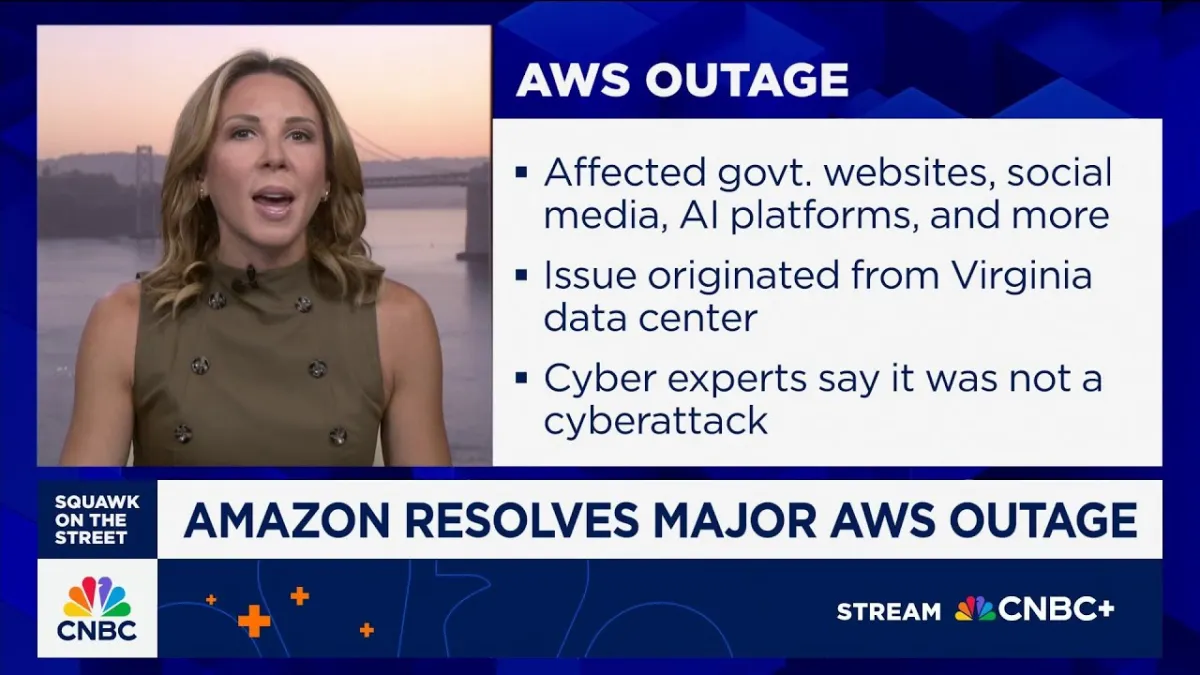
The recent AWS outage, which crippled major AI and crypto providers, serves as a stark reminder of the delicate balance underpinning the digital economy, particularly the burgeoning artificial intelligence sector. This incident, rooted in a critical failure within Amazon’s busiest cloud region, US-East-1, has forced a re-evaluation of the foundational infrastructure upon which the modern web, and increasingly, advanced AI capabilities, depend.
Carl Quintanilla, host of CNBC’s "Squawk on the Street," introduced the segment where CNBC Business News reporter MacKenzie Sigalos detailed the widespread disruption. Sigalos highlighted the immediate impact, stating that "Amazon Web Services saying 10 minutes ago that there are significant API errors and connectivity issues across multiple servers in its US East 1 region." This region, known for its extensive interconnectivity, became a single point of vulnerability, sending ripple effects across a multitude of industries. The failure originated from a Northern Virginia data center, disrupting over 70 services and knocking dozens of high-profile companies offline, ranging from government websites to social media platforms, and crucially, AI tools and crypto platforms like Perplexity AI.
While cyber experts quickly clarified that the incident was not a cyberattack, its impact underscored a profound systemic fragility. MacKenzie Sigalos emphasized this, noting, "Cyber experts say it wasn't a cyberattack, but it does highlight how fragile the internet's backbone has become, especially in the age of AI." This distinction is critical; it points not to malicious intent but to inherent vulnerabilities in highly centralized, interconnected systems. The comparison to last year's Crowdstrike meltdown, which shut down individual computers requiring manual recovery, further illuminates the nature of this AWS failure. As one expert explained, "Crowdstrike shut down the computers themselves, while AWS shut down the services that those computers talk to." This implies a deeper, more pervasive disruption to the operational fabric of cloud-dependent applications.
The outage arrives at a sensitive juncture for Amazon Web Services. Despite its significant market share, AWS has recently faced challenges in maintaining its growth trajectory, lagging behind competitors like Microsoft Azure and Google Cloud in certain metrics. This incident further complicates investor sentiment, with Morgan Stanley calling the event "not helpful to already fragile AWS sentiment." Such disruptions can erode client confidence, prompting a re-evaluation of vendor loyalty and cloud strategy.
For the AI ecosystem, the implications are particularly acute. Generative AI models and their applications demand immense computational power and near-perfect uptime for real-time operations. Companies like Perplexity AI, heavily reliant on AWS, experienced direct disruption. This reliance is not unique; the entire AI industry is "hungry for compute," as Sigalos explained, "and they are primarily getting it from these cloud providers while they build out all this infrastructure." The nascent stage of dedicated AI infrastructure development means that for the foreseeable future, AI companies will remain deeply intertwined with and dependent on the stability of major cloud providers.
This dependence is already driving strategic shifts among leading AI players. Anthropic, for example, has actively diversified its infrastructure, adopting a multi-cloud strategy to leverage platforms like Google Cloud Platform (GCP). This move is a direct response to the need for resilience and to mitigate the risks associated with single-provider outages. The goal is to avoid the kind of disruption that can halt critical research, development, and user-facing services.
Related Reading
- Vertiv's Data Center Dominance Fuels AI Infrastructure Boom
- AI Infrastructure: The Next Frontier Beyond Hyper-Scalers
- AI's Dual Nature: Creature or Machine? The Battle Over Regulation
The economic scale of AI development, with "OAI deals worth $1.5 trillion" yet to be fully realized and brought online, further highlights the urgency of addressing cloud fragility. These massive investments underscore the foundational role of cloud infrastructure in enabling the next generation of AI innovation. Any impediment to this foundation, such as a major outage, introduces significant risk to these ambitious timelines and financial commitments. The current infrastructure is a temporary, albeit essential, bridge to a future state of potentially more diversified or purpose-built AI compute.
The AWS outage serves as a critical stress test for the foundational infrastructure of the digital age. It forces founders, VCs, and AI professionals to confront the reality that even the most robust cloud services are not immune to failure. This event necessitates a renewed focus on redundancy, multi-cloud strategies, and the overall resilience of the systems that power our increasingly AI-driven world.

