
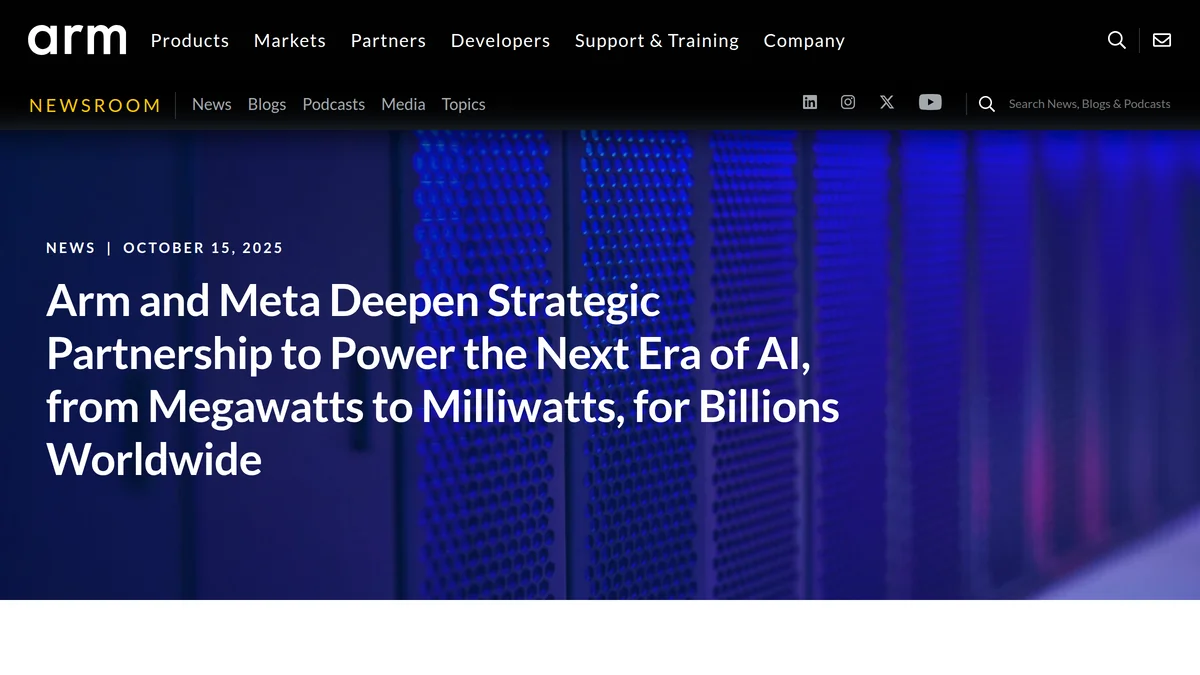
The future of artificial intelligence isn't just about bigger models; it's about smarter, more efficient deployment. That's the core message behind a newly announced strategic partnership between Arm and Meta, a collaboration poised to reshape how AI is delivered, from the vast data centers powering our social feeds to the devices in our pockets. This isn't just another press release; it's a full-stack commitment to making AI both powerful and profoundly power-efficient.
Meta, with its sprawling ecosystem of over 3 billion users, is betting big on Arm's leadership in power-efficient compute. The goal? To scale AI innovation across every layer of compute, from the milliwatt-scale devices running on-device intelligence to the megawatt-scale systems training the world’s most advanced AI models. As Santosh Janardhan, Meta’s Head of Infrastructure, put it, this partnership enables them to “efficiently scale that innovation to the more than 3 billion people who use Meta’s apps and technologies.”
Powering the Cloud and Edge with Arm Meta AI
A significant part of this Arm Meta AI initiative involves Meta’s data centers. The company’s critical AI ranking and recommendation systems, which personalize experiences across Facebook and Instagram, will now leverage Arm’s Neoverse-based data center platforms. The promise here is substantial: higher performance and lower power consumption compared to traditional x86 systems. This isn't just a marginal gain; Arm claims performance-per-watt parity at hyperscale, a crucial metric for companies operating at Meta’s scale.
But the collaboration extends far beyond the cloud. Arm and Meta are also deepening their work on AI software optimizations across the entire PyTorch machine learning framework. This includes ExecuTorch, Meta’s edge-inference runtime engine, and vLLM, its datacenter-inference engine. By optimizing ExecuTorch with Arm KleidiAI, they aim to improve efficiency on billions of devices, making AI applications faster and more responsive directly on your phone or VR headset.
Crucially, much of this work is being contributed back to the open-source community. Optimizations to components like Facebook GEneral Matrix Multiplication (FBGEMM) and PyTorch, exploiting Arm’s vector extensions, are being shared. This means millions of developers worldwide will benefit, enabling them to build and deploy efficient AI everywhere on Arm architectures. It’s a move that not only benefits Meta’s own infrastructure but also strengthens the broader AI ecosystem, democratizing access to high-performance, low-power AI.
Rene Haas, Arm’s CEO, emphasized the broader vision: “AI’s next era will be defined by delivering efficiency at scale. Partnering with Meta, we’re uniting Arm’s performance-per-watt leadership with Meta’s AI innovation to bring smarter, more efficient intelligence everywhere — from milliwatts to megawatts.” This Arm Meta AI partnership isn't just about two tech giants; it's about setting a new standard for AI deployment, making advanced intelligence more accessible and sustainable for everyone.