

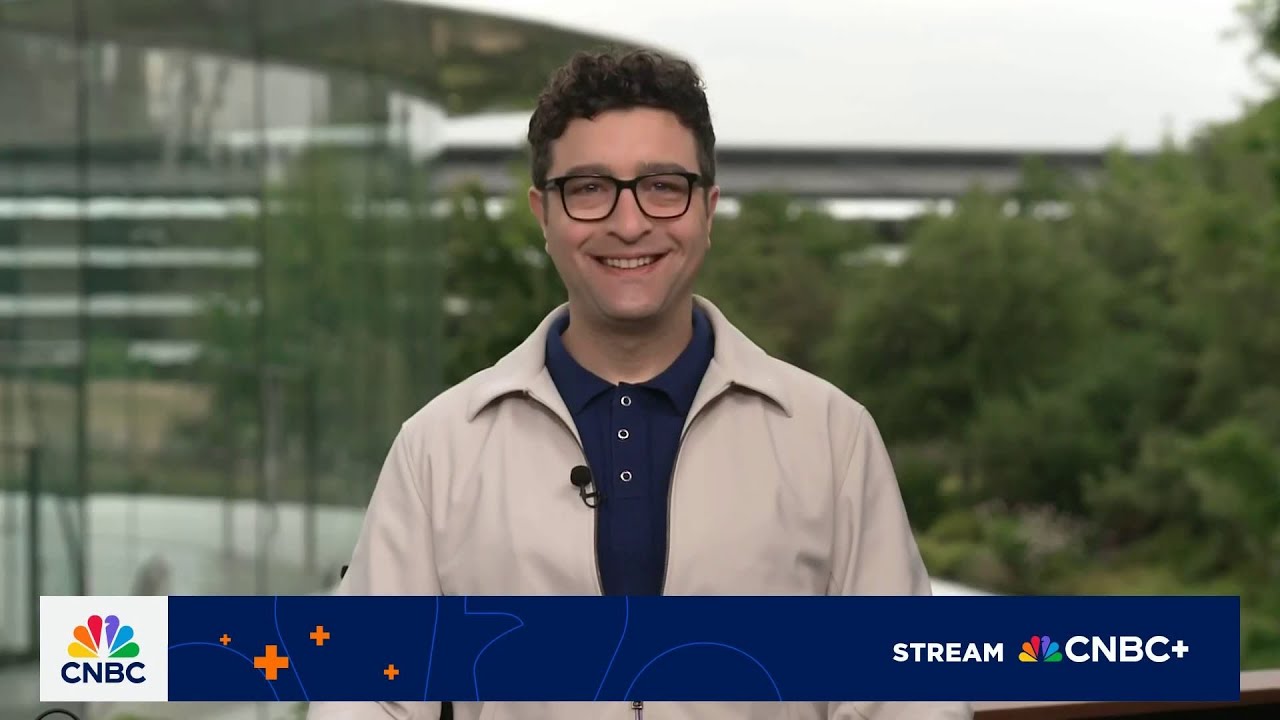
“Artificial intelligence, this was the coming out party for Apple Intelligence a year ago, and since then we saw Apple kind of fail to deliver on that big promise it made.” This blunt assessment from CNBC’s Steve Kovach, reporting live from Apple Park during the company’s annual Worldwide Developers Conference (WWDC), cuts to the core of the challenge facing Cupertino. For a company that has long prided itself on seamless integration and pioneering user experiences, its recent AI journey has been conspicuously lagging. This WWDC was not just another product unveiling; it was Apple’s chance to reset a narrative that has seen it fall behind in the generative AI arms race, and in doing so, it revealed critical shifts that the startup ecosystem must heed.
Kovach, speaking with Carl Quintanilla on CNBC’s *Squawk on the Street*, laid bare the stakes for Apple at WWDC. With Apple’s stock down nearly 20% year-to-date heading into the event, the market’s skepticism was palpable. The big questions swirling around AI and tariffs formed a difficult backdrop. The worst run for Apple shares heading into a WWDC since 2010 underscored the immense pressure. The core of the issue, as Kovach highlighted, was Apple’s prior AI missteps. The anticipated "big upgrade to Siri," positioned as Apple's answer to the burgeoning power of ChatGPT, was initially slated for a spring release but has been "delayed indefinitely." Furthermore, the existing "AI features that did come out, largely overwhelmed, including that ChatGPT integration which just isn't as good or as useful as what you would get with the regular ChatGPT app." This candid critique points to a fundamental strategic vulnerability for Apple, one that creates both challenges and opportunities for the broader AI startup landscape.
One of the most significant insights gleaned from the discussion is Apple’s apparent shift towards strategic partnerships to bolster its AI capabilities. Kovach emphasized that a key thing to watch was "what kind of deals can it make with artificial intelligence, whether that's through search or something else, in order to kind of fill in the holes that Siri has left behind." This is a stark admission for a company known for its vertically integrated approach and preference for in-house innovation. The mention of potential talks with search engine Perplexity, and the earlier discussions about integrating Google Gemini, signals a pragmatic, if somewhat belated, recognition that Apple cannot build all foundational models internally at the pace required by the market. For AI startups developing specialized large language models (LLMs), search technologies, or advanced conversational AI, this opens a tantalizing door. Apple, with its massive user base and device footprint, represents an unparalleled distribution channel. Companies with robust, privacy-centric models that can seamlessly integrate into Apple’s ecosystem might find themselves in a prime position for acquisition or lucrative partnership deals, especially if they can address the "holes that Siri has left behind."
The second critical insight revolves around Apple’s relationship with its developer community, particularly in the context of AI. WWDC is, at its heart, a developer’s event. Kovach underscored the importance of "what are they giving developers on the AI front that will help them make their apps more AI-friendly?" There’s a reported move to allow developers to tap into Apple’s AI system to create iPhone apps, which could be a significant enabler. However, the caveat is crucial: "they're going to have to really make a case guys that their AI development tools are just as good or better than what you'd already get on ChatGPT." This highlights a competitive imperative. For years, Apple has provided developers with powerful tools, but the generative AI paradigm demands a new level of sophistication and accessibility. Startups building AI development platforms, specialized APIs, or developer-focused AI tools that can integrate seamlessly with Apple’s frameworks—and critically, prove superior to or more tailored than general-purpose solutions like OpenAI’s—stand to gain immense traction. The challenge for Apple is to make its AI tools so compelling that developers *choose* to build within its native ecosystem, rather than relying solely on third-party AI services.
Finally, the discussion touched upon the ongoing legal battles, specifically the Epic Games case, and its implications for developer economics. This point, while seemingly separate from AI, is deeply intertwined with Apple’s ability to attract and retain top AI talent within its app ecosystem. As Kovach explained, if Apple loses its appeal in the Epic Games case, forcing it to "allow payments on the web instead of through the App Store," developers will have the opportunity to "capture back some of that cut that Apple's been taking off the top of their App Store sales." This isn't just about revenue; it's about trust and partnership. For AI startups, particularly those building subscription-based or transaction-heavy AI applications, the prospect of better economics outside Apple’s 30% cut could dictate their platform strategy. Apple needs to demonstrate that even with potential changes to its payment structure, the value proposition of building for its platform—especially with new AI tools—remains overwhelmingly strong. A more developer-friendly economic model, combined with robust AI capabilities, would be a potent combination to reignite innovation and ensure that the next wave of groundbreaking AI applications isn't built exclusively on competing platforms.
Apple’s WWDC 2025 was a moment of truth, a critical juncture where the company had to articulate a clear and compelling AI vision. Its past stumbles with Siri and underwhelming initial integrations have created a perception of playing catch-up. The path forward appears to be a blend of internal development and strategic external partnerships, coupled with a renewed focus on empowering developers. For founders and VCs in the AI space, Apple’s evolving strategy presents a complex but potentially rewarding landscape. The company's need to "reset the narrative" means that it is actively seeking solutions, whether built in-house or acquired externally. The key takeaway for the startup ecosystem is clear: while Apple plays its long game, there are significant opportunities for agile, innovative AI companies to fill the gaps, offer superior tools, or become the strategic partners that Apple increasingly needs. The future of AI on Apple devices will likely be a collaborative effort, and the door is now more open than ever for startups to step through and shape that future.



