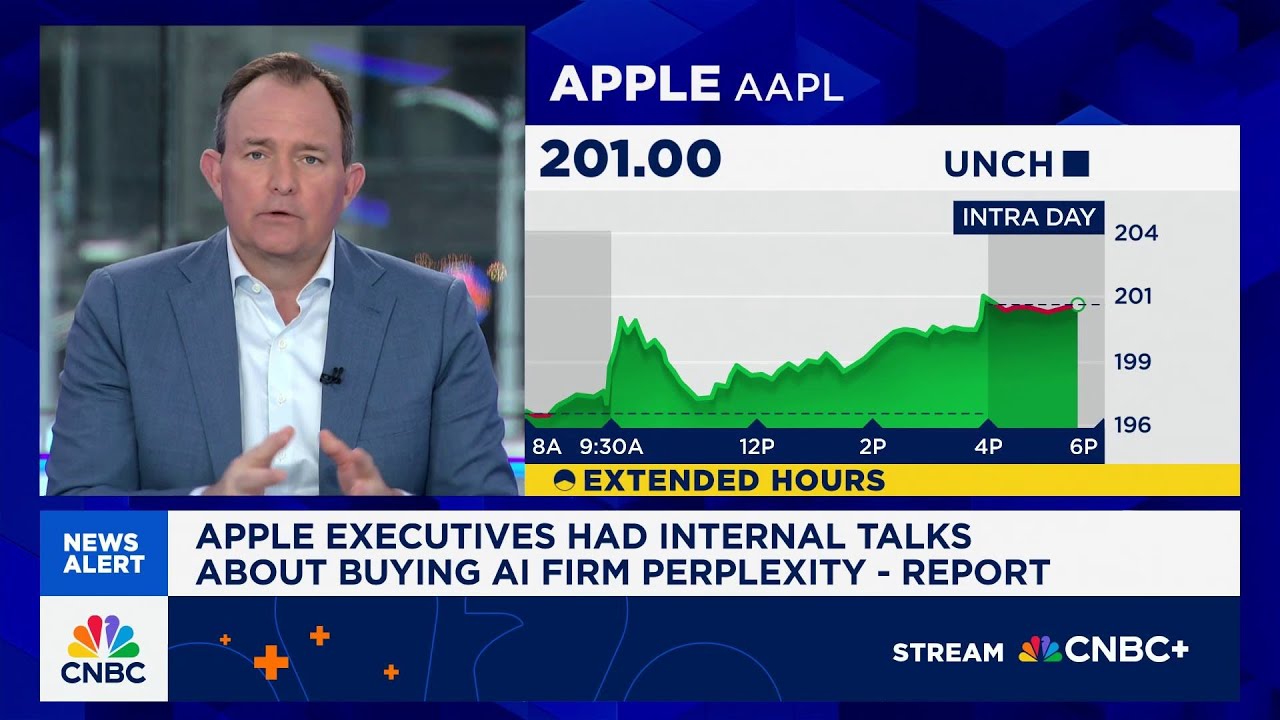
A recent Bloomberg report, discussed by the "Fast Money" panel on CNBC, revealed that Apple held internal talks about acquiring Perplexity AI, a move that signals a profound shift in the iPhone maker's long-standing operational philosophy. This revelation, and the subsequent commentary from market analysts like Tim Seymour, Karen Finerman, and Guy Adami, underscores Apple’s perceived urgency to catch up in the generative AI arms race, potentially redefining its historical "build, not buy" ethos.
Tim Seymour highlighted the magnitude of this potential transaction, stating, "Apple has never been a buyer really of anything. They just build it." He added, "This would be clearly the biggest deal Apple's ever done." This sentiment resonates deeply within the tech community, where Apple is renowned for its insular development cycles and selective, often smaller, acquisitions aimed at talent or niche technologies rather than foundational platforms. Such an acquisition would represent a stark departure, indicating a critical need to accelerate its AI capabilities, rather than relying solely on organic innovation.
The conversation further delved into the competitive landscape, noting that Meta had also reportedly approached Perplexity but ultimately opted for a partnership with Scale AI. Karen Finerman articulated the prevailing market perception, observing, "So much has been made of Apple not having, you know, just so far behind in AI." This perceived lag in generative AI, particularly when compared to rivals like Google and Microsoft, could be a driving force behind Apple's willingness to consider such a significant acquisition.
However, the panel also raised questions about the rationale and implications of such a high-value purchase. Perplexity's valuation was estimated at $1.4 billion as of its last funding round in December, a figure likely higher now. Guy Adami questioned the necessity of an outright acquisition when licensing agreements could suffice, remarking, "Why buy it when you can rent it, pay per use?" He further challenged Apple’s traditional approach, stating, "They're never innovative, they replicate. And this would be a break from that tradition." His point highlights the fundamental tension between acquiring established technology and cultivating proprietary innovation, especially in a rapidly evolving field like AI where long-term control and strategic integration are paramount.
The implications of such a deal extend beyond mere financial figures. An acquisition of this scale would not only inject Perplexity's advanced conversational AI and search capabilities directly into Apple's ecosystem but also bring potential liabilities, such as ongoing content licensing disputes, as exemplified by BBC’s recent lawsuit against Perplexity.