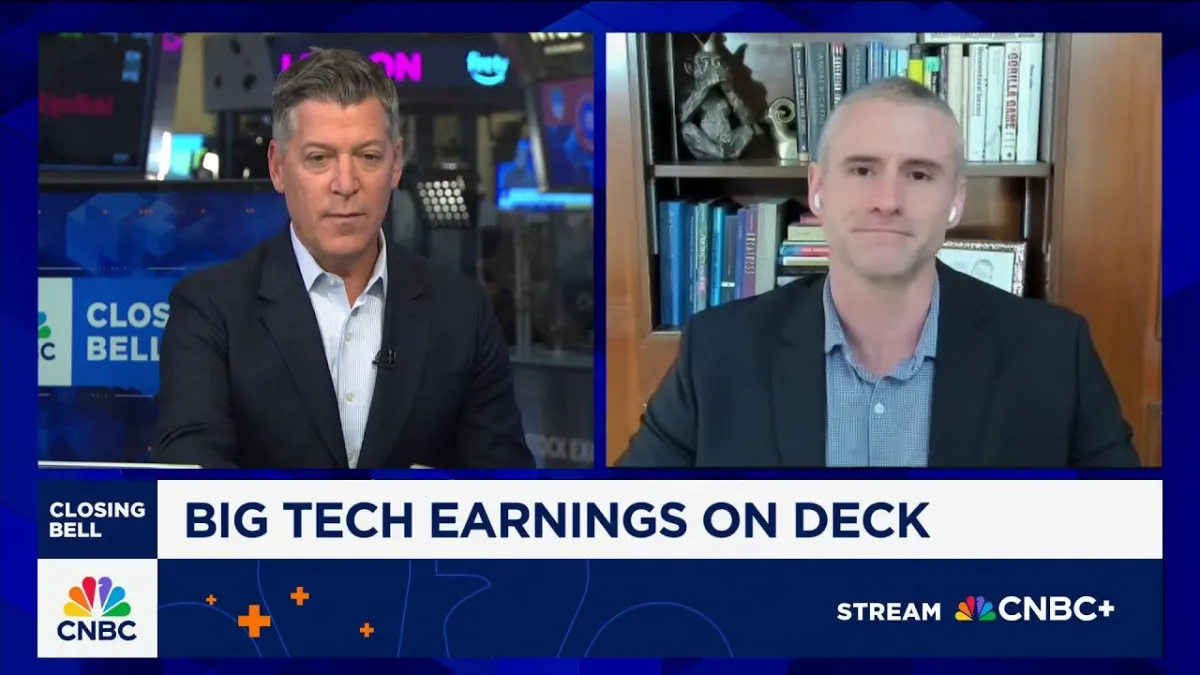
The prevailing sentiment around Apple's near-term earnings is one of deliberate understatement, a strategy that could conceal significant future upside. Doug Clinton, founder and CEO of Intelligent Alpha and Managing Partner at Deepwater Asset Management, recently articulated on CNBC's 'Closing Bell' that Apple has adeptly managed to keep "the bar super low" for its current earnings and projections stretching into mid-next year. This cautious stance, Clinton posits, centers on the unanswered question of "what will Apple ultimately do with AI?" and the critical need to "fix Siri," hinting at a latent AI opportunity that remains largely unpriced in the stock. While the iPhone 17 has reportedly outperformed investor expectations since its launch, the real inflection point for Apple's AI narrative is anticipated around next June's Worldwide Developers Conference (WWDC), when the company is expected to unveil its comprehensive AI strategy.
Clinton’s commentary extended beyond Apple, highlighting what he perceives as a significant underestimation of capital expenditure (CapEx) for tech giants like Alphabet (Google) and Amazon. He notes that street numbers project only about 12% growth for Google's CapEx next year, and even lower "high single digits" for Amazon. These figures strike Clinton as "almost unbelievable," especially when benchmarked against Meta Platforms, which is expected to see "strong double digits," perhaps "something like 30 to 40 percent," in its CapEx growth. This discrepancy suggests a considerable disconnect between market expectations and the actual investment required to fuel the ongoing AI infrastructure buildout.
This underestimation of CapEx is not merely an accounting anomaly; it represents a profound opportunity for companies that provide the foundational components for AI. Such robust spending on infrastructure, particularly in the cloud and data center domains, directly benefits hardware and semiconductor manufacturers. Clinton explicitly identifies Nvidia and Taiwan Semiconductor Manufacturing Company (TSMC) as prime beneficiaries of this accelerated CapEx boom, noting that both are key holdings in his firm's portfolio. The demand for advanced AI chips and the facilities to run them is set to drive substantial growth for these foundational technology providers, irrespective of how individual tech giants monetize their AI initiatives.
Beyond the immediate hardware and software players, Clinton also offered a nuanced perspective on the broader AI investment landscape, drawing parallels to the dot-com era. He suggests that the core AI trade, encompassing the direct hardware and software components, is currently in the "equivalent of 1997" in terms of trading and investment. This implies a nascent but powerful growth phase, where fundamental value is still being established and significant long-term potential remains. However, he cautions that certain "components of the trade" and areas on the "periphery," such as nuclear energy and quantum computing, feel more akin to "1999," suggesting that excitement and speculative pricing might be outpacing tangible development or near-term returns.
Related Reading
- Meta's AI Talent Raid Exposes Apple's Critical Juncture in Generative AI
- Asia's Insatiable AI Appetite: Wedbush's Dan Ives Declares "Second Inning" of Growth
- Nvidia's Moat Under Siege: AI Market Shifts Towards Diversification and Open Source
One intriguing "under the radar" AI play Clinton identifies is First Solar. This American company, which manufactures some of its solar panels domestically, is positioned to address a critical bottleneck in the AI revolution: power. The immense computational demands of AI data centers require vast amounts of electricity, and the current energy infrastructure is struggling to keep pace. Clinton argues that solar power is "inevitable as part of the solution" to this energy deficit. He observes that while much of the energy excitement around AI has focused on nuclear power, solar offers a compelling and increasingly cost-effective alternative. First Solar, with its low double-digit EPS and domestic manufacturing capabilities, represents a potentially undervalued asset in the context of burgeoning AI energy demands.