


The true power of artificial intelligence isn't just in its ability to generate text or code, but in its capacity to interact dynamically with the vast, complex world beyond its immediate data. This pivotal interaction is precisely what Anthropic's Model Context Protocol (MCP) aims to unlock. It's a foundational shift, moving AI models from isolated processors to active, real-world agents.
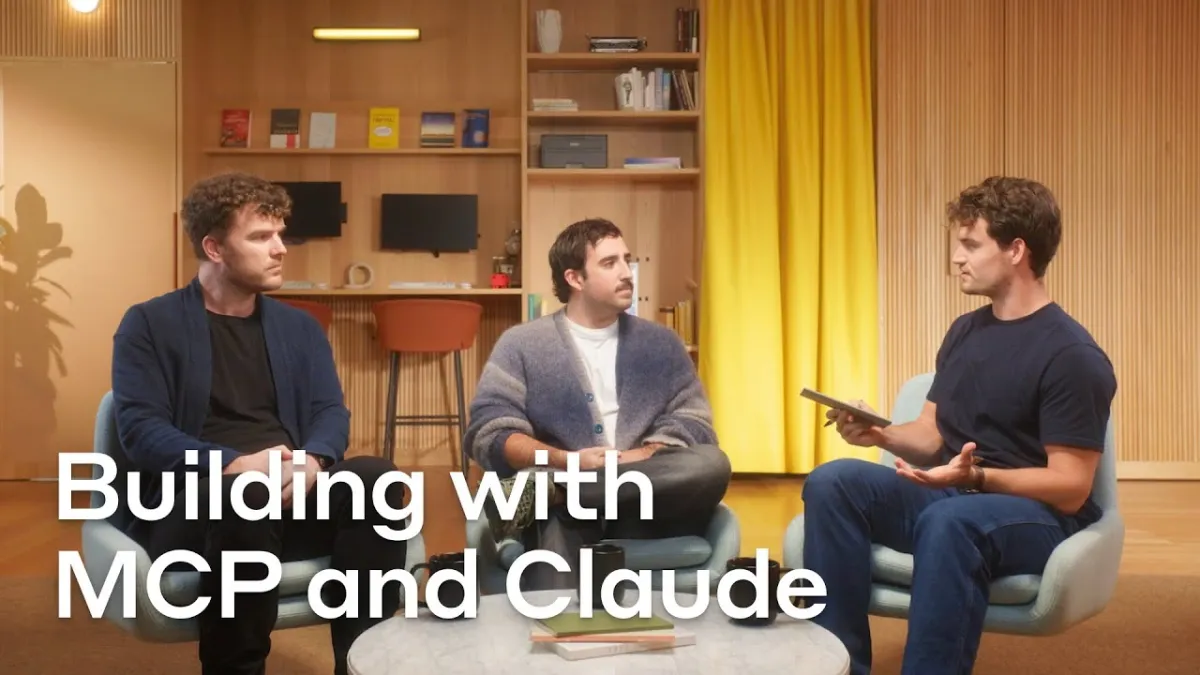
In a recent discussion, Alex Albert, who leads Claude Relations at Anthropic, sat down with John Welsh, an engineer on the MCP team, and Michael Cohen from the Claude API team. Their conversation delved into the origins, functionality, and future of MCP, highlighting its critical role in connecting AI applications to external systems and enabling more powerful agentic capabilities for Claude.

John Welsh concisely defined MCP as "the Model Context Protocol... a way of providing external context to models." Alex Albert further elaborated, calling it "the universal connector between applications and the model." The genesis of MCP stemmed from a clear pain point within Anthropic: as Claude's capabilities in tool use advanced, Michael Cohen noted, "we were starting to notice that we were reimplementing a lot of the same capabilities in various different contexts." This redundancy spurred the creation of a unified protocol, allowing functionalities to be built once and deployed across multiple AI surfaces.
The strategic decision to open-source MCP was pivotal, designed to foster a broader ecosystem. John Welsh emphasized the "lot of value in open standards to allow a wide network of engineers, companies... to build an ecosystem around something." This approach proved remarkably successful, with Welsh proudly stating that MCP became "the fastest-growing open-source protocol in history," validating the widespread need for such a solution. Initially, MCP servers often required local execution, a setup Michael Cohen described as "clunky." The introduction of remote MCP support dramatically simplified this, paving the way for a central registry where developers can share and access these servers.
MCP fundamentally transforms AI models from isolated processors into active agents capable of real-world interaction. It's the connective tissue that allows Claude to move beyond mere conversation, enabling it to "talk to the internet" or "reach out to a travel agency to book your flight," as John Welsh put it. This universal adapter facilitates seamless data exchange and action execution, bridging the gap between an LLM's internal knowledge and external systems.
Anthropic's commitment to open-sourcing MCP underscores a belief that shared infrastructure accelerates innovation for everyone. Instead of proprietary connectors for every model, an open standard like MCP reduces fragmentation and development overhead, creating a rising tide that "floats all boats" by making advanced AI integration accessible and efficient.
Developers can now leverage the Claude API's native MCP connector feature, simply specifying the URL of a remote MCP server. This eliminates much of the boilerplate code, allowing developers to streamline their applications. Among the innovative MCPs emerging, Michael Cohen highlighted Context7, which keeps LLMs updated by pulling the latest documentation from various websites. John Welsh praised Playwright, a Microsoft-backed project that allows Claude to "interact with browsers as though it was a user clicking around," enabling visual analysis of webpages for design improvements or bug fixes.
A critical aspect of working with MCP is understanding that "MCP servers and tools are really at its core prompts," as John Welsh pointed out. The descriptions, parameter names, and even few-shot examples provided within an MCP server's definition directly influence how Claude interprets and utilizes that tool. Developers must be "careful and precise about the language" used, as well-defined prompts lead to significantly better results. Overloading Claude with too many tools or conflicting information, as Michael Cohen warned, can lead to confusion and inefficiency, emphasizing the need for carefully scoped and relevant toolsets. "As you give LLMs more information, it makes it harder for them to make good decisions," Welsh added, reinforcing the principle of thoughtful context management.
Related Reading
- OpenAI's DevDay Innovations: Agents, Apps, and the Future of AI Development
- OpenAI's Agentic Leap: Reshaping Software Development with Powerful APIs
- AGI's Imminent Arrival: Founders Must Re-evaluate Everything
Both John and Michael actively use MCP in their daily work and side projects. John leverages MCP servers for home automation, allowing Claude to check if his door is locked and offering to secure it. Michael uses it for project management, feeding Claude past status updates and asking it to generate new ones in the same format. This highlights a fascinating phenomenon: "emergent properties" arise when disparate MCP servers are connected. John shared an example of a knowledge graph server that, when hooked up to Claude, enabled the AI to act like an "investigative journalist," forming connections and "scribbling down" insights it wouldn't have otherwise.
The ultimate goal for MCP, as Michael Cohen envisions, is for it to become so seamlessly integrated that "we should never know that MCP is happening under the hood." This vision of an invisible, ubiquitous protocol for AI agents to interact with the world is rapidly taking shape. The growth of the MCP ecosystem, driven by open standards and innovative applications, is transforming how developers build agentic AI systems, pushing the boundaries of what these powerful models can achieve in real-world contexts.



