

The shift from large language models (LLMs) serving as conversational interfaces to functioning as autonomous agents capable of executing complex, multi-step tasks is the most significant pivot in enterprise AI this year. Anthropic’s introduction of Cowork, integrated directly into the Claude desktop application, serves as a clear declaration that the competitive focus has moved beyond raw token output to high-fidelity, actionable workflows. This is not merely a feature update; it is the launch of a personalized knowledge worker, capable of navigating the user's local file system and external tools to complete assignments that previously required constant human supervision.
This release positions Anthropic not just as a foundational model provider, but as a direct competitor in the productivity layer, challenging existing paradigms of how office work is structured. Cowork leverages the agentic capabilities previously demonstrated in Claude Code, extending them to the general professional workflow. The core value proposition is the ability to delegate entire projects rather than just prompts. The demonstration focuses on high-leverage tasks common to managers and executives, tasks that are time-consuming, involve disparate data sources, and require synthesis, planning, and execution across multiple applications.
The demo vividly illustrates this shift. Instead of a simple query, the user inputs a complex, multi-faceted demand: “Summarize my meetings from this week and find action items. Where do you think I can be more efficient?” Crucially, the user then grants Claude access to a specific local directory, in this case, "Meeting Transcripts." This mechanism of explicit context granting is a critical architectural choice, addressing the paramount concern among enterprise users regarding data privacy and accidental exposure. The AI's work is confined to the specific folder, establishing a necessary boundary for trust and compliance.
Upon receiving the initial instruction and context, Claude immediately demonstrates recursive reasoning by asking a clarifying question: "How detailed do you want this?" This interactive feedback loop is essential. Agents must be able to refine their understanding of the goal before commencing execution, mitigating the risk of scope creep or irrelevant output. The user selects "Detailed notes: Full breakdown with context." This interaction underscores the collaborative nature of the agent, it is not a black box, but a transparent partner that checks assumptions before committing resources.
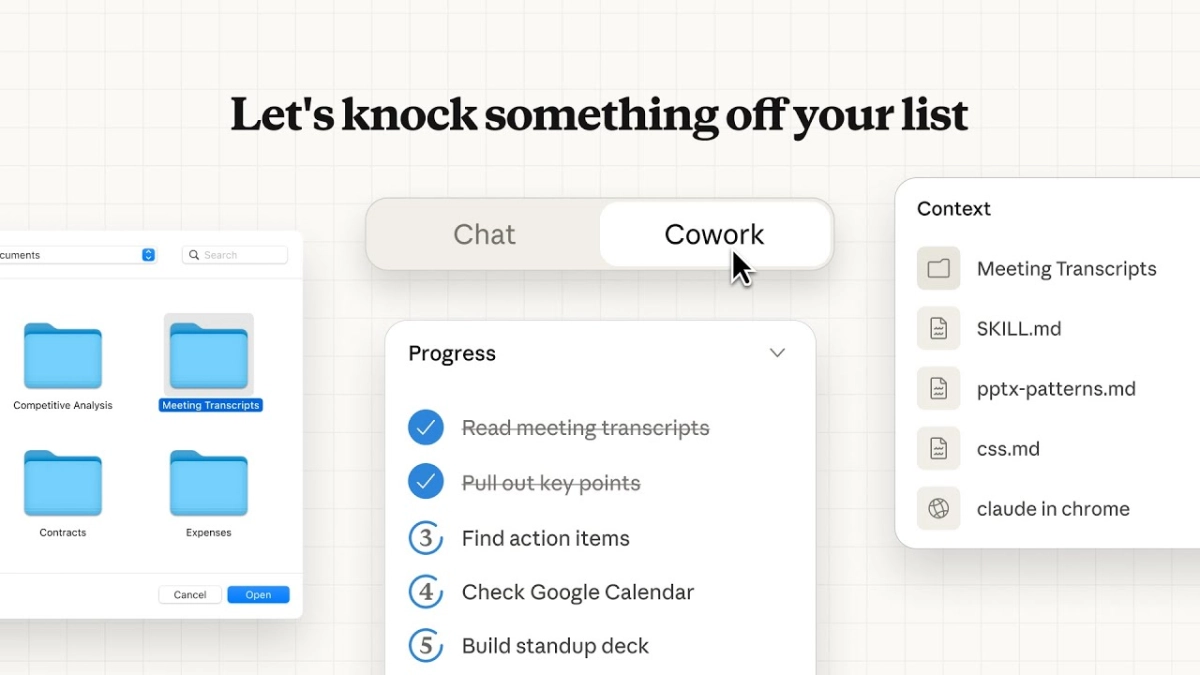
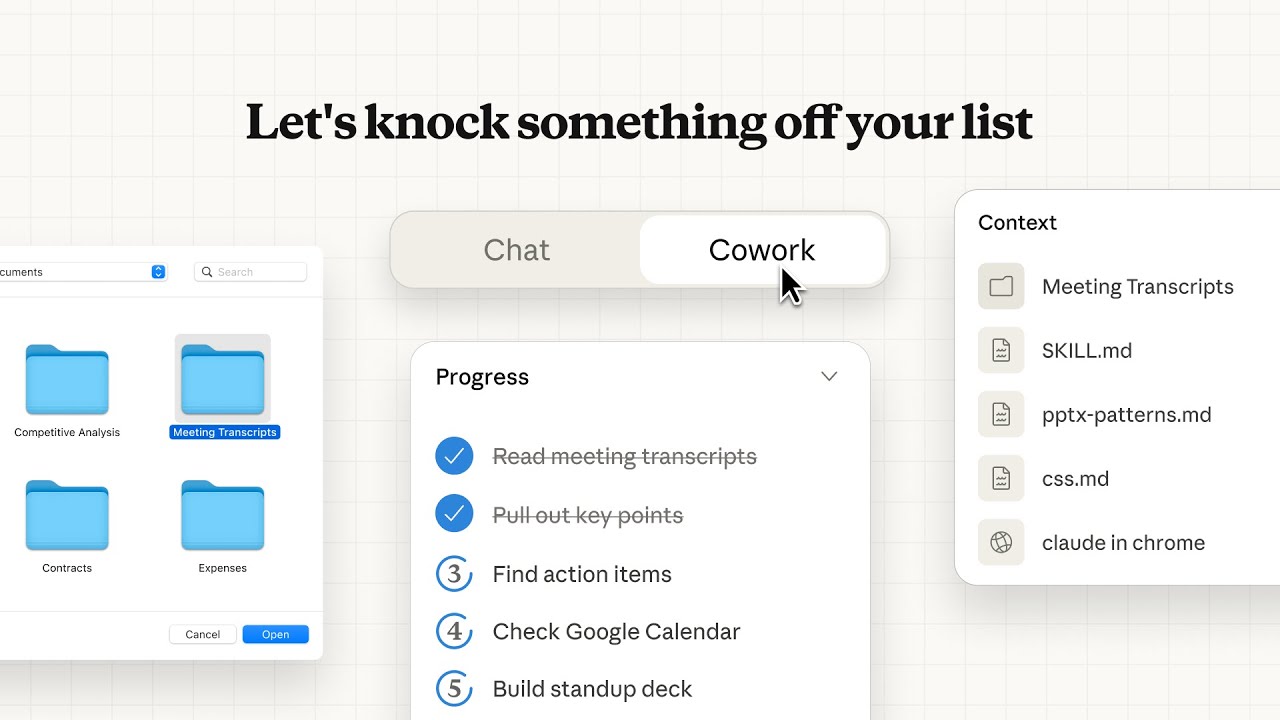
The agent’s real power emerges when the task is expanded mid-execution. A human user interjects, adding two new, urgent demands: “actually one more thing, can you check my calendar for what's urgent tomorrow? oh and prep the deck for tmrw's team standup.” A traditional LLM would likely struggle to reprioritize and integrate these requests seamlessly. Cowork, however, immediately updates its internal plan, displaying a clear, numbered sequence of steps: "Read meeting recordings," "Pull out key points," "Find action items," "Check Google Calendar," and "Build standup deck." This detailed, sequential planning is the hallmark of true agentic behavior, showing VCs and founders that the underlying model has sophisticated planning and tool-use capabilities, specifically including external API calls (implied by the Google Calendar check).