

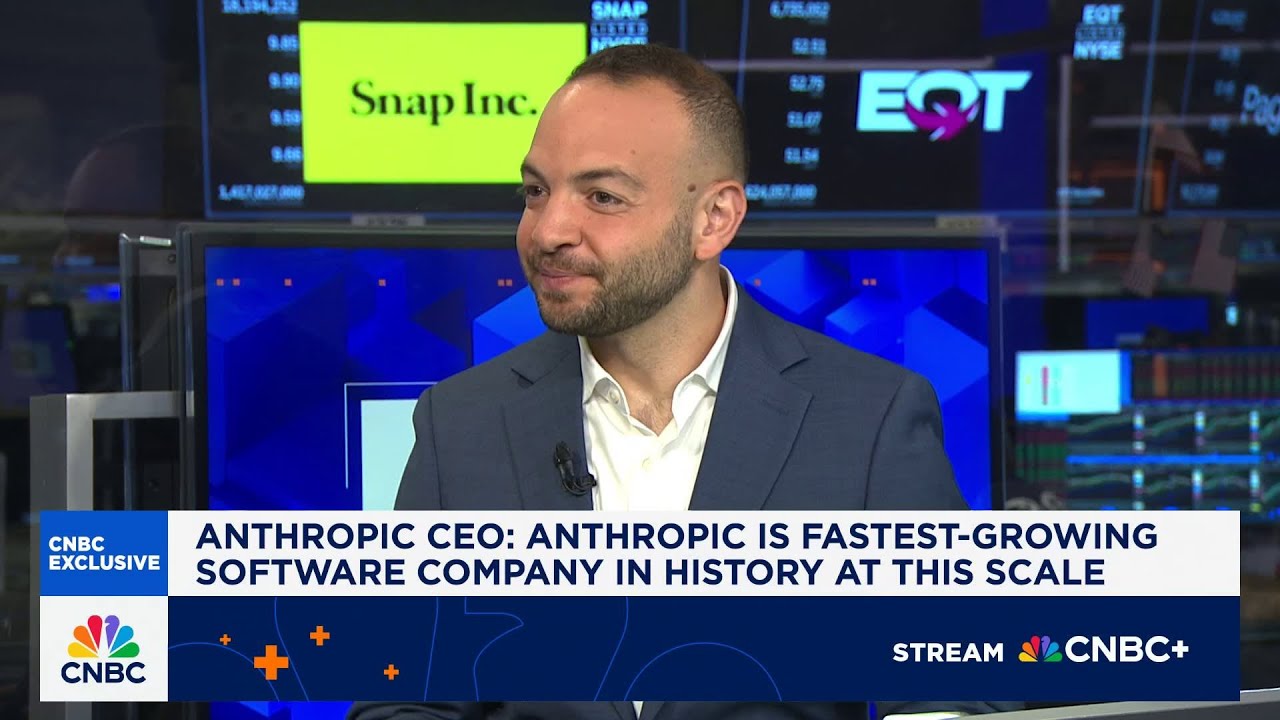
"I view Anthropic as the most interesting generative AI company," stated Alex Kantrowitz, founder of Big Technology, during his recent appearance on CNBC's Closing Bell. Kantrowitz joined the broadcast to discuss Anthropic's unique position within the burgeoning generative AI landscape and its implications for the broader industry. His commentary provided sharp insights into how Anthropic's business model serves as a critical indicator of generative AI's real-world utility and growth trajectory.
Kantrowitz emphasized that Anthropic’s revenue predominantly stems from other companies integrating its models via API, rather than direct consumer applications like ChatGPT. This B2B focus makes Anthropic a crucial barometer for the generative AI business. "As Anthropic goes, so goes the generative AI trade," he asserted, explaining that if the underlying technology proves truly useful, its impact will be directly reflected in Anthropic’s financial performance. The company’s rapid growth from a $1 billion run rate last year to approximately $4.5 billion this month underscores this emerging utility, particularly within enterprises and for coding applications.
A significant differentiator for Anthropic, according to Kantrowitz, is its superior performance in coding. "They have the best coding models," he noted, highlighting why software engineers are increasingly adopting Anthropic’s tools like Windsurf and Cursor to enhance their workflows. This strategic focus on a high-value, high-adoption segment of the market has been a successful bet, driving their impressive growth.
However, the generative AI business is not without its challenges. The immense cost associated with running and continuously improving these complex models raises questions about whether generative AI companies will ever achieve gross margins comparable to traditional software firms. Despite these financial considerations, the progression of AI capabilities is undeniable.
Dario Amodei, Anthropic's CEO, is depicted as a profound believer in AI's accelerated advancement. Kantrowitz explains that Amodei's consistent discussion of AI risks isn't a pessimistic outlook but a pragmatic approach. It’s an acknowledgment that with rapid improvement comes the need to proactively address potential downsides, preventing problems from "ignor[ed] in the outset" only to "emerge later because no one was paying attention to them." This proactive stance is seen as essential for the responsible development and deployment of increasingly powerful AI. The underlying "scaling law," an observed phenomenon where increased compute, data, and model size lead to predictable improvements, fuels this belief and the overall industry's rapid evolution.