


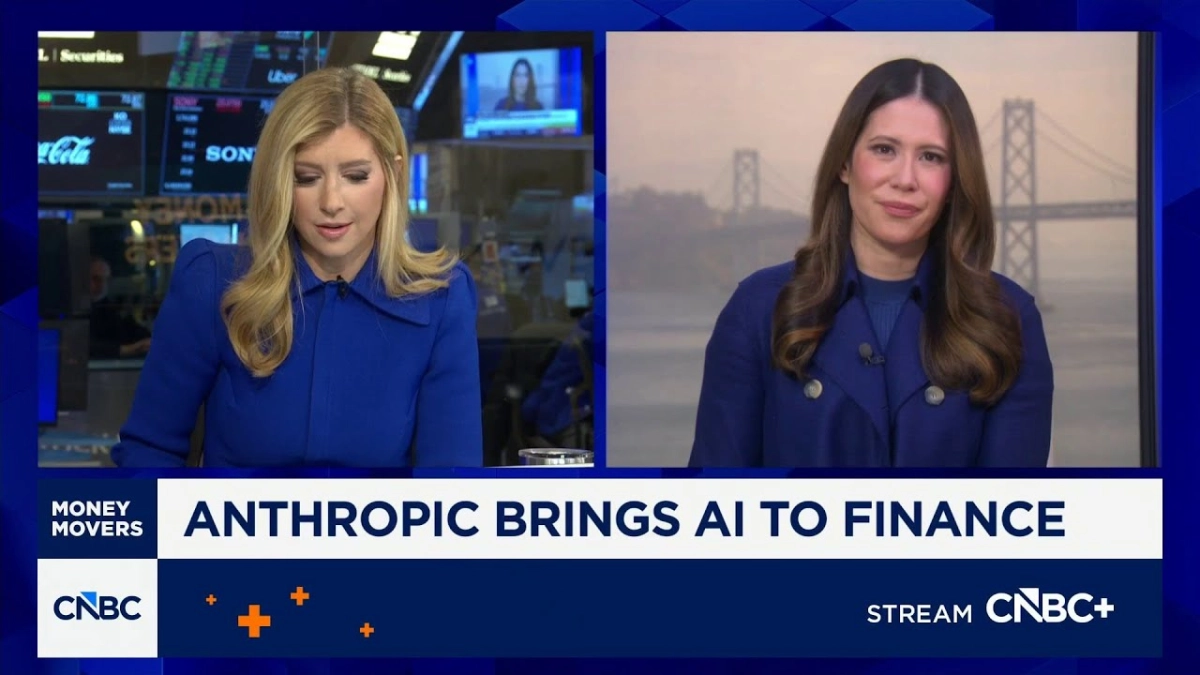
The battleground for AI supremacy is rapidly shifting from abstract chat interfaces to the fundamental tools of enterprise workflow, and nowhere is this more evident than in financial modeling. Anthropic, with its advanced Claude 3 Opus model, has launched a direct assault on the traditional domain of spreadsheets, offering an integration into Excel that allows users to execute complex scenario analysis with unprecedented speed and depth. This move not only positions Anthropic as a serious competitor to OpenAI and its backers but directly challenges the established utility of Microsoft’s ubiquitous financial software suite.
CNBC’s Deirdre Bosa, reporting on the development, highlighted the immediate disruptive potential of Anthropic’s Claude Code and its Excel integration. Bosa noted that the functionality enables sophisticated financial modeling previously restricted to highly trained analysts. The core insight here is the democratization of high-level financial reasoning. As Bosa observed, “Anyone can do the work of a financial analyst with just a few prompts.” This is not merely about automating formulas; it is about providing the capacity for deep, contextual scenario planning.
Bosa demonstrated this capability using a hypothetical three-year projected income statement for Alphabet Inc., toggling between Bull, Base, and Bear cases. The analysis went beyond simple projection, diving into critical sensitivities like the “AI tax”—the rising cost of serving AI search queries versus traditional ones. In the Bear case, Claude analyzed a scenario where AI compute costs escalated by 5% annually, revealing exactly how much revenue growth would be required to offset the resulting margin pressure. The output was a clear, concise takeaway showing that the difference between the Best Case (Bull) and Worst Case (Bear) scenarios resulted in an almost $11 billion difference on gross income. This level of rapid, multi-scenario analysis, generated in "less than 10 minutes" without manual cell adjustments, signals a profound acceleration in corporate finance and investment research workflows.
A crucial strategic distinction emphasized by Bosa is the contrast between Anthropic’s approach and that of legacy technology giants. The question arises: why hasn't Microsoft, the owner of Excel, or Google, with its Sheets product, already deployed this level of integrated, reasoning AI? The answer, Bosa posits, lies in the "innovator's dilemma." Traditional tech companies are "layering AI on top of old foundations," attempting to retrofit large language models into existing, often cumbersome, infrastructures. Anthropic, conversely, is "AI-native." It is rebuilding the fundamental way these tools are utilized, focusing on deep reasoning capabilities rather than simply formatting or basic calculation assistance. This architectural advantage allows Claude to reason with the numbers in the spreadsheet, generating complex financial frameworks based solely on natural language prompts.
The implication for founders and VCs is clear: the value proposition of foundation models is rapidly shifting from general-purpose conversation to domain-specific utility and application. The race is no longer centered on who has the best chatbot; it is about who can seamlessly integrate powerful AI reasoning into specialized, high-value enterprise functions. The financial sector, with its reliance on complex data processing and scenario planning, is an ideal target for this next wave of AI disruption.
The movement of AI capabilities from conversational interfaces to concrete, functional tools means that previously specialized knowledge barriers are dissolving. Bosa summarized this shift by noting that AI is moving "from something that most people chat with, to something that you can actually build with." This access allows individuals without specific coding or advanced Excel skills to create complex models that once required specialized teams or extensive training. Anthropic's successful foray into financial modeling via Excel is a powerful indicator that the next phase of AI competition will be defined by deep, integrated utility that fundamentally redefines professional productivity.


