

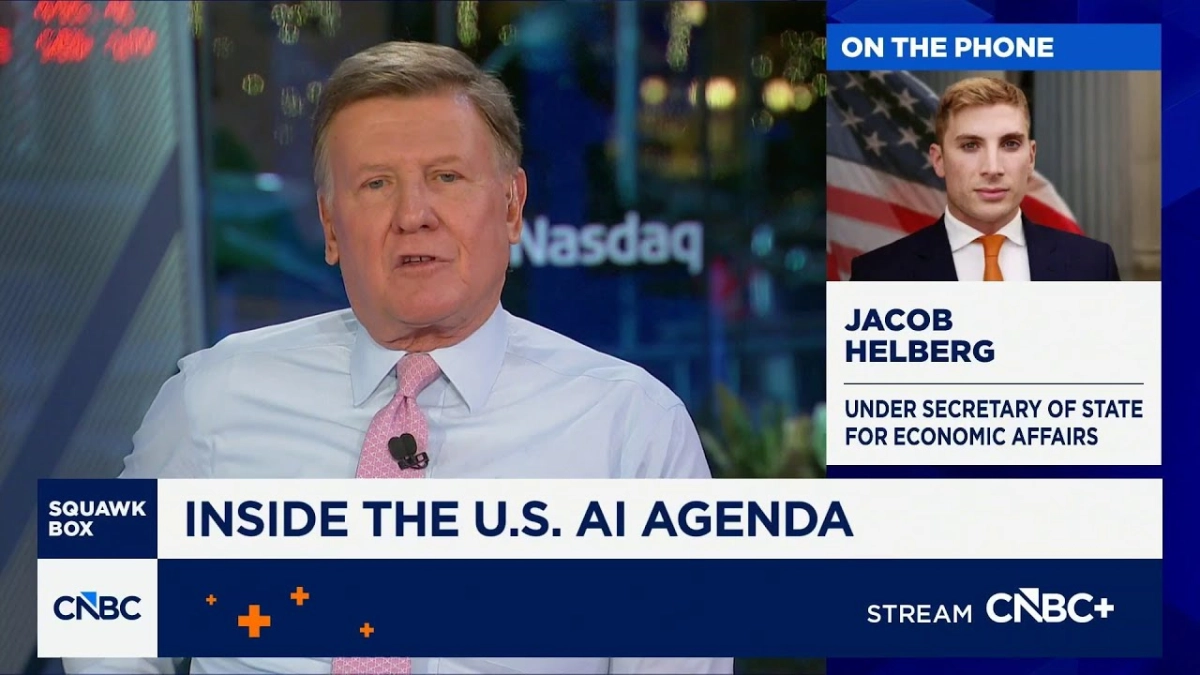
"The greatest geopolitical challenge of the 21st century is the technological competition with China, and at the center of that competition is artificial intelligence." This stark assessment, delivered by Jacob Helberg, Under Secretary of State for Economic Affairs, cuts straight to the core of Washington’s current strategic outlook. The era of pure technological globalization, predicated solely on efficiency and the free flow of high-end computational resources, is definitively over, replaced by a mandate defined by strategic resilience and national security.
Helberg spoke on CNBC’s Squawk Box regarding the Biden administration’s comprehensive AI agenda, specifically focusing on securing the critical supply chain infrastructure necessary to maintain America's technological edge. The discussion underscored the extent to which the government now views the components underlying AI—from advanced semiconductors to raw materials—as instruments of national power, requiring active state intervention and strategic policy coordination with allies.
The government’s primary function in this new paradigm is not to invent the next large language model, but rather to construct the defensive and foundational scaffolding upon which American innovation can thrive securely. This dual mandate involves rigorous export controls aimed at restricting the flow of advanced computing power to strategic rivals, particularly China, while simultaneously subsidizing and incentivizing domestic production of crucial components. Helberg stressed that the stakes are existential, stating clearly, "We need to make sure that we are ahead of China in terms of AI innovation." This is the foundational premise driving the export control regime—a recognition that GPUs and advanced chips are not merely commercial goods but strategic weapons systems powering the next generation of military and surveillance capabilities.
For founders and venture capitalists navigating this landscape, the signal is clear: the federal government is actively shaping the market to favor secure, trusted supply chains. The policy apparatus is moving rapidly to define what constitutes a "trusted ecosystem," and capital flows, particularly federal funding through mechanisms like the CHIPS Act, are explicitly linked to geographic security and decoupling from adversarial nations. This necessitates a fundamental re-evaluation of where and how AI hardware is sourced, built, and deployed within the U.S. innovation cycle.
The conversation quickly pivoted to the tangible elements underpinning AI: semiconductors and rare earth minerals. The CHIPS Act funding is explicitly designed to de-risk the semiconductor supply chain, ensuring that the critical hardware required for training and deploying advanced AI models is manufactured on secure, domestic soil or within allied nations. This pivot away from reliance on adversarial jurisdictions is viewed as a national security imperative, given the potential for disruption or sabotage.
Securing the rare earth mineral supply chain presents a distinct but equally urgent challenge. These materials are essential for countless high-tech components, and current dependencies pose a severe vulnerability.
The government recognizes the tension between imposing controls and fostering innovation. Helberg addressed this delicate balance, arguing that the government must act as a strategic partner, not an impediment. "The role of the government is to try to create a level playing field, to de-risk the supply chain, and to invest in foundational research," he noted, underlining the intention to preserve the dynamism of the U.S. private sector while safeguarding national interests. The goal is to ensure that American companies, particularly startups driving frontier AI development, have access to secure, reliable infrastructure, thereby embedding resilience into the core of the AI ecosystem.
The effectiveness of export controls remains a central point of debate in the tech community, but Helberg defended the restrictions as necessary to create "choke points" in the innovation cycle, specifically targeting the most advanced chips that are difficult for China to replicate domestically. This strategy necessitates constant vigilance and calibration, recognizing that technological leakage is a continuous threat. For VCs and founders operating in the dual-use technology space, this environment dictates an unavoidable integration of national security considerations into core business strategy.
Crucially, the U.S. strategy extends beyond unilateral action. The Under Secretary emphasized the necessity of coordinating with allies, particularly those with sophisticated manufacturing capabilities, such as Japan, South Korea, and European partners. He asserted that this is not just an American endeavor but a collective security effort, stating, "We need to work with our allies and partners to coordinate our policies." This multilateral approach is key to creating effective, widespread restrictions that cannot be easily circumvented, reinforcing the idea of "friend-shoring" critical technological dependencies. The overall objective is not merely to regulate AI, but to strategically manage the underlying physical and intellectual infrastructure that fuels it, ensuring that the next generation of computational power remains firmly aligned with democratic values and national security interests.



