


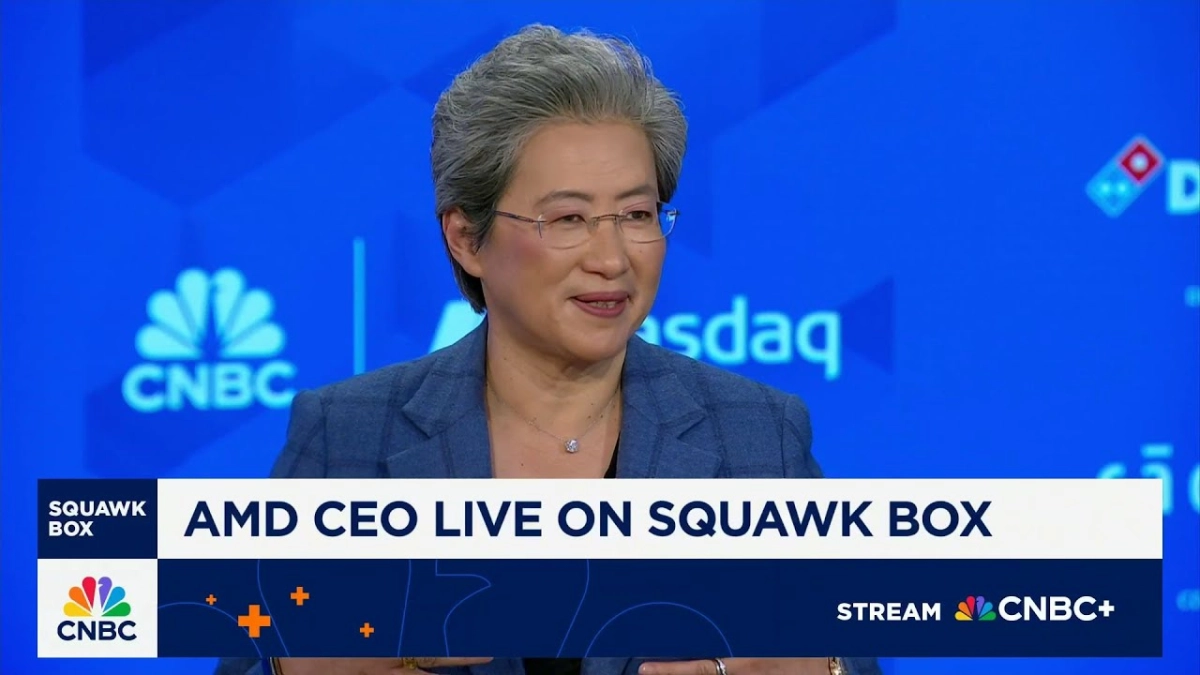
The artificial intelligence revolution, far from being a speculative bubble, represents "a trillion-dollar overall market as we get through 2030," according to AMD CEO Lisa Su. This bold declaration, made during a recent appearance on CNBC's Squawk Box, underscores a profound shift in the tech landscape, where computing power is increasingly synonymous with intelligence, and investment in AI infrastructure is not merely a gamble, but a strategic imperative. Su’s insights, shared following AMD’s Analyst Day, painted a confident picture of the company's aggressive pursuit of this burgeoning opportunity, projecting staggering growth rates and strategic partnerships designed to capture significant market share.
Lisa Su spoke with Becky Quick and Aaron Task on CNBC's Squawk Box, discussing AMD's strong quarterly earnings, takeaways from the company's recent Analyst Day, the insatiable demand for AI chips, the state of the AI tech race, AMD's partnership with OpenAI, and the expansive data center business. The conversation provided a rare glimpse into the strategic thinking at the helm of one of the world's leading semiconductor companies, highlighting the conviction behind massive capital allocations in a rapidly evolving sector.
AMD's bullish outlook is rooted in a fundamental re-evaluation of the AI market's scale. Su acknowledged that initial estimates of the AI accelerator market, once pegged at a substantial $300 billion, have been dwarfed by the reality of accelerating demand. This market, she states, is now "accelerating at a pace that we just did not understand until over the last few years." The driving force is simple yet profound: "If you can get more intelligence, why wouldn't you want more computing?" This equation forms the bedrock of AMD's confidence, viewing increased computing as a direct pathway to enhanced intelligence and, critically, tangible productivity gains across industries.
The company's projections are ambitious: revenue growth is expected to expand 35% a year over the next three to five years, with the AI data center segment alone poised for over 80% annual growth, potentially hitting tens of billions of dollars in sales by 2027. This aggressive stance is not born of mere optimism, but from direct engagement with the ecosystem. Su emphasizes that "the key is what people are saying as they're actually utilizing the technology." She observes that major hyperscalers and enterprises are now clearly seeing the "inflection point," recognizing real productivity improvements from AI use cases and consequently increasing their capital expenditures.
Aaron Task probed whether such substantial investments, particularly by companies like OpenAI which reportedly face significant losses, constituted a "big gamble." Su swiftly countered, asserting, "I don't think it's a big gamble, I think it's the right gamble." She elaborated that these are "extremely disciplined companies" with the balance sheets to invest, understanding that "more computing and more investments equate to a faster pace of innovation." While the exact timing of return on investment might be "a little fuzzier," the fundamental belief in AI's transformative power and its demand for advanced computing is unequivocal among industry leaders.
Navigating a market currently dominated by rivals like Nvidia, which holds a commanding share in AI data centers, requires a multi-faceted approach. AMD's strategy centers on relentless innovation and strategic partnerships. Su points to the company's product roadmap, including the current MI350 series in production and upcoming rack-scale architectures, as critical differentiators. Furthermore, AMD is actively cultivating a robust network of partnerships, including collaborations with OpenAI, Oracle, and Meta, among other hyperscalers. This collaborative strategy acknowledges that "everybody wants to have multiple solutions and frankly there's no one solution that fits all." By offering a diverse and competitive portfolio, AMD aims to position itself as an "excellent option" for the varied and escalating demands of the AI ecosystem.
The sheer scale of the AI market and the fundamental need for more computing power provide a compelling narrative for AMD's strategic direction. The company's confidence stems from a clear understanding of customer needs and a commitment to delivering the advanced technology required to unlock AI's full potential.

