


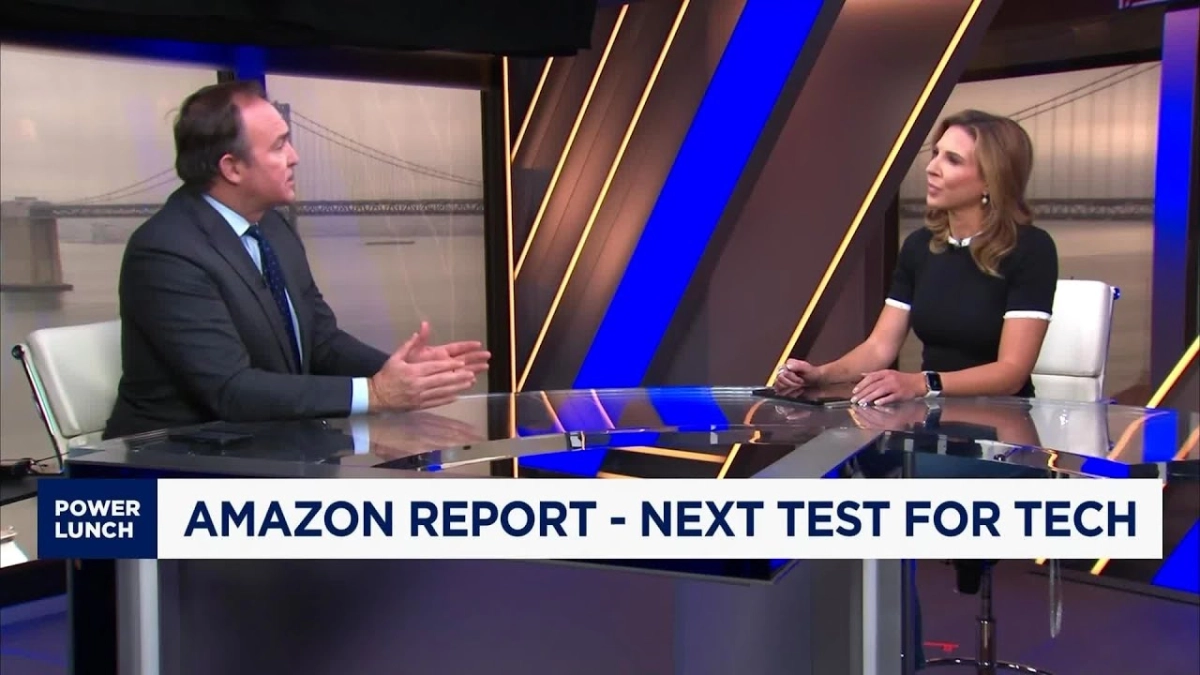
The burgeoning demands of generative AI are fundamentally reshaping the competitive landscape of cloud computing, compelling even market leaders like Amazon to critically assess their strategic investments. CNBC’s MacKenzie Sigalos, reporting on Amazon’s third-quarter earnings, underscored that the company’s cloud momentum and substantial AI infrastructure spending are now under intense scrutiny, with investors eager to see tangible returns. Sigalos spoke with the CNBC Power Lunch host about Amazon's financial performance, the fierce competition in the cloud sector, and the critical role of AI in shaping its future trajectory.
A central theme emerging from the discussion is that Amazon Web Services (AWS), the company's cloud arm, remains its primary profit engine, yet it faces mounting pressure from aggressive rivals. MacKenzie Sigalos noted, "Everyone is looking at their cloud business." While Amazon still commands a significant 30% market share in the cloud, Microsoft's Azure is rapidly closing in, having achieved a 20% share. This tightening race means that AWS's year-over-year growth is paramount; Sigalos warned that if Amazon fails to achieve "between 18.5 to 19%," its stock is "very likely going down." This illustrates the high expectations placed on AWS to continue its robust expansion, especially as the broader tech market grapples with economic headwinds.
The generative AI boom is not merely a new revenue stream; it is a catalyst for a massive re-evaluation of cloud infrastructure and capital expenditure. Sigalos highlighted how "Gen AI clients are asking a lot. These are workloads that are different to what they are used to servicing." This distinction is crucial for founders and VCs to grasp, as it implies that existing cloud infrastructure, particularly older "legacy infrastructure" like some of Amazon's East Coast hubs, may not be optimally configured for the intensive, specialized demands of AI workloads. This creates an urgent need for providers to invest in new compute capabilities, a point underscored by Amazon's ongoing data center build-out in Indiana.
Competition in the AI-driven cloud space is not limited to traditional hyperscalers. Google, despite being a "distant third" in overall cloud market share, is demonstrating significant traction in securing AI workloads. Sigalos pointed out that Google "has been winning workloads away from Amazon, most notably a contract with Anthropic to the tune of tens of billions of dollars signed just last week." This indicates a shift in client preference and a willingness to diversify cloud providers for AI-specific needs. Google's reported 80% boost in its cloud backlog further solidifies its position as a formidable contender, suggesting a strong future revenue pipeline that Amazon must contend with.
The discussion also touched upon Amazon's evolving corporate identity. The interviewer posed the question of whether Amazon is still primarily a retail company or if it has transitioned into a technology and cloud powerhouse. Sigalos unequivocally stated, "E-commerce is not where they're getting the profitability from. It's from their cloud business." This insight is vital for understanding Amazon's strategic priorities. While its advertising business, directly tied to its consumer e-commerce platform, is booming and highly profitable, the long-term, high-margin growth driver remains AWS and its ventures into AI.
Related Reading
- Alphabet's AI Gamble Pays Off in Q3, Fueling Search and Cloud Growth
- How labor shortages may delay data center plans
- Microsoft's Profitable AI Play: A Strategic Masterclass
This fundamental shift necessitates substantial capital investment. The disparity in capital expenditure between Amazon and its chief rival, Microsoft, is a key metric to watch. Microsoft's current run rate for capex is $140 billion, significantly higher than Amazon's approximate $100 billion for the fiscal year. This gap raises questions about Amazon's commitment to scaling its infrastructure to meet the exponential demands of generative AI, particularly when competing for large-scale enterprise and AI startup contracts. The ability to rapidly deploy and optimize new compute resources will be a defining factor in who captures the lion's share of the AI cloud market.
The implications for the broader tech ecosystem are profound. Startups building on generative AI models will increasingly scrutinize the capabilities and infrastructure commitment of their cloud providers. Defense and AI analysts will recognize that robust, specialized cloud infrastructure is becoming a critical national asset, influencing innovation and competitive advantage. The era of generic cloud services is giving way to a new phase where specialized AI compute and resilient, cutting-edge data centers are the true differentiators. Amazon’s future success in this new paradigm will depend heavily on its ability to not only innovate in AI services but also to invest aggressively in the underlying infrastructure that powers them.

