

Amazon’s latest strategic maneuver, an investment of up to $50 billion to forge a purpose-built AI and supercomputing cloud infrastructure for U.S. government agencies, marks a pivotal moment in the intersection of artificial intelligence, national security, and enterprise cloud dominance. This is not merely an expansion; it is a profound declaration of intent to embed Amazon Web Services (AWS) at the heart of the federal government's most sensitive and critical AI operations, setting a new benchmark for what is possible in secure, high-performance computing for public service.
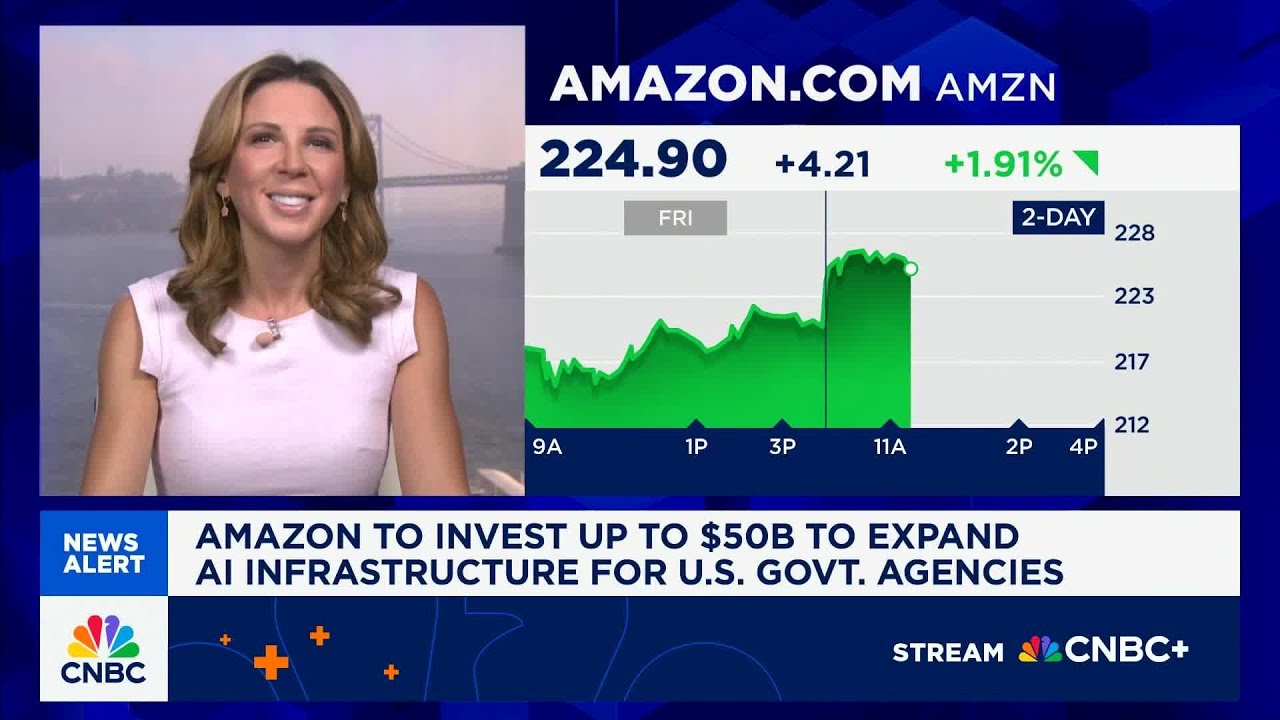
CNBC's MacKenzie Sigalos reported on this colossal undertaking, detailing Amazon's plan to construct the first-ever AI and supercomputing data centers specifically designed to serve federal agencies across all classification levels. This unprecedented commitment underscores a recognition by both Amazon and the U.S. government of AI's transformative potential, particularly when harnessed within environments demanding the highest levels of security and operational integrity. The announcement signals a deepening of Amazon’s long-standing relationship with federal clients, moving beyond general cloud services to specialized, cutting-edge AI capabilities.
The investment solidifies AWS’s position as a critical national infrastructure provider, extending its formidable cloud leadership into the burgeoning field of governmental AI. For years, AWS has been a dominant force in securing lucrative contracts with federal entities, from defense to intelligence. This $50 billion commitment, however, elevates that relationship to a new plane, positioning AWS not just as a vendor but as an indispensable partner in national AI strategy. It’s a move that will likely entrench AWS further, making it exceptionally difficult for competitors to dislodge.
As MacKenzie Sigalos highlighted, "Amazon is making its biggest bet yet on AI for the federal government, announcing a $50 billion investment to construct the first-ever AI and supercomputing data centers built specifically for U.S. agencies." This financial commitment is staggering, reflecting the immense capital intensity required to build and operate advanced AI infrastructure at scale, especially under the stringent security protocols mandated by government clients.
This massive capital injection into AI infrastructure for the public sector underscores a fundamental shift in the AI race. It’s no longer solely about algorithms or models; it’s about the foundational compute and data capabilities that underpin them. The project is slated to add nearly 1.3 gigawatts of compute capacity across AWS's top-secret, secret, and GovCloud regions, a scale that few, if any, other providers can match or afford to replicate. This creates a significant barrier to entry for smaller players and even other hyperscalers looking to compete in this highly specialized and regulated segment.
The sheer volume of compute capacity is designed to accelerate mission-critical tasks. Construction is set to begin next year.
Crucially, this initiative promises to democratize access to advanced AI tools for government agencies, albeit within a highly controlled ecosystem. Sigalos noted that "government customers will gain access to the same AI tools that Amazon offers enterprises, including its in-house AI chips and Anthropic's Claude models." This means federal departments, from intelligence to logistics, will be able to leverage state-of-the-art AI for complex problem-solving, data analysis, and operational efficiencies, mirroring the capabilities enjoyed by leading commercial enterprises. For AI professionals and founders, this opens up a new, highly specialized market, requiring solutions that are not only innovative but also compliant with rigorous security and ethical standards. Startups aiming to serve this sector must now consider deep integration with AWS GovCloud environments and the unique demands of classified data.
Amazon itself views this as a transformative undertaking. MacKenzie Sigalos reported that Amazon is calling it "a fundamental transformation in how the government uses supercomputing." This isn't just an incremental upgrade; it’s a re-imagining of how federal agencies can leverage computational power to fulfill their mandates. The implications for national defense, intelligence gathering, scientific research, and even public services are profound, promising capabilities previously confined to the realm of science fiction or highly specialized, isolated research facilities.
Related Reading
- Data Centers Fuel Freight Boom Amidst Economic Shifts
- Open Source vs. Closed AI: Navigating the Trillion-Dollar AI Stack
- AI's Unquenchable Thirst: The Looming Energy Crisis and Global Power Shift
The investment is also a direct response to, and support for, the White House’s broader AI Action Plan, aligning Amazon’s commercial interests with national strategic priorities. As governments worldwide grapple with the dual challenges of harnessing AI's potential while mitigating its risks, secure and robust infrastructure becomes paramount. Amazon's move positions it as a key enabler of the U.S. government's AI ambitions, from securing critical data to accelerating the development and deployment of AI-powered solutions for national security. This strategic alignment will undoubtedly resonate with defense and AI analysts, who understand the imperative of a robust, secure AI backbone for maintaining technological superiority.
While Google and Microsoft are also aggressively pursuing government cloud and AI contracts, Amazon's $50 billion commitment sets a new precedent for the scale of investment in this domain. It’s a calculated move to capture a significant share of the future government AI market, leveraging its existing cloud infrastructure and security clearances. This investment is a testament to the belief that the future of governmental operations will be deeply intertwined with advanced AI, and that the infrastructure supporting it will be as critical as any physical asset.

