

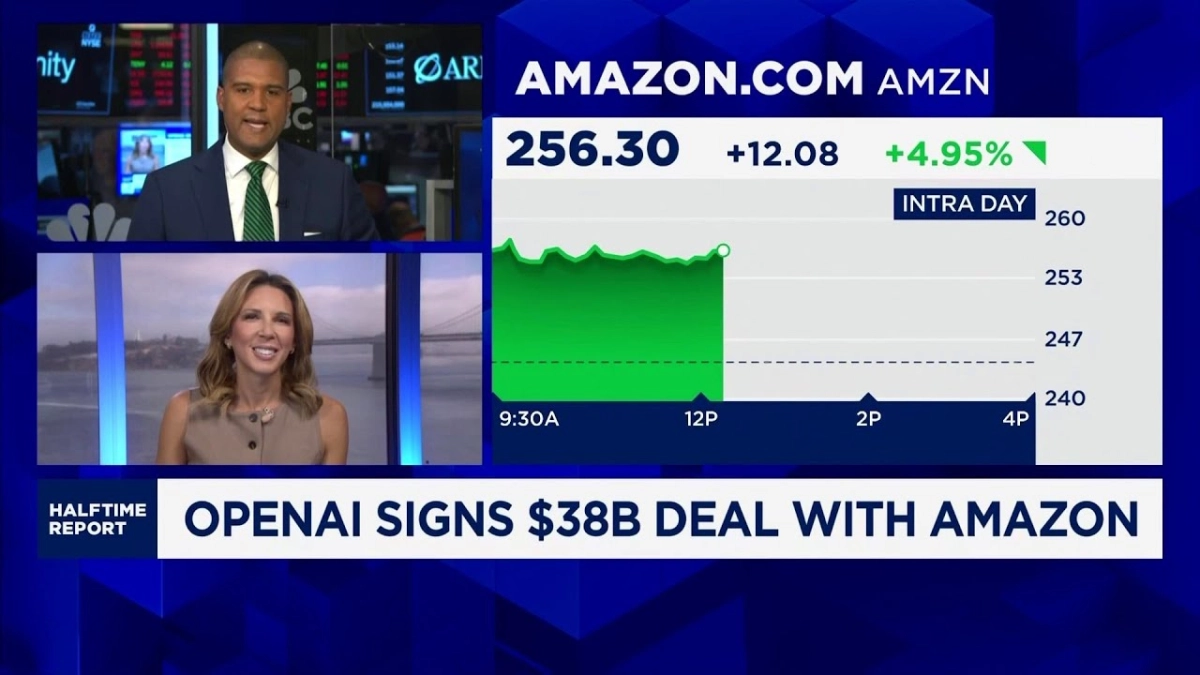
The unprecedented $38 billion compute deal between OpenAI and Amazon Web Services, as reported by CNBC's MacKenzie Sigalos on the Halftime Report, signals a seismic shift in the foundational infrastructure powering artificial intelligence. This strategic agreement, which sent Amazon's shares soaring to new record highs, underscores the escalating demand for high-performance computing resources and the fierce competition among cloud providers to capture the burgeoning AI market. It is a stark illustration of how the race for AI supremacy is being fought not just in algorithms and models, but in the underlying hardware and cloud capacity that enables their development and deployment.
Frank, the CNBC anchor, introduced MacKenzie Sigalos, who provided the detailed breakdown of this monumental agreement. The discussion centered on Amazon's stock performance following the announcement and the critical implications of OpenAI's decision to diversify its cloud infrastructure beyond its long-standing, and until recently exclusive, relationship with Microsoft. This move is more than just a large transaction; it represents a strategic recalibration for OpenAI and a significant competitive victory for AWS.
One of the immediate and most striking insights from this announcement is OpenAI's newfound flexibility in scaling its infrastructure. As Sigalos noted, "The partnership gives OpenAI more flexibility as the company rushes to scale up infrastructure." This is paramount for an organization at the vanguard of AI development, where the insatiable demand for compute power to train and run increasingly complex models is a constant challenge. Relying on a single cloud provider, even one with deep investment, carries inherent risks related to capacity constraints, pricing leverage, and technological lock-in. By tapping into AWS, OpenAI gains access to a broader pool of resources, including Nvidia GPUs, which are critical for advanced AI workloads, and mitigates potential bottlenecks. This diversification is a clear signal to the market that even the most deeply integrated AI entities are seeking optionality in their foundational compute layers.
For Amazon Web Services, this deal is a powerful reassertion of its cloud dominance and a strategic coup in the AI infrastructure wars. Securing OpenAI as a major customer, especially given their prior exclusivity with Microsoft, validates AWS's investment in its AI-optimized compute offerings and its ability to meet the most demanding workloads. Sigalos highlighted the scale of AWS's ambition, noting that Amazon will not only host OpenAI's workloads but "will also build out new data centers specifically for OpenAI." This bespoke infrastructure development demonstrates the lengths to which cloud providers will go to secure high-value AI clients, recognizing that these partnerships drive significant long-term revenue and strategic positioning. The deal also underpins Amazon's robust Q4 revenue guide of over $210 billion, a landmark achievement that makes it the first company to reach such a figure, with CEO Andy Jassy having previously teased several unnamed major deals.
The implications for Microsoft are equally significant. Until last week, Microsoft Azure held an exclusive cloud provider relationship with OpenAI, complete with a right of first refusal for new compute needs. The $38 billion deal with AWS effectively ends that exclusivity, marking a substantial shift in the competitive landscape. While Microsoft remains a key investor and partner for OpenAI, this move by OpenAI underscores a broader trend: even deeply integrated strategic alliances in the AI space are subject to market forces and the imperative for companies like OpenAI to optimize for scale, cost, and technological diversity. It suggests that AI companies are increasingly unwilling to put all their compute eggs in one basket, even when that basket is backed by a major investor.
This development also illuminates the escalating arms race in AI compute. The sheer scale of the $38 billion commitment underscores the astronomical costs associated with developing and deploying cutting-edge AI. For founders and VCs, this partnership serves as a potent reminder that access to vast, scalable, and specialized compute resources is not merely an operational detail but a fundamental strategic imperative for any ambitious AI venture. It suggests that the future of AI innovation will heavily depend on robust cloud partnerships and the ability to leverage diverse infrastructure to maintain competitive velocity. The battle for AI dominance is increasingly a battle for compute infrastructure.
Related Reading
- OpenAI's $38 Billion AWS Compute Deal Reshapes AI Infrastructure Landscape
- OpenAI Forges $38B AWS Alliance, Signaling Multi-Cloud Future
- Amazon's AI Investments Drive AWS Re-acceleration and Retail Innovation
The deal also signals a maturing market where AI companies, once perhaps more beholden to early strategic investors, are now exercising greater autonomy in their infrastructure choices. This newfound leverage allows them to optimize for performance and cost, driving intense competition among cloud providers. AWS's commitment to building out specialized data centers for OpenAI is a testament to the custom, high-touch services demanded by the leading AI innovators. This level of investment and tailored infrastructure indicates that the traditional cloud-as-utility model is evolving to meet the unique and intensive requirements of generative AI.
This partnership is a bellwether for the broader tech industry, indicating that the foundational layers of AI are becoming increasingly distributed and diversified. It suggests a future where leading AI models may run across multiple cloud environments, optimizing for specific workloads, regional presence, and cost efficiencies. The strategic maneuvering of companies like OpenAI, balancing deep investor relationships with the practical demands of scaling a compute-intensive enterprise, will be a defining characteristic of the AI ecosystem for years to come.



