

AlphaGenome Atlas Maps 9 Billion DNA Variants

DeepMind's 1-petabyte AlphaGenome Atlas precomputes molecular effects for all 9 billion possible human DNA variants.

S
StartupHub.ai Staff
3 min read
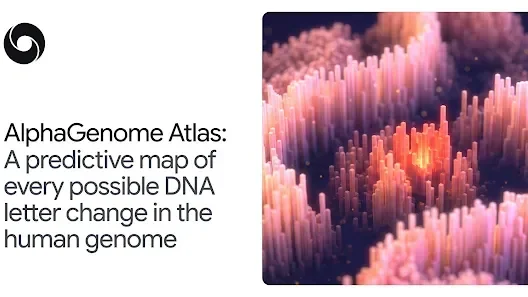
Visualization of DNA variants mapped across the human genome by AlphaGenome Atlas
Google DeepMind's AlphaGenome Atlas predicts molecular effects for every possible single-nucleotide variant.· Deepmind
Contents(3)

AlphaGenome Atlas from Google DeepMind predicts the molecular impact of 9 billion single-nucleotide variants across the human genome.

StartupHub data

Companies working on this

Profiles of the companies named in this story, with funding and a one-liner from our database.

Google DeepMind
$677M
Pioneering AI research and development to solve intelligence and advance science for humanity.

The system was demoed September 8 as a free portal, API and Antigravity skill covering hundreds of human and mouse cell types and tissues.

The affected system is the whole genome itself, where testing each variant in the lab is impossible and 98 percent of variants lie outside coding regions.

Attacker requirement is minimal: a single letter change is enough to disrupt splicing, expression or chromatin accessibility.

How AlphaGenome Atlas predictions actually work

AlphaGenome Atlas precomputes thousands of molecular effect predictions for each variant using the AlphaGenome model.

Think of it like a weather map for DNA, where every coordinate gets a forecast instead of waiting for a storm report.

The AlphaGenome Variant Impact score then condenses those effects plus AlphaMissense protein impact into a single rankable number.

AVI feature attributions break that number back into additive drivers such as splicing, expression, chromatin accessibility and conservation.

A linked compendium of more than 2,500 DNA motifs maps the recurrent words of the genome that those variants actually disrupt.

Why this matters and what is not fixed

Builders get instant lookup instead of running heavy inference, which matters because the dataset is 1 petabyte, more than 30 times larger than the AlphaFold Database.

Early users show signal: the GREGoR Consortium with Laura Covill and Anne O’Donnell-Luria at the Broad found a DNM1 splice-creating variant tied to epileptic encephalopathy that prior filters missed.

Gareth Hawkes at the University of Exeter grouped rare variants by predicted effect in 54,000 UK Biobank genomes and found 22 percent more non-coding associations for proteins like PLA2G7 and EGLN1.

The same approach surfaced 19 non-coding regions linked to body mass index when restricted to the top 1 percent of predicted impact.

Stowers researchers Julia Zeitlinger and Melanie Weilert used the motif map to separate transcription factors that only open DNA from those that also activate genes.

What is not fixed is experimental truth, as these are predictions for non-commercial use today with commercial Cloud access still to come, and they require lab validation before clinical use.

For startups, the shift matters because precomputation turns a GPU problem into a data lookup problem, letting small rare disease teams rank variants without model hosting.

© 2026 StartupHub.ai. All rights reserved. You may not republish this article in full without a license. Search engines and AI research tools may crawl and summarize for reference. Bulk reproduction or model training requires a license. See our terms.
S

Written by

StartupHub.ai Staff

Editorial team

The staff writers of StartupHub.ai, ranging from investment analysts to avid AI tool users, early adopters and critical enthusiasts. Backgrounds span engineering, business and the arts. We hold every piece to rigorous standards of research and review.