

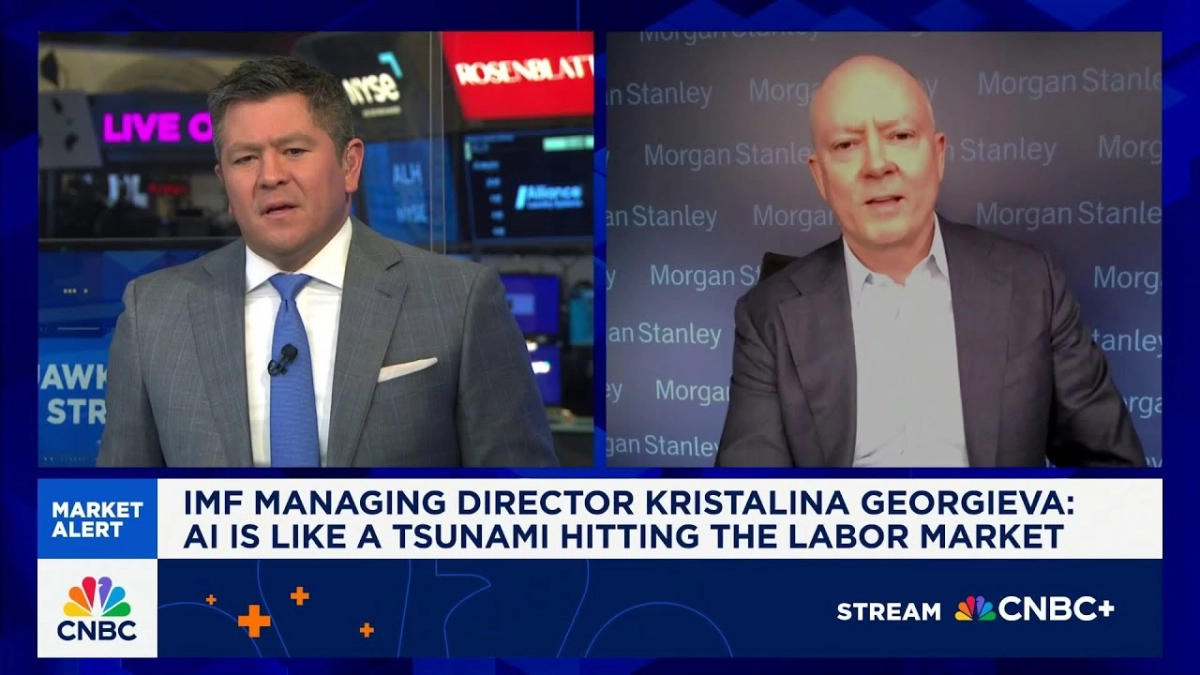
"Virtually every job will be impacted by AI in some way," declared Stephen Byrd, Morgan Stanley's Global Head of Thematic Research, in a recent interview on CNBC's 'Squawk on the Street.' Byrd, whose team has conducted extensive research into artificial intelligence's economic implications, unpacked the multifaceted ways this technological revolution is poised to reshape the global labor market and create unprecedented value. He spoke with the CNBC interviewer about the scale of AI’s impending influence, the sectors most ripe for disruption, and the accelerating pace of innovation that defies conventional predictions.
Byrd underscored that AI's impact isn't a binary choice between human or machine, but rather a spectrum ranging from complete automation of certain tasks to the augmentation of human capabilities. In the latter scenario, AI serves as an indispensable assistant, enhancing productivity and enabling new forms of creativity. This nuanced view challenges the simplistic narrative of wholesale job displacement, suggesting a more complex integration where human-AI collaboration becomes the new norm across industries.
What truly surprised Byrd in his team's analysis was the revelation that the highest-tech sectors might not experience the most profound *relative* impact on their bottom line. Instead, sectors characterized by "fairly low income per employee" are positioned for the most significant efficiency gains. He cited consumer and logistics sectors as prime examples, where AI's ability to streamline operations could lead to substantial improvements, in some cases exceeding "more than 100% of their operating income over time." This insight is crucial for founders and VCs, indicating that the most fertile ground for AI-driven value creation may lie not just in cutting-edge tech, but in optimizing traditional, labor-intensive industries.
The dynamic nature of AI’s development is another critical, yet often "under-appreciated," factor. Byrd emphasized, "AI is not static. It’s improving at a very rapid rate." What might appear as mere "science fiction today" in terms of AI's capabilities, he predicts, will be commonplace reality by "2026 and beyond." This exponential growth trajectory means that current models and analyses of AI's potential are constantly being rendered obsolete by new advancements.
He pointed to the dramatic increase in computational power being deployed by leading AI labs. The top five U.S. labs are applying approximately "ten times the computational power" to train their next-generation models, expected to be unveiled later this year and early next. This massive investment in compute is anticipated to yield "not a little improvement, but a fairly massive improvement" in AI performance. Such a leap signifies a critical inflection point, where the sheer scale of processing power unlocks capabilities previously unimaginable, driving a "step function" in AI's evolution.
While acknowledging that the industry is navigating "unknown territory," Byrd expressed optimism rooted in recent, tangible breakthroughs. He highlighted instances where AI models have recently "scored a gold medal on the International Math Olympiad" and where "world-class physicists, mathematicians, computer scientists are now using AI to really enhance their thought process." These achievements are not just academic curiosities; they represent a fundamental shift in AI’s ability to engage in complex problem-solving and even creative reasoning, extending its utility beyond mere automation.
The promise of these advancements is not without its uncertainties, as the interviewer rightly noted regarding the sustainability of scaling laws. Yet, Byrd maintains that by "the spring or early summer" of next year, with the unveiling of models trained on significantly higher compute, the industry will gain much clearer insights into the true extent of these performance improvements. This forthcoming data will be vital for strategic planning, allowing businesses and investors to better calibrate their expectations and investments in AI.
Morgan Stanley's report projects a staggering "$920B in annual net benefits" and "$13T-$16T in long-term market value creation" for the S&P 500 due to AI adoption. This colossal potential underscores the urgency for leaders across all sectors to understand and strategically integrate AI. The coming months will be a crucible for AI development, offering a critical window for enterprises to adapt, innovate, and harness its transformative power.



