
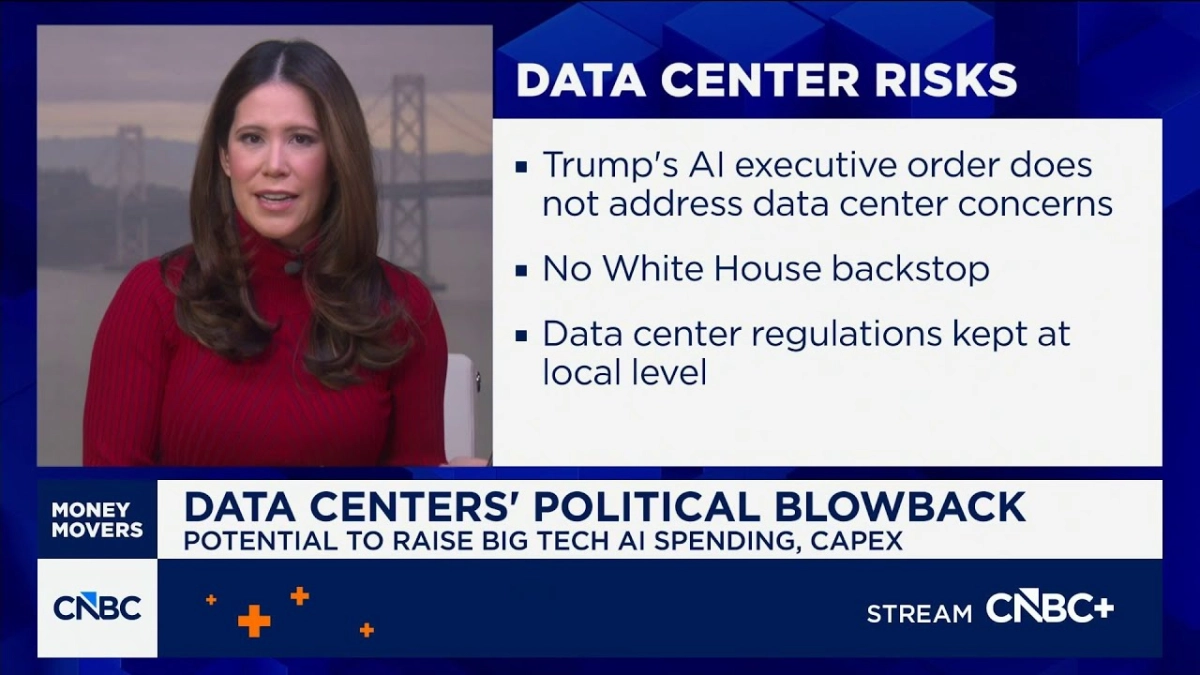
The burgeoning computational demands of artificial intelligence are rapidly colliding with public policy and local politics, as highlighted in a recent CNBC "Money Movers" segment. CNBC Business News TechCheck Anchor Deirdre Bosa reported on growing political pressure stemming from the massive energy consumption of AI data centers, revealing a new front of risk for the booming AI sector that extends beyond market valuations to tangible utility costs for everyday citizens.
Deirdre Bosa, speaking with Carl Quintanilla on CNBC's "Money Movers," detailed the investigation launched by three Democratic senators—Elizabeth Warren, Chris Van Hollen, and Richard Blumenthal—into the role of major tech companies like Google, Meta, and Amazon, alongside data center firms such as CoreWeave, in the escalating cost of electricity. This scrutiny centers on the significant and rapidly expanding power requirements of AI infrastructure, which critics argue are being unfairly passed on to households.
The senators' letters to these tech giants underscore a critical concern: data centers are already consuming over four percent of U.S. electricity, a figure government estimates project could triple to twelve percent by 2028. This dramatic surge in demand necessitates billions in grid upgrades, the cost of which is ultimately borne by utility ratepayers, not solely by the tech companies driving the demand. Bosa succinctly articulated this core tension, stating, "The senators say AI data centers are forcing billions in grid upgrades and households, not Big Tech, are footing the bill." This direct impact on consumer utility bills transforms what might seem like a distant infrastructure challenge into a potent political issue.
The political blowback is not confined to Washington D.C.; it is reverberating at the local level. An Arizona city recently rejected a proposed AI data center following an AI lobbying push, illustrating how local communities are increasingly resistant to projects perceived as energy hogs. Similarly, rising electricity prices, often exacerbated by data center demands, have already played a role in statewide political races in New Jersey and Virginia. This grassroots opposition signals a fundamental shift: the public is becoming acutely aware of the tangible costs of the AI buildout, directly linking it to their personal finances and local resources.
This decentralized opposition presents a unique challenge for Big Tech. Unlike federal regulations that might offer a broad, unified framework, data center regulations are largely managed at the state and local levels. President Trump’s AI executive order, for instance, focuses on AI models but "does not preempt state or local regulation of data centers or power use." This absence of a federal backstop means that every new data center project becomes a local battleground, where land zoning, environmental concerns, and electricity rates are fiercely debated. The fragmented regulatory landscape introduces unpredictability and can significantly inflate capital expenditure for tech companies, slowing down the pace of AI infrastructure development.
The implications of this energy bottleneck extend beyond domestic concerns, touching on geopolitical competition. China, with its more centralized governance, possesses a structural advantage in rapidly deploying energy infrastructure without the same level of local public consultation or political hurdles. As Bosa pointed out, "If AI is a race of compute and power, China has a structural advantage. It can build without asking permission." While the White House recognizes this power disparity as a bottleneck, the ability of the U.S. to quickly close this gap remains uncertain. The U.S. commitment to democratic processes, while valuable, inherently introduces complexities and delays in large-scale infrastructure projects that China does not face.
For founders, VCs, and AI professionals, this rising political pressure signals a crucial shift in the investment landscape. What was once primarily a financial calculation for cloud CapEx now includes a significant and often unpredictable political variable. The cost of building and operating AI infrastructure will increasingly reflect not just hardware and software, but also the escalating price of securing land, navigating local opposition, and contributing to grid upgrades. This dynamic demands a more sophisticated approach to site selection, public relations, and regulatory engagement, moving beyond purely technical or economic considerations.
The current environment suggests that the future of AI infrastructure development in the U.S. will be heavily influenced by these political and local dynamics. The industry must grapple with the reality that public and political sentiment regarding energy consumption can quickly translate into higher costs and slower deployment, directly impacting the speed and scale of innovation.