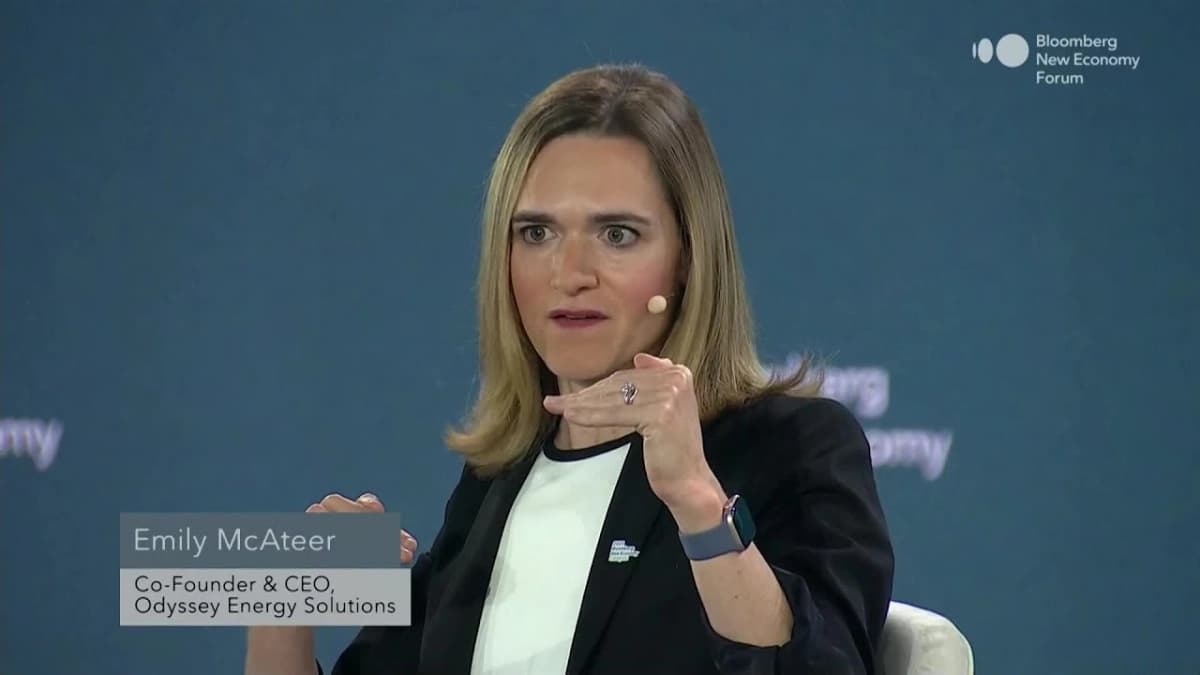
"We're talking a lot about AI, but the real story behind it... is actually the energy that's the real limit to the transition to an AI and robotics-driven economy." This stark assessment by Patrick Maloney, Co-Founder and CEO of CIV and Co-Founder & Chair of The Nuclear Co., set the tone for a compelling discussion at the 2025 Bloomberg New Economy Forum in Singapore. Alongside Emily McAteer, Co-Founder & CEO of Odyssey Energy Solutions, and Josephine Wapakabulo, Founder & Managing Director of TIG Africa, Maloney engaged with Bloomberg's Senior Executive Editor John Fraher on the unprecedented energy demands sparked by artificial intelligence and the geopolitical implications for global power and climate challenges.
Maloney detailed a profound shift in the global energy landscape. For two decades, the world, particularly the United States, experienced a relatively low-demand, low-volatility energy environment, even becoming a net energy exporter thanks to innovations like natural gas fracking. However, the advent of AI and the global push towards re-industrialization have fundamentally altered this dynamic. The computational power required to fuel AI models and vast data centers represents a "voracious energy need" that is driving demand curves to an inflection point. The sheer scale of this impending demand is staggering; Maloney stated that by 2030, the extra energy required globally will be equivalent to adding an entire country the size of Japan to the grid. He bluntly called the aspiration to "3x energy production in the next 10 years just in the US alone" a "physical impossibility." The world is critically short of power, and the race to secure electrons has become an "arms race" at both corporate and governmental levels.
This burgeoning energy crisis poses a particularly acute challenge for emerging economies. Josephine Wapakabulo articulated the grim reality for Sub-Saharan Africa: "If you're energy poor, you're AI poor." She traced Africa's existing energy deficit back to its colonial past, where extraction was prioritized over industrialization, leaving many nations with underdeveloped infrastructure post-independence. The risk now is not just missing out on this new industrial revolution, but being "completely locked out and on the margins of innovation and global value chains for up to a century." For Africa, where renewable energy growth lags significantly behind the global average (7% vs. 15%), the practicalities of financing the necessary infrastructure are immense. Wapakabulo cited real-world examples, like a major European bank pulling out of a critical pipeline project in Uganda due to shareholder pressure, forcing the region to seek alternative, often less favorable, funding.
Despite these formidable hurdles, there is a glimmer of optimism, particularly through distributed energy solutions. Emily McAteer highlighted how Odyssey Energy Solutions is accelerating financing for such projects in emerging markets. These regions, already grappling with demand outstripping traditional grid supply, are "leapfrogging the grid entirely" by deploying small, onsite solar and storage systems. The dramatic cost reductions in solar PV (99%) and batteries (95%) have made this feasible. This approach offers several advantages: faster deployment due to less reliance on sprawling, centralized grid infrastructure, and the opportunity to build "really smart grids" with integrated demand response and DER (Distributed Energy Resources) optimization.
McAteer emphasized that emerging economies, like India, could actually become attractive hubs for AI infrastructure precisely because they are building new, agile energy systems from the ground up, unburdened by legacy infrastructure issues plaguing developed nations. India, for instance, is seeing massive data centers co-located with solar parks and new regulations facilitating open-access power purchase agreements for renewables. However, the financing model for these distributed systems is fundamentally different; it requires consumer-level financing, akin to mortgages or car loans, rather than traditional infrastructure finance, a paradigm shift that still requires significant innovation and capital mobilization.
Related Reading
- Bitcoin's Infrastructure Fuels the AI Gold Rush
- AI's Bifurcated Future: Musk and Huang on Compute, Consciousness, and Civilization
The discussion also delved into the potential role of nuclear energy. Patrick Maloney argued that fission, a proven technology for 75 years, offers unmatched reliability and energy density. He pointed out that while the US currently leads in nuclear energy generation, it has dramatically fallen behind in deployment, having brought only two new reactors online in the last three decades, often late and over budget. In stark contrast, China has over 30 reactors online, 30 under construction, and 400 in its development pipeline, on track to surpass the US as the leading nuclear power by the mid-2030s. This aggressive expansion, mirrored in countries like France and South Korea, is driven by the understanding that "if you want to be the world's leading economy, you have to have the world's leading supply of electricity and electrons." The Nuclear Co., Maloney explained, is focused on solving this deployment problem through standardized designs and a fleet-scale business model to reduce cost, time, and friction.
However, Wapakabulo countered with the practicalities for Africa, where the immense cost of nuclear infrastructure, coupled with existing financial barriers, makes it a distant prospect for immediate, large-scale industrialization. The continent still needs fundamental energy sources like gas to meet current demands before it can even consider the "luxury" of exploring other options on a realistic financial footing. The urgency to meet base-load energy needs for industrialization cannot wait for multi-decade nuclear projects, even if globally there is a growing consensus that nuclear must be part of the "all of the above" energy solution. The energy crisis spurred by AI is not merely a technological hurdle but a complex web of economic, geopolitical, and developmental challenges that demand tailored, innovative, and equitable solutions, recognizing the diverse realities of nations across the globe.