

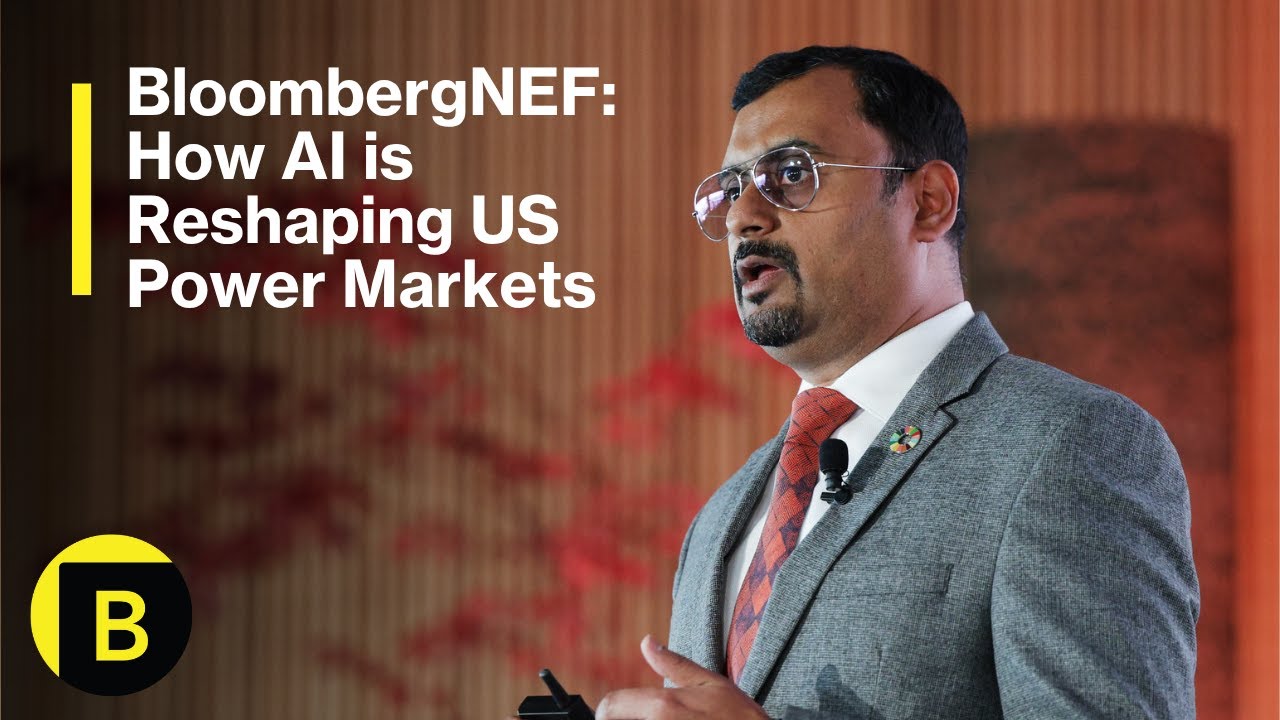
The burgeoning demand for artificial intelligence applications is fundamentally altering the trajectory of US power consumption, compelling an urgent re-evaluation of grid infrastructure and energy sourcing. Ashish Sethia, Global Head of Commodities, Energy & Environmental Markets at BloombergNEF, spoke with a Bloomberg interviewer at Bloomberg Green Seattle 2025, detailing how new AI data centers are creating an unprecedented surge in electricity demand and transforming the energy market.
Sethia highlighted the dramatic shift in projections, stating, "The demand forecast for electricity in the US has doubled in the last five years." This staggering increase is primarily driven by the rapid proliferation of AI data centers, which dwarf the energy appetite of their traditional counterparts. While a standard data center might consume 100-200 megawatts, AI-focused facilities are scaling to 300-500 megawatts, with some projects even reaching a gigawatt. To put this into perspective, Sethia noted that "A 1 GW data center is like adding a million homes to the grid." This concentrated demand presents an immense challenge for existing power grids, which were not designed for such rapid and localized load growth.
The strategic placement of these energy-intensive facilities is also undergoing a significant transformation. Historically, data centers prioritized proximity to fiber optic networks. However, with power now becoming the dominant constraint, location decisions are shifting dramatically. Sethia explained that these new facilities "are going to go where the power is cheapest and where the power is clean." This pivot means a greater emphasis on regions with abundant renewable energy resources and robust, affordable grid connections, rather than solely relying on established tech hubs.
This shift inherently positions the AI data center industry as a pivotal force in the clean energy transition. These facilities require not only immense quantities of power but also a high degree of reliability and, increasingly, a commitment to sustainability. Consequently, "The AI data center industry is going to be the biggest buyer of clean power in the world." This demand could accelerate renewable energy deployment, as developers seek to co-locate with or directly contract power from wind, solar, and other clean sources to meet the stringent requirements of AI operators.
Despite the potential for driving renewable growth, the critical bottleneck remains grid infrastructure. Building new transmission lines, essential for delivering power from generation sites to demand centers, is a notoriously time-consuming process. Sethia underscored this challenge, pointing out, "It takes 10 to 15 years to build a transmission line." This lag between surging demand and the slow pace of infrastructure development creates significant strain and uncertainty for utilities and grid operators nationwide, who are now grappling with load growth projections unseen in decades. The unprecedented scale and speed of AI's energy requirements are forcing an urgent re-evaluation of long-term energy planning and investment strategies across the United States.