

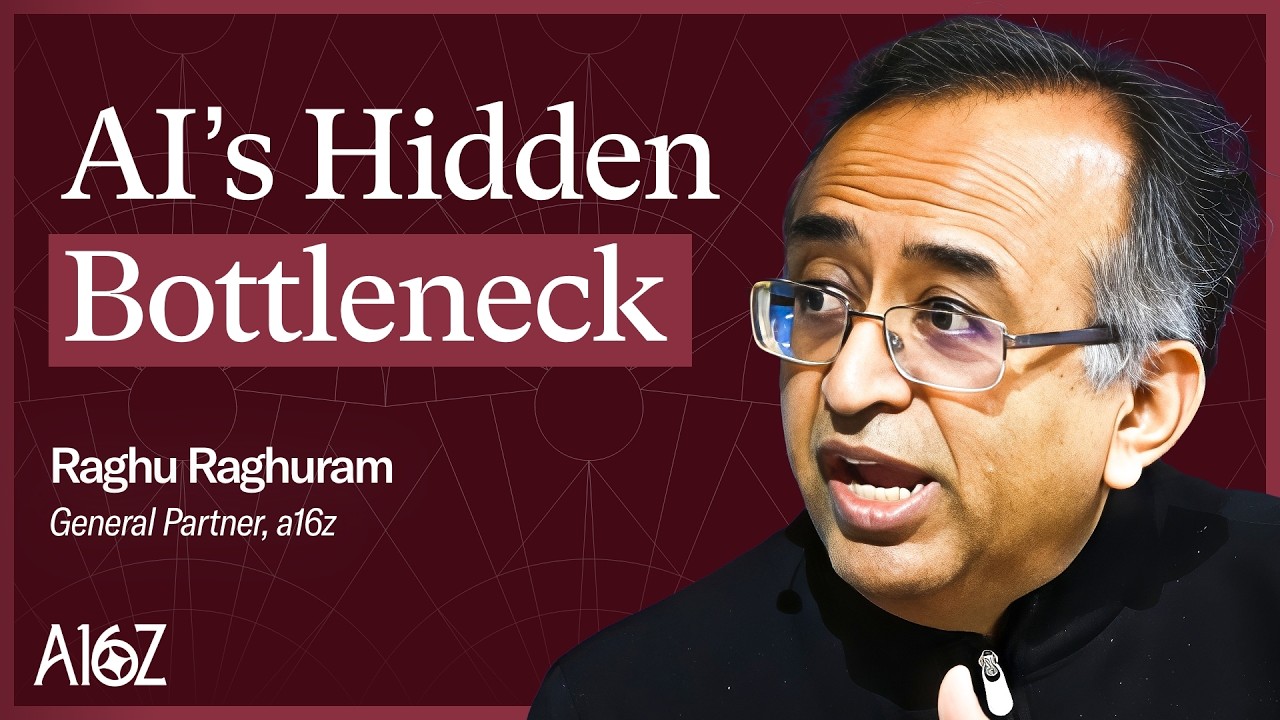
"I've seen nothing like this. I'm fairly certain no one's seen anything like this. The Internet in the late 90s, early 2000s was big... this makes it... 10x is an understatement. It's 100x what the Internet was." This stark assessment by Amin Vahdat, VP and GM of AI and Infrastructure at Google, encapsulates the central theme of a recent discussion at a16z's Runtime event. Vahdat, alongside Jeetu Patel, President and Chief Product Officer at Cisco, spoke with a16z General Partner Raghu Raghuram about the unprecedented scale and unique challenges of building the real-world infrastructure for artificial intelligence. Their consensus: this isn't just another tech cycle; it's a monumental undertaking with profound geopolitical, economic, national security, and technological implications.
The sheer scale of the AI buildout dwarfs previous technological revolutions. Raghuram likened it to a fusion of the internet's expansion, the urgency of the space race, and the strategic depth of the Manhattan Project. This comparison highlights not only the vast capital expenditure involved but also the multifaceted nature of the challenge. Companies are pouring trillions into this new "AI industrial revolution," yet Vahdat suggests that "we are grossly underestimating the buildout." The demand is so immense that even seven and eight-year-old Google TPUs (Tensor Processing Units) are operating at 100% utilization, indicating a persistent and insatiable hunger for compute.
This insatiable demand has swiftly redefined what constitutes a scarce resource. Power, compute, and network are no longer commodities but critical, limited assets. Power, in particular, has emerged as the primary bottleneck. Data centers are now being strategically located not where they might traditionally make sense, but where ample power can be secured. This fundamental shift in resource allocation is exacerbated by limitations in transforming land, securing permits, and ensuring robust supply chains for essential components. Vahdat warns that the supply side is struggling to catch up, predicting that this CapEx supercycle will extend for another three to five years, a testament to the enduring imbalance between demand and availability.
The constraints are also driving a profound shift towards specialization and co-design in hardware. We are entering a "golden age of specialization," as Vahdat describes, where purpose-built chips like TPUs offer 10-100 times greater power efficiency per watt for specific AI computations compared to general-purpose CPUs. This efficiency is critical in a power-constrained world. Geopolitical factors further complicate this landscape; Patel highlighted how nations like China, facing restrictions on advanced chip manufacturing, might leverage abundant power and engineering talent to optimize performance on older, less advanced process nodes, creating distinct architectural philosophies across different regions. This divergence necessitates a tight, iterative co-design process across hardware, software, and networking, moving away from generic, off-the-shelf solutions towards deeply integrated systems.
The evolution of networking is equally transformative. Patel noted the escalating demand for both scale-up networking (within racks) and scale-out networking (across geographically dispersed racks and clusters). Cisco’s recent launch of new silicon and systems for scale-across networking, capable of connecting data centers hundreds of kilometers apart, directly addresses the power scarcity that forces distributed architectures. Vahdat underscored that the network itself is becoming a primary bottleneck, requiring a complete reinvention. AI workloads are incredibly bursty, swinging from periods of massive computation to intense network communication. Building networks that can handle these extreme, unpredictable bursts while remaining power-efficient is a "fascinating problem" that demands innovative solutions beyond traditional packet switching.