


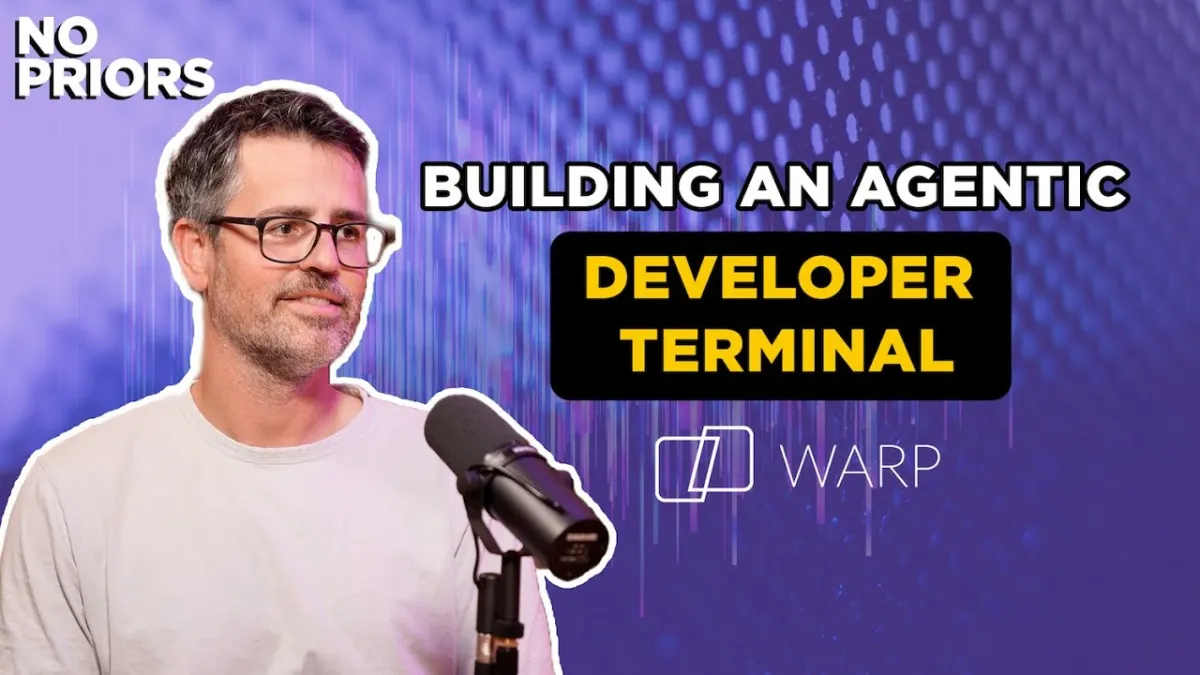
"I think what's fascinating to me is how much intelligence you can get out of just like next-token prediction," mused Zach Lloyd, co-founder and CEO of Warp, during a recent conversation with Elad Gil on the No Priors podcast. This provocative statement immediately set the tone for an interview that transcended typical product discussions, delving into the profound philosophical implications of AI's rapid ascent and its transformative impact on the software development landscape. Lloyd, with a Master's degree in the philosophy of science, brought a unique lens to the discussion, dissecting the very nature of intelligence versus consciousness in the age of advanced large language models (LLMs) and outlining a future for coding agents.
Lloyd posited that current AI advancements represent a "distillation of intelligence," a mechanistic process akin to sophisticated pattern recognition and prediction, rather than the recreation of genuine consciousness. He referenced the science fiction novel *Blindsight*, which explores the concept of an intelligent, space-faring species that lacks consciousness, highlighting the deep chasm between functional capability and subjective awareness. This distinction, he argued, renders the classic Turing Test, once the gold standard for AI intelligence, largely irrelevant. "The Turing Test is passed. What's crazy to me is like, we just passed it and no one seemed to care."

The current generation of AI, while capable of generating coherent text and even complex code, operates without a sensory experience or a continuous feedback loop that might underpin consciousness. It reasons, interprets language, and synthesizes knowledge, yet remains a mechanical process.
This mechanistic intelligence, however, is profoundly reshaping the developer's world. Lloyd outlined three phases of software development: "develop by hand," the traditional era; the current "develop by prompt" era, where AI assists human coders; and the coming "automated development" phase, where AI agents will handle significant portions of the development process autonomously. This shift necessitates a re-evaluation of the developer's role, elevating the importance of deep architectural and system-level understanding.
Far from devaluing human expertise, Lloyd argued that AI agents, functioning much like junior engineers, make senior engineering skills more critical than ever. "I think it's actually, in the short term at least, it's more important to know what you're doing as an engineer than it ever has been," he stated. Senior developers will be indispensable for architecting robust systems, reviewing AI-generated code for bugs and security vulnerabilities, and ensuring overall code maintainability. This human oversight becomes the bulwark against the potential for AI to introduce subtle errors or create unmanageable technical debt.
Warp, Lloyd's venture, embodies this vision of an AI-augmented development future. It's an "agentic development environment" built on a terminal-first approach. Unlike many AI dev tools that operate as web interfaces or IDE plugins, Warp leverages the terminal as a powerful launchpad for AI agents. These agents can interpret natural language prompts ("tell your computer what to do in English") or traditional terminal commands to execute a wide range of development tasks, from coding and project setup to debugging server crashes. Warp's success, evidenced by its rapid growth to nearly a million monthly active users, underscores the demand for tools that integrate AI directly into the developer's core workflow, offering enhanced user experience and features like integrated code review.
Related Reading
- ChatGPT Atlas Redefines Web Browsing with AI Integration
- ChatGPT Atlas Redefines Web Interaction with Browser-Native AI
- Build AI Apps for free in Google AI Studio!
Looking ahead, Lloyd sees a dynamic landscape for dev tools. He anticipates a continued blend of interactive and automated development, with a long-term trend towards more comprehensive automation. The debate centers on whether this automation will be delivered by monolithic platforms (like OpenAI integrating apps within ChatGPT) or by specialized tools that can be programmed against foundational models. Lloyd suggested that core development functions like security analysis, automated verification, and code review are ripe for consolidation within agentic platforms, as they benefit significantly from a holistic understanding of the codebase.
The future, as envisioned by Lloyd, will see increasing competition at the model layer, potentially commoditizing intelligent tokens. The true value will then lie in the "harness" – the platforms and tools that effectively leverage these models within a rich context to deliver tangible outcomes. The challenge remains in building robust, programmable agentic systems that empower developers to automate the mundane, allowing them to focus on higher-order architectural and creative problems.



