

"What's interesting is *how* is the model doing this? Like what signals has it found in the data that enable this capability? Like what does it know that we don't?" This fundamental question, posed by Dr. Jessica Rumbelow, CEO of Leap Labs, encapsulates the profound shift occurring in the application of artificial intelligence, moving beyond mere automation to genuine scientific discovery.
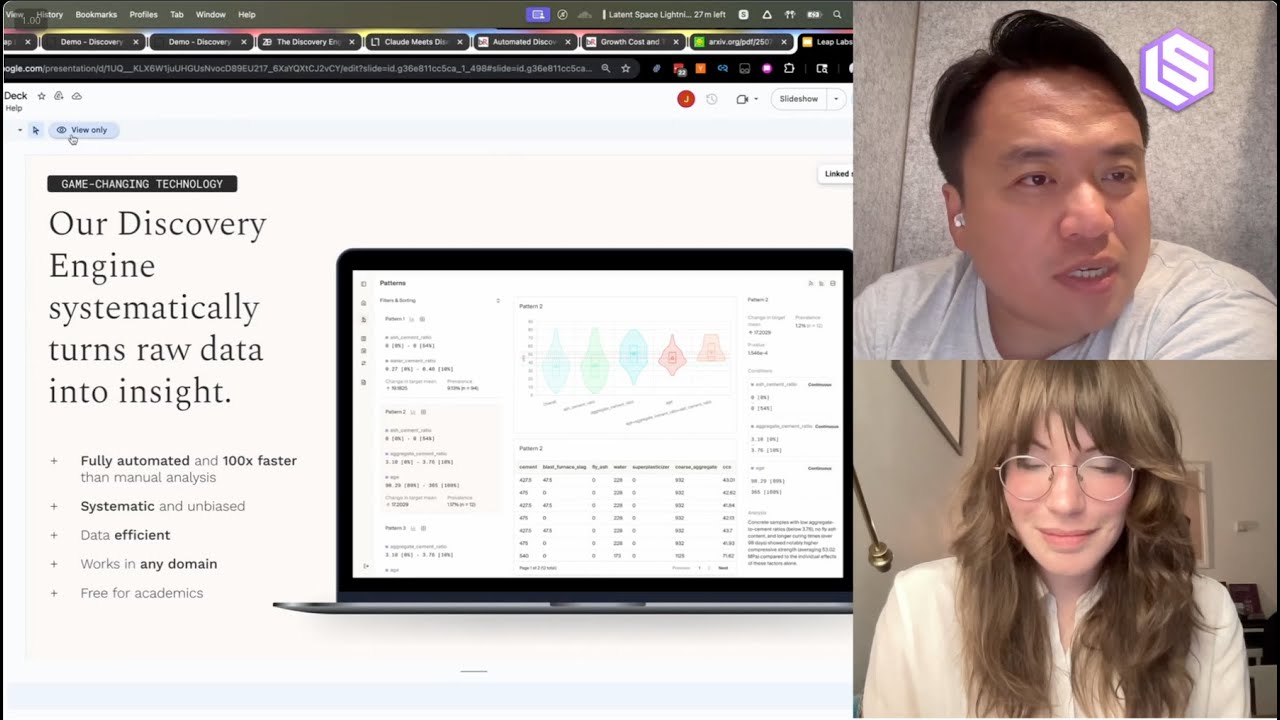
Dr. Rumbelow, speaking with Swyx on the Latent Space podcast, detailed Leap Labs' mission to revolutionize scientific inquiry. Her journey, sparked by an early academic project involving neural networks in histopathology, highlighted a critical realization: while AI could perform complex tasks like identifying immune cells from biopsies with unprecedented accuracy, the underlying mechanisms remained opaque. This opacity underscored the limitations of AI as a black box and ignited her pursuit of interpretable AI, a path that ultimately led to the creation of Leap Labs' Discovery Engine.
The prevailing paradigm in scientific research often relies on human intuition, hypothesis-driven exploration, and manual data analysis. This approach, while foundational, is inherently limited by cognitive biases, the sheer volume of data, and the laborious nature of traditional methods. Researchers spend weeks or months wrestling with spreadsheets, often accessing only a fraction of the potential discoveries hidden within their datasets. More concerning still, many findings struggle with reproducibility, a persistent challenge in various fields.
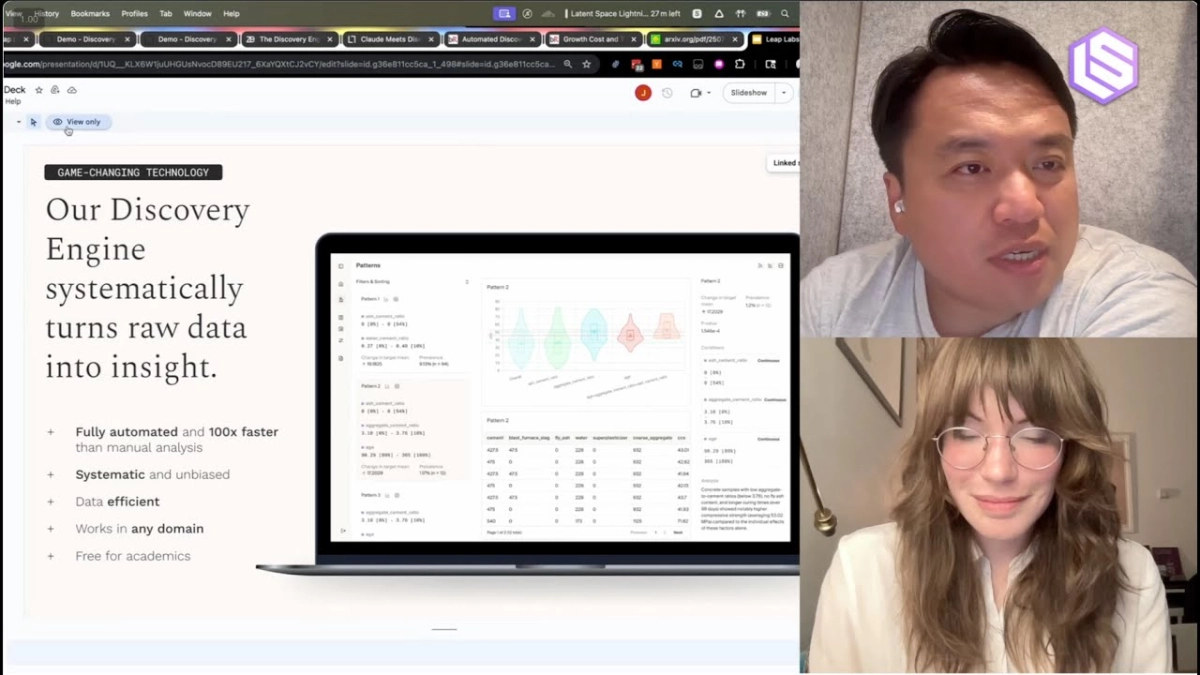
Leap Labs' Discovery Engine offers a systematic and unbiased alternative. It operates as an end-to-end system, designed to ingest arbitrary scientific datasets. From there, it automatically trains a battery of neural networks, then leverages proprietary interpretability methods to systematically extract hidden patterns. These patterns are then contextualized against existing scientific literature, ranked by novelty and prevalence, and presented in a human-parsable format. This process fundamentally transforms AI from a tool that automates known tasks into a genuine partner in uncovering new scientific principles.
The implications of such a system are vast, extending across diverse scientific disciplines. Dr. Rumbelow shared compelling examples of its early successes. In immunology, the Discovery Engine identified novel markers associated with T-cell receptor reactivity to tumors, insights previously unknown to human experts. These findings hold significant promise for advancing personalized immunotherapies.
In plant biology, Leap Labs collaborated with a researcher studying root structure optimization for drought and flood resistance. Despite the biologist's prior extensive manual analysis, the Discovery Engine uncovered novel factors influencing root architecture, critical for developing robust crops in challenging environments. This capability is paramount for global food security.
Perhaps most strikingly, in meteorology, the Discovery Engine challenged a long-held foundational assumption in surface layer theory (MOST), a model underpinning critical climate and weather predictions. The AI discovered that the MOST assumption of constant fluxes in the atmospheric surface layer does not hold true in approximately 20% of coastal environments. This single insight has the potential to improve meteorological modeling by a margin valued in the billions of dollars, impacting everything from offshore wind farm placement to hurricane path prediction. Such foundational challenges are precisely where AI can offer transformative value, pushing the boundaries of human-led inquiry.
Related Reading
- Python SDK and AI Agents Redefine Data Pipeline Automation
- Anthropic's Latest: Claude Code on the Web and Haiku 4.5 Reshape Developer Workflows
The distinction between AI as an automation tool and AI as a discovery tool is crucial. Current large language models (LLMs), while powerful in language synthesis and reasoning, are fundamentally ill-suited for arbitrary, large-scale numerical scientific datasets. As Dr. Rumbelow explained, LLMs are models of language, not inherently designed for scientific data analysis. Their hypothesis-driven nature, coupled with a tendency to "hallucinate" or overgeneralize, limits their utility for true scientific discovery without specialized tools. Giving LLMs access to data-driven discovery tools like Leap Labs' engine, however, represents a significant step change in their ability to contribute to frontier science, allowing them to leverage their synthesizing capabilities with robust, data-backed insights.
The Discovery Engine accelerates the scientific process by approximately 100 times compared to manual analysis. It shifts the burden from months of iterative, hypothesis-driven exploration to hours of systematic, unbiased pattern extraction. Leap Labs is now offering industry pilots and plans for a free, self-serve web platform for academics, fostering a new era of collaborative, AI-augmented scientific discovery. This marks a pivotal moment for science, promising to reveal the hidden truths within vast datasets and accelerate the pace of human knowledge.

