Eric Schmidt, a titan of the technology world, asserts that artificial intelligence marks "the beginning of a new epoch." This profound claim, made during his compelling interview with Henri Delahaye at the RAISE Summit, sets the stage for a discussion on the rapid, transformative, and potentially unsettling future of AI.
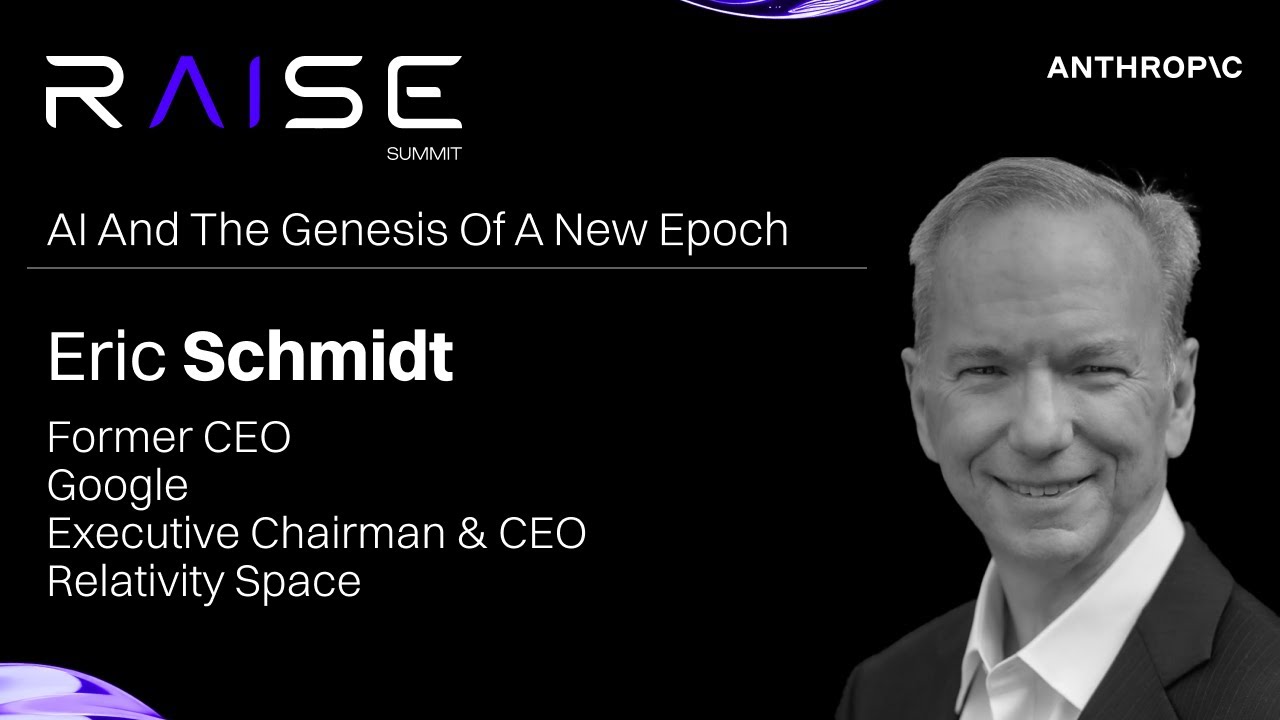
Dr. Eric Schmidt, Executive Chairman & CEO of Relativity Space and former Google CEO, joined Henri Delahaye, Co-Founder of RAISE Summit, for a closing session on Day 1, titled "AI and the Genesis of a New Epoch." The conversation drew heavily from Schmidt's book co-authored with the late Henry Kissinger and Greg Allen, *The Age of AI: And Our Human Future*.
Schmidt posits that humanity is experiencing a shift akin to the Enlightenment, where humans learned to rely on reasoning rather than direct faith. Now, a new "non-human intelligence" is arriving, one "likely to have better reasoning skills than humans can have," leading to what is generally termed Artificial General Intelligence (AGI) and eventually superintelligence. This progression, he warns, will unfold "really, really fast," and people are fundamentally "not prepared for it."
A central concept discussed is the "San Francisco Consensus," a prevailing belief among leading AI developers in the Bay Area. This consensus, though not necessarily an absolute truth, holds that within two to four years (an average of three), the entire world will undergo a radical transformation due to AI. This imminent shift stems from two intertwined revolutions: the agentic revolution, where AI gains memory and can execute tasks through planning, and the reasoning revolution, where AI systems demonstrate advanced problem-solving capabilities.
Schmidt elaborates on the concept of "recursive self-improvement," a critical juncture where an AI system begins to learn and enhance itself at a rate incomprehensible to humans. "The consensus is that this marches forward and that there's a moment when what is called recursive self-improvement, the system begins to learn on itself where it goes forward at a rate that is impossible for us to understand." This capability signals that when superintelligence arrives, it will happen "at a big scale."