

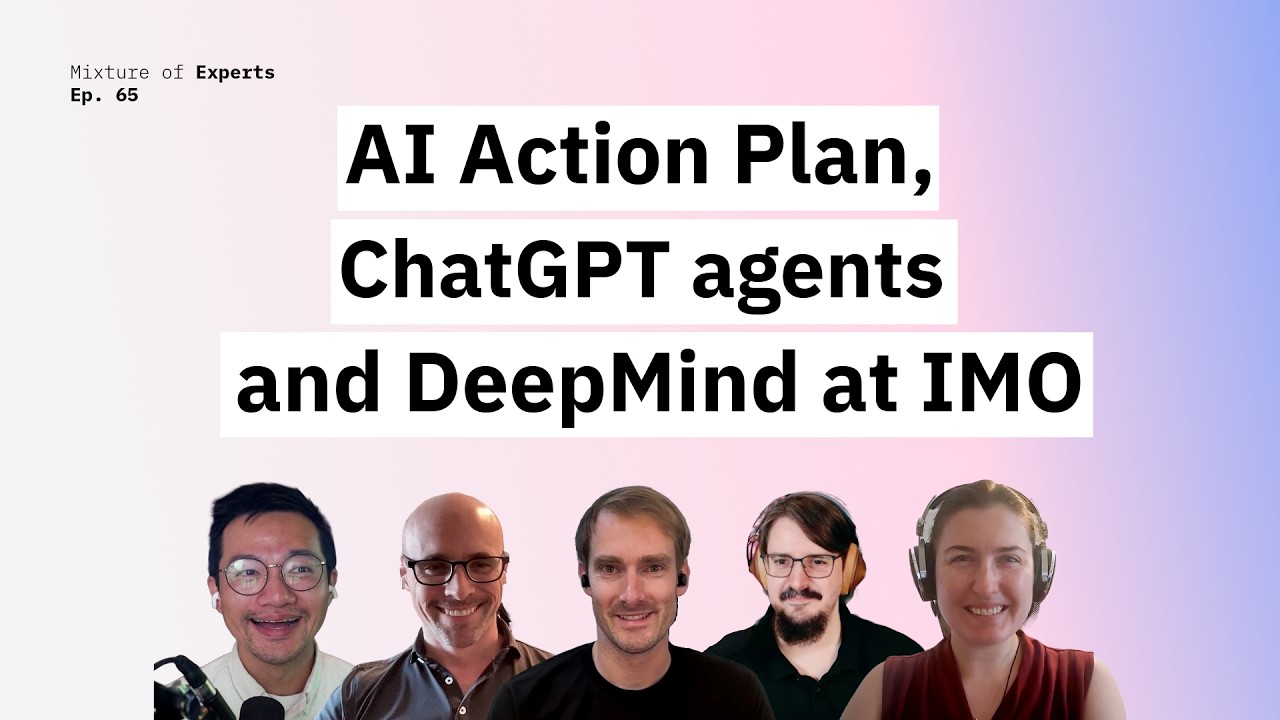
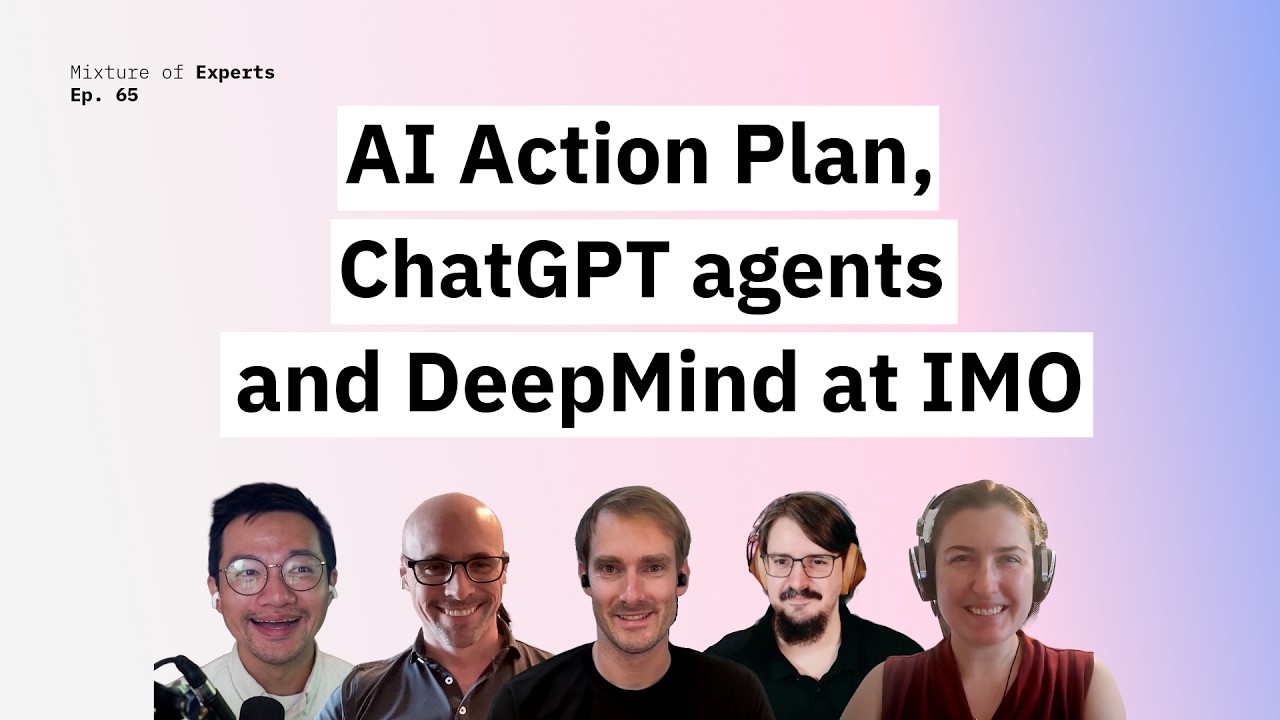
In a recent episode of Mixture of Experts, host Tim Hwang convened a panel of AI thought leaders, Kate Soule, Director of Technical Product Management at Granite; Gabe Goodhart, Chief Architect, AI Open Innovation; and Mihai Criveti, Distinguished Engineer at Agentic AI, to dissect pivotal advancements and policy shifts in the artificial intelligence landscape. Later, Ryan Hagemann, Global AI Policy Issue Lead, joined to analyze the White House's new AI Action Plan. The discussion illuminated the evolving capabilities of AI, from excelling in complex mathematical challenges to enabling autonomous agents, while also scrutinizing the practical implications and underlying infrastructure.
A central theme of the discussion revolved around Google DeepMind's Gemini Deep Think achieving a gold standard performance at the International Math Olympiad (IMO), comparable to the top 8-10% of high school mathematicians. While this feat signifies a remarkable technical leap in AI's reasoning capabilities, the panel debated its immediate real-world impact. Gabe Goodhart acknowledged it as a "really cool piece of technology change," emphasizing the depth of logic and techniques employed in this well-defined mathematical ecosystem. Kate Soule, however, cautioned that despite its similarity to the "AlphaGo moment" in cracking a new benchmark, it's unlikely to have "tremendous real-world tangible impact in the next couple of years." Mihai Criveti highlighted that the success showcases advanced agentic techniques like computer use and building calculators, underscoring a shift towards more sophisticated problem-solving approaches beyond mere large language model training.
The conversation naturally transitioned to the recent release of ChatGPT agents by OpenAI, a development that promises more autonomous AI interaction. Mihai Criveti clarified that the underlying agentic principles and tool utilization were not entirely novel, but the current iteration brings increased tool availability, customizability, and robust tooling support. He noted that the market is clearly "pushing towards agentic" systems. A key insight from Kate Soule was the focus on "asynchronous workflow enablement," allowing users to "start a task and then close your laptop. Walk away, the agent's going to run, do different things for you." This capability represents a significant leap in user experience.
However, the path to widespread enterprise adoption for these agents is fraught with challenges. Kate Soule expressed skepticism, citing security concerns and the need to "flush out all the bugs" before widespread deployment. Mihai Criveti’s own project, MCP Gateway, directly addresses these concerns. It's an open-source initiative providing critical infrastructure for AI agents, including observability, guardrails, monitoring, security, authentication, and authorization. The project aims to manage the inherent "messiness" and "chaos" of diverse agent implementations, offering a standardized way to control agent interactions with tools and resources. This infrastructure is crucial for building trust and enabling scalable, secure agent deployments.
Finally, the panel touched upon the White House's new AI Action Plan. Ryan Hagemann outlined its three pillars: accelerating AI innovation, building out American AI infrastructure, and leading international AI diplomacy and security. A significant takeaway for IBM and the industry was the plan's explicit endorsement of "open source and open-weight model development and deployment." This marks a positive shift in policy, moving from a neutral stance to actively supporting open AI development. While the immediate legislative action might be slow, this policy framework sets a clear direction for future administrative and congressional engagement with AI, prioritizing transparency and collaborative development in the burgeoning AI landscape.