

“Don't bet against AI,” advises Jeff Crume, a Distinguished Engineer at IBM, setting a compelling tone for his exploration of artificial intelligence's remarkable trajectory and its persistent boundaries. Crume’s presentation, delivered as part of an IBM Tech series, meticulously unpacks the evolution of AI, categorizing its capabilities through a hierarchy of knowledge and illuminating the milestones already achieved, while candidly addressing the formidable challenges that remain.
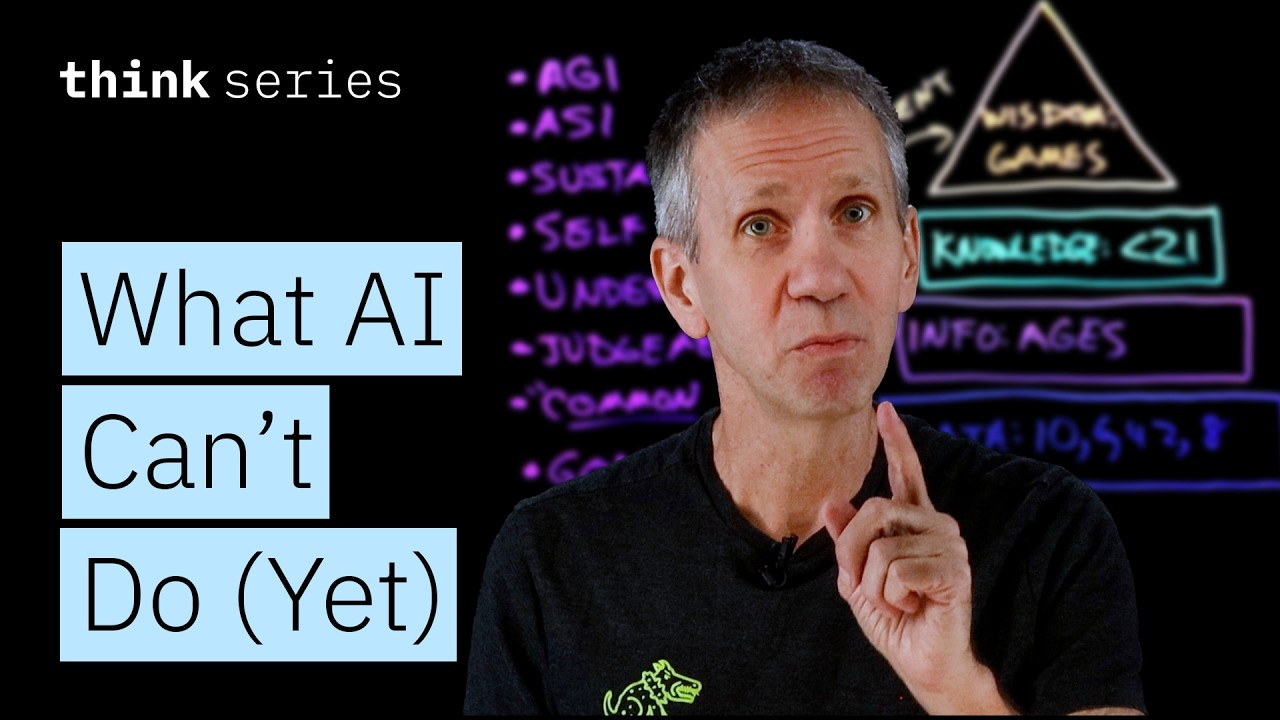
Crume initiates his discourse by illustrating the progression from raw data to wisdom, a foundational concept for understanding AI’s cognitive journey. Data, he explains, is merely raw facts, such as a sequence of numbers like "10, 6, 42, 8." Adding context transforms this into information, for instance, realizing these numbers represent the ages of people in a room. Further interpretation of this information, noting that most individuals are under 21, yields knowledge. The pinnacle, wisdom, emerges when this knowledge is applied with judgment, leading to decisions like planning age-appropriate games for the group. This layered understanding highlights where traditional IT primarily handles data and information, while AI begins to operate at the knowledge level, striving towards wisdom.
The rapid acceleration of AI has consistently defied once-firm predictions about its limitations, a central insight Crume underscores. Many capabilities once deemed exclusive to human intellect have now been mastered by machines. Take reasoning and complex problem-solving: in 1997, IBM's Deep Blue famously defeated chess grandmaster Garry Kasparov, a feat of strategic reasoning thought impossible for computers. Similarly, natural language processing (NLP), with its inherent nuances, idioms, and figurative speech, was considered a significant hurdle. Early chatbots like Eliza (1965) offered rudimentary conversational abilities, but it was IBM Watson's victory on Jeopardy! in 2011 that demonstrated a profound leap in understanding human language's complexities. Modern generative AI models further exemplify this, displaying an astonishing capacity to comprehend and respond to intricate prompts.
Creativity, another bastion of human exceptionalism, has also fallen within AI's grasp. Generative AI now composes music, paints art, and writes prose that can be indistinguishable from human creations. Crume argues persuasively that human creativity itself is often a synthesis of influences and existing knowledge; thus, AI's ability to generate novel works, even if informed by vast datasets, should be considered genuinely creative. Real-time perception and autonomous action, once the realm of science fiction, are now commonplace with robots and self-driving cars continuously processing environmental data and making split-second decisions.
However, despite these profound advancements, AI still confronts several significant, largely unresolved limitations. Emotional intelligence (EQ), for instance, remains elusive. While AI can simulate understanding human moods and expressions, whether it genuinely *feels* or comprehends the depth of human emotion is a philosophical rather than a purely technical question. Another critical challenge is the phenomenon of "hallucinations" in generative AI, where models confidently assert false information. While techniques like Retrieval Augmented Generation (RAG) and Mixture of Experts (MoE) are being developed to ground AI responses in factual data, mitigating hallucinations remains a difficult, ongoing problem.