

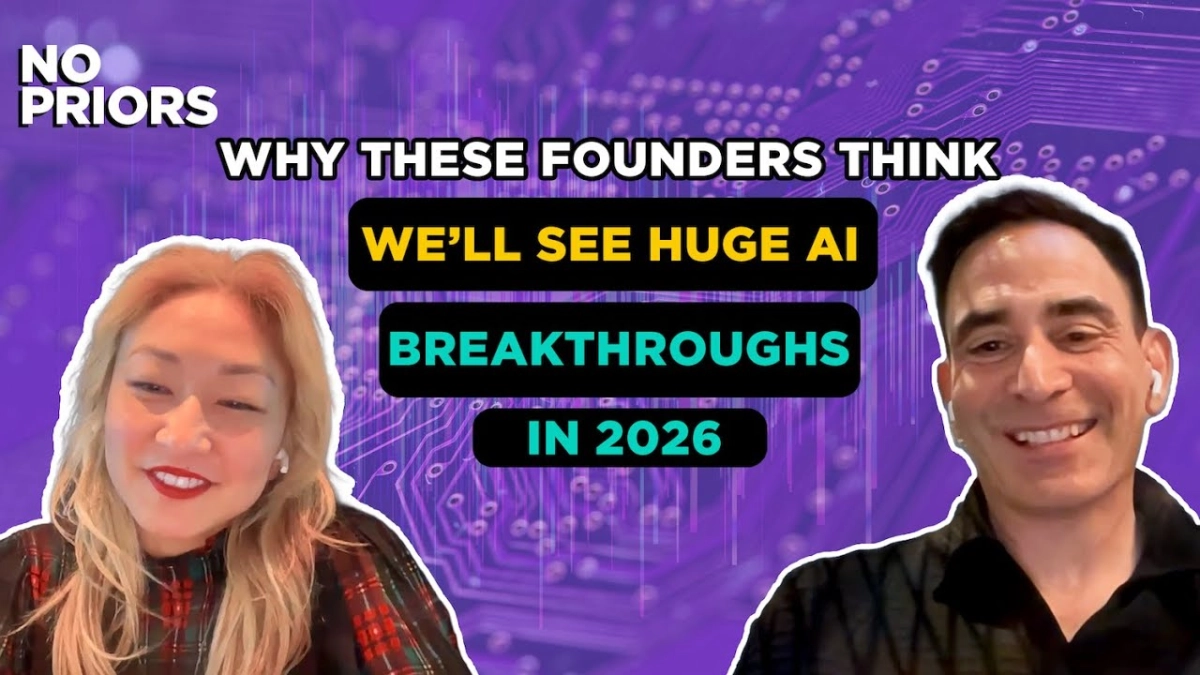
The year 2025 has already proven to be a pivotal period for artificial intelligence, marked by significant leaps and profound discussions on its implications. In the "No Priors" episode titled "The Best of 2025 (So Far)," hosts Sarah Guo and Elad Gil curate a series of illuminating excerpts from their conversations with leading founders and scientific minds, painting a comprehensive picture of AI's current trajectory and future challenges. These dialogues, featuring visionaries from Harvey, OpenAI, World Labs, Mercor, the Center for AI Safety, Flagship Pioneering, Gleen, and Abridge, collectively highlight AI's burgeoning capabilities, its societal disruption, and its potential to redefine human endeavor.

One of the most compelling narratives emerging from these discussions is AI's capacity to unlock immense value in unexpected domains. Winston Weinberg, CEO of Harvey, recounts his "aha moment" with GPT-3. He was "incredibly surprised that no one was talking about GPT-3 and no one was using it in any way, shape or form," despite its public availability. By applying the model to landlord-tenant legal questions, Weinberg discovered that it produced answers deemed acceptable by attorneys 86% of the time without edits, a finding that quickly captured the attention of OpenAI’s General Counsel. This demonstrates how identifying novel applications for powerful AI models can yield extraordinary value in domains previously thought impenetrable.
The conversation extends to the very nature of intelligence itself. Dr. Fei-Fei Li, a luminary in AI, emphasizes spatial intelligence as a profoundly complex problem that evolution has grappled with for eons. Animals, including humans, must process light, reconstruct a 3D world in their minds, and navigate it effectively. She illustrates the difficulty by asking one to close their eyes and build a 3D model of their surroundings, highlighting that even for humans, this is not a fully solved problem. AI's advancement in this area promises a new dimension of capability, allowing for more fluid interactivity and editability in digital and physical spaces, fundamentally altering how we perceive and manipulate our environment.
However, the rapid ascent of AI also brings forth significant societal challenges. Brendan Foody, CEO of Mercor, offers a stark prediction regarding the workforce. He believes that "displacement in a lot of roles is going to happen very quickly, and it's going to be very painful, and a large political problem."
The economic and social ramifications of such displacement are undeniable, leading to questions about wealth redistribution and the nature of future work. Dan Hendrycks, Director of the Center for AI Safety, draws a parallel to nuclear strategy, where mutual vulnerability deterred aggression. He cautions that as AI becomes more salient and pivotal to national futures, states might attempt to leverage it as a "super weapon," leading to a destabilizing arms race. This geopolitical tightrope demands careful navigation and international frameworks to prevent catastrophic outcomes.

Beyond the challenges, AI is poised to transform the very process of innovation. Noubar Afeyan, founder and CEO of Flagship Pioneering (and co-founder of Moderna), argues for making entrepreneurship a scientific discipline rather than a random, improvisational pursuit. He questions, "Why isn't entrepreneurship a profession? And if it was going to be a profession, how could it be a profession?" Afeyan believes AI can provide the systematic rigor needed to tackle "damn near impossible" problems in critical areas like healthcare and climate, turning them into valuable, practical solutions. This shift towards scientific entrepreneurship promises to de-risk venture creation and accelerate progress on grand challenges.
The architectural underpinnings of this transformation are also evolving rapidly. Brandon McKinzie and Eric Mitchell from OpenAI discuss reasoning models as the biggest paradigm shift in AI since the transformer. They highlight models' ability to estimate their own uncertainty, indicating when they "can't really see the thing you're talking about very well." Crucially, when these models are given access to tools, their productivity skyrockets. This allows for a more efficient allocation of computational resources, deferring tasks where the model lacks a comparative advantage to specialized tools, thereby optimizing performance and resource use.
The journey of AI development is often marked by moments of profound realization, even when success is anticipated. Isa Fulford from OpenAI describes the "visceral experience" of seeing a model trained on browsing tasks actually work, despite prior conviction. These moments, rooted in taste, data generation, and diligent effort, underscore that breakthroughs aren't always grand theoretical leaps but often the tangible manifestation of persistent work. Yet, the models still surprise with unexpected mistakes, revealing the continuous need for refinement and deeper understanding.
AI is also disrupting seemingly stagnant markets, turning "graveyards" into fertile ground for innovation. Arvind Jain, founder of Gleen, recounts building an enterprise search solution in a market notorious for failures. He explains that the fundamental problem in the pre-SaaS era was the inability to access and connect disparate data within an enterprise. SaaS solved this by centralizing data and providing open APIs, which was "a big unlock." This allowed Gleen to build a turnkey product for the first time, addressing the explosion of content within businesses and providing scalable search capabilities that were impossible in the pre-cloud era.
Related Reading
- No Dark GPUs: Why AI Isn't a Bubble, But an Existential Race
- Andrew Yang on AI's Economic Storm and Shifting Political Tides
- AI's Economic Churn: Layoffs, Trillion-Dollar Valuations, and the Shifting Labor Landscape
Ultimately, the most resonant aspect of AI's current revolution is its human impact. Dr. Shiv Rao, CEO and founder of Abridge, shares a poignant anecdote about a doctor using Abridge who, thanks to the technology, could leave work early to have dinner with her family. Her son, witnessing this change, remarked, "Mommy's going to be able to eat dinner with us every night now." Rao emphasizes that while the "dopamine hits" of hypergrowth are motivating, it's the "oxytocin hits" of purpose and fulfillment derived from such profound human impact that truly drive the mission. This immediate understanding of AI's benefit provides a powerful reminder of why innovation matters.
These diverse conversations collectively portray AI not merely as a technological advancement but as a fundamental force reshaping our world. From revolutionizing industries and challenging geopolitical norms to redefining work and enhancing human lives, AI stands at a critical juncture. It is a hinge moment in history, compelling us to embrace its capabilities while thoughtfully navigating its complexities, always anchoring its development in meaningful purpose.


