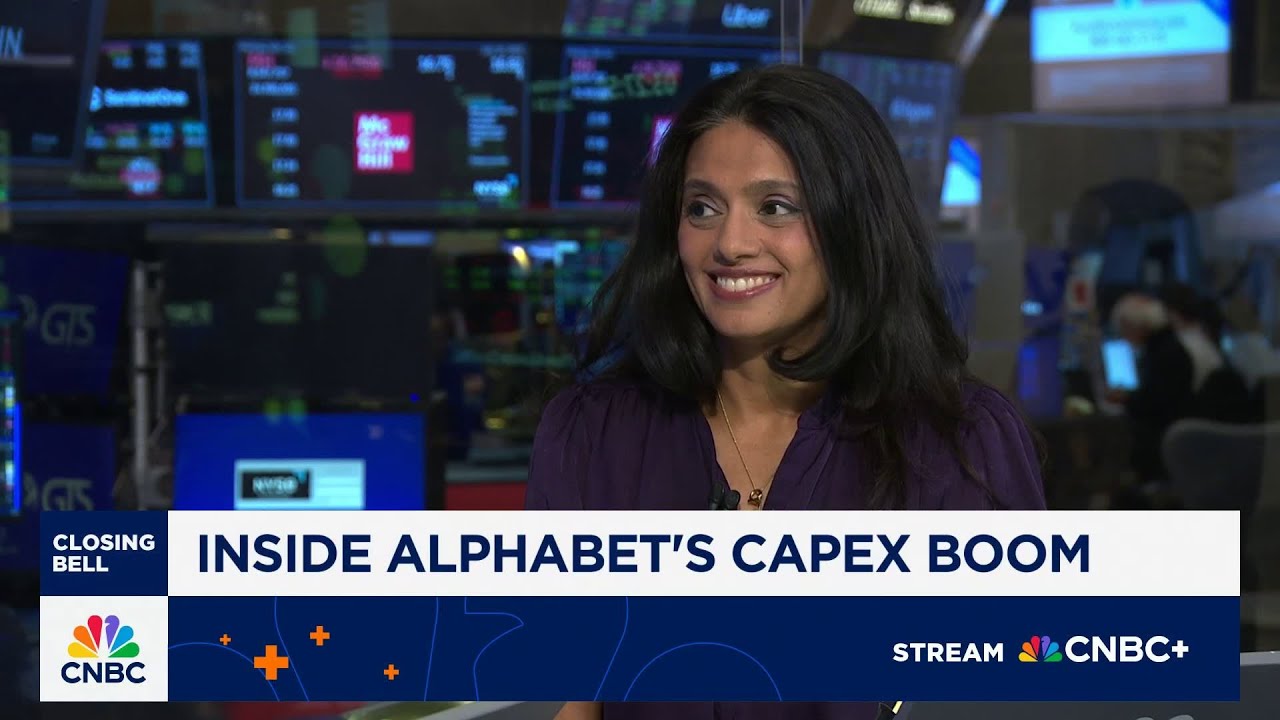
The conventional wisdom that Google had fallen behind in the AI race is being rapidly rewritten, according to Alger EVP and Portfolio Manager Ankur Crawford. During a recent appearance on CNBC's 'Closing Bell,' Crawford spoke with Scott Wapner about her firm's decision to significantly increase its position in Alphabet, discussing the tech giant's latest earnings, the perceived threats to its search dominance, and the broader implications of accelerating AI adoption.
Crawford noted that Alphabet's recent quarter exceeded expectations, with strong performance across search, YouTube, and Google Cloud Platform (GCP). Crucially, she highlighted that increased capital expenditure (CapEx) was for the "right reason" – to meet surging demand and add capacity for their burgeoning AI infrastructure. This investment underscores a strategic pivot, challenging the narrative that had prematurely dismissed Google as an AI laggard.

Indeed, Crawford asserted, "Everyone had written them off as an AI loser." However, she quickly countered this, stating that in the fast-paced world of AI, "companies have the ability to leapfrog and come back in the game, especially a company like Google." She pointed to Gemini 2.5 as a leading model and praised AI Overviews as an "incredibly convenient onboarding" for the average Google user, seamlessly integrating advanced AI capabilities into their daily search experience. This integration is vital, as it allows Google to leverage its massive existing user base without forcing them onto new, unfamiliar platforms like Perplexity or ChatGPT.
While acknowledging that search remains an "existential question" for Google, Crawford believes the company is actively proving its ability to "cross this chasm" and defend its core business against emerging AI competitors. The market’s initial overreaction, which she termed the "Eddie Cue sell-off" after a perceived misstep regarding Google search numbers, was largely overdone. Google's strategic investments and rapid product development are closing the perceived gap.
The broader implications for the AI ecosystem are equally profound. Crawford emphasized the sheer exponential growth in AI usage, offering a compelling personal anecdote: her own ChatGPT usage saw a "30-fold increase in the last 8 months." This personal observation scales across industries. We are, she stressed, still in the "very early stages" of AI adoption among the general population, meaning the demand for compute power and advanced models will only continue to skyrocket.
This burgeoning landscape also presents unique strategic opportunities for other tech giants. When pressed by Wapner about her personal shift in AI tool preference, Crawford revealed she no longer uses Perplexity, having moved on to superior alternatives. She then delivered a striking proposition: "I think Apple should buy OpenAI." This bold suggestion highlights the aggressive M&A appetite and the need for immediate, impactful moves to secure leadership in the fiercely competitive AI arms race. Such an acquisition would instantly propel Apple to the forefront of generative AI, marrying OpenAI's cutting-edge models with Apple's vast hardware ecosystem and user base, potentially reshaping the entire industry.