


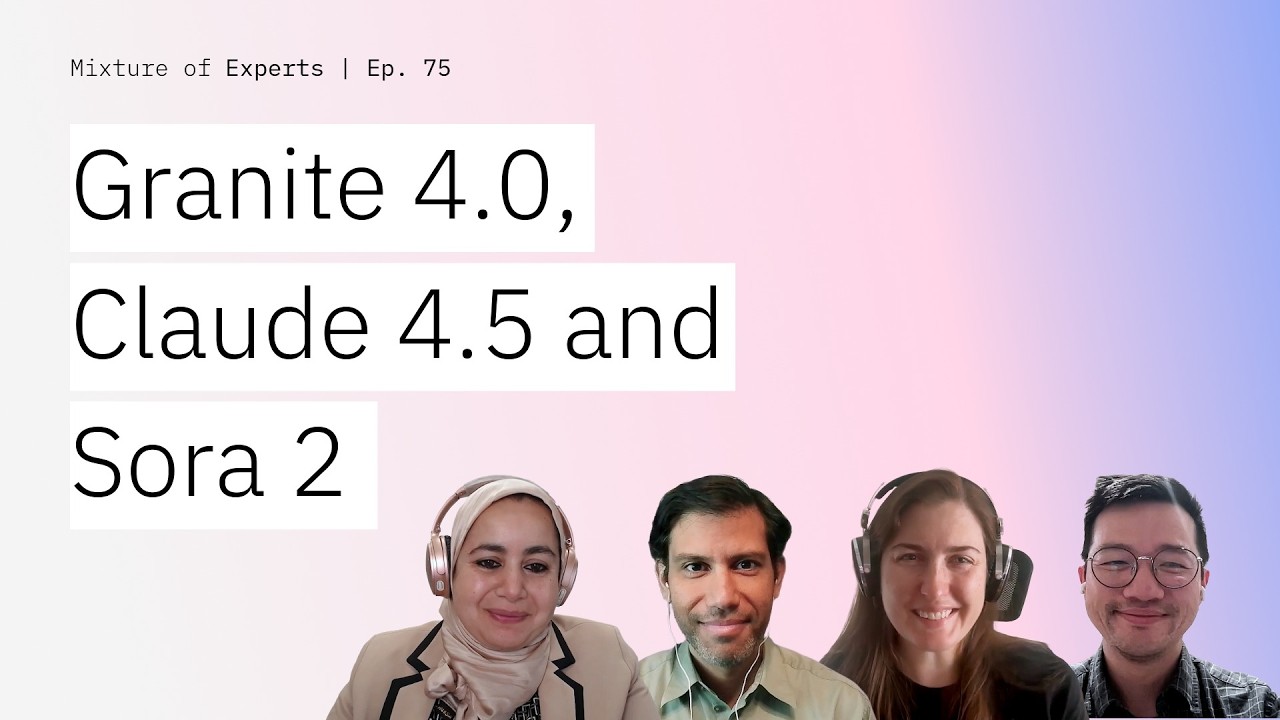
The latest "Mixture of Experts" podcast episode, hosted by Tim Hwang, illuminated a pivotal moment in artificial intelligence development, showcasing a divergence in strategic approaches among leading tech entities. Joined by IBM's Kaoutar El Maghraoui, Kate Soule, and Kush Varshney, the discussion dissected recent model releases, IBM Granite 4.0, Claude Sonnet 4.5, and Sora 2, revealing a landscape increasingly defined by both hyper-efficiency and immersive user experiences. This week’s insights offered a crucial lens for founders, VCs, and AI professionals navigating the rapidly evolving ecosystem.
A core insight emerging from the panel was the strategic pivot towards smaller, more efficient models, exemplified by IBM's Granite 4.0. Kate Soule, Director of Technical Product Management for Granite, highlighted this shift, stating, "The models feature a range of very efficient smaller language models. So they're really designed for developers to pick them up, play with them, deploy them, as well as for enterprise customers that are looking for models and options for LLMs that don't require eight A100s to host." This emphasis on reduced computational footprint allows for broader accessibility and lower operational costs, a significant advantage for enterprises. The smallest Granite 4.0 model, requiring only 4 gigabytes, impressively outperforms its larger Granite 3 predecessor, even when handling extensive context lengths.
This pursuit of efficiency is not merely about cost savings; it redefines the very notion of "good" in AI. Kaoutar El Maghraoui articulated this, suggesting, "IBM is fundamentally changing the question from how do we make these models bigger to how do we really make them smarter per compute." This strategic brilliance acknowledges the unsustainable trajectory of ever-larger models, where escalating compute costs and environmental impact become prohibitive. Instead, IBM is focusing on architectural innovations like hybrid efficiency, enabling powerful performance on more accessible hardware, including consumer-grade GPUs.
In parallel to IBM's efficiency drive, other players are specializing their models for distinct applications. Claude Sonnet 4.5, for instance, focuses heavily on coding, offering longer run times and sharper reasoning tailored for software development tasks. Kush Varshney of IBM underscored this trend, noting, "If you don't have a user in mind and you're creating a model, you're creating a system, then you're kind of in a weird position that what is it really good for?" This highlights a growing understanding that a "jack of all trades" approach may dilute impact, making targeted specialization a more viable path to market dominance.
This specialization extends beyond enterprise development to the consumer and creative sectors. OpenAI's Sora 2, for example, is positioned as a "vibe video production" app, emphasizing mobile-first social experiences. Similarly, OpenAI's new "Buy in ChatGPT" feature signals a bold foray into e-commerce, allowing the AI to act as an agent for direct purchases. These developments, as Aili McConnon pointed out in her news brief, raise questions about whether such moves are "clever or creepy," touching on the ethical implications of AI-driven commerce and content creation.