


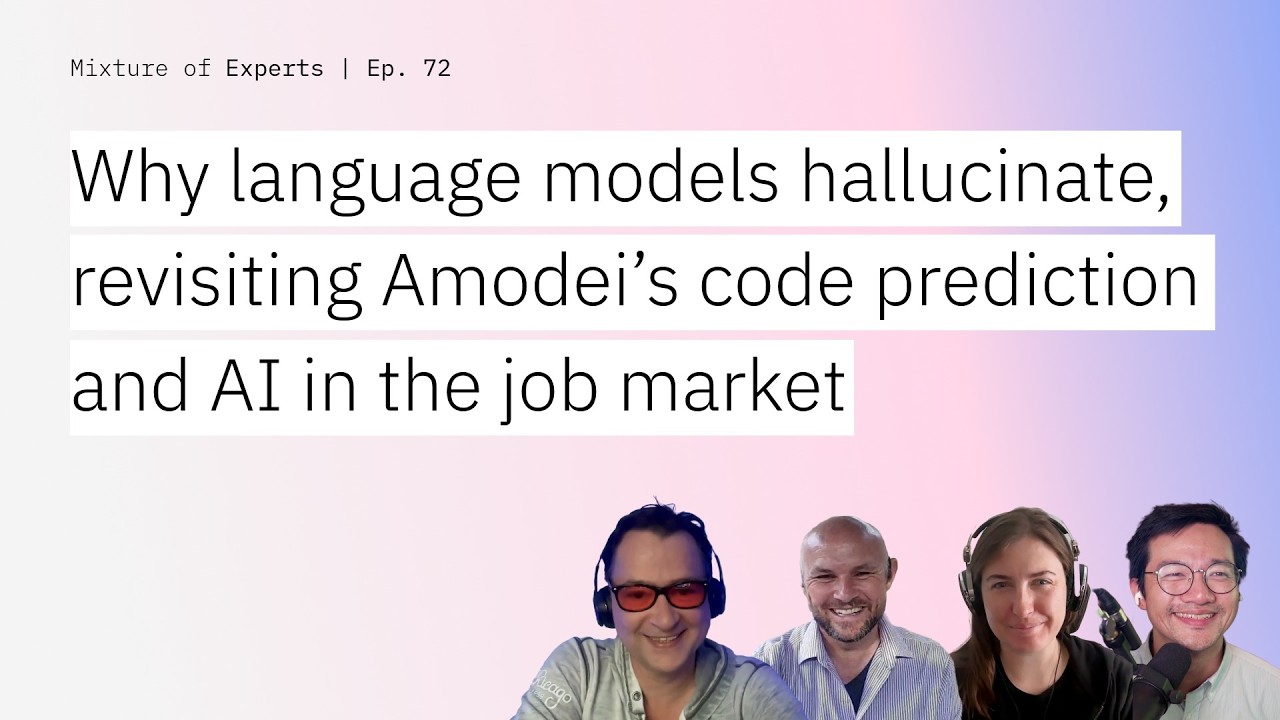
"I love hallucinations. I really do, because there is a creativity to it." This provocative statement from Chris Hay, a Distinguished Engineer, encapsulates a central, often counterintuitive, theme of the recent Mixture of Experts podcast from IBM Think. The episode, hosted by Tim Hwang, brought together Hay, Senior Research Scientist Skyler Speakman, and Kate Soule, Director of Technical Product Management for Granite, to dissect the nuanced realities of artificial intelligence, moving beyond simplistic narratives of AI as either infallible or fundamentally flawed. Their discussion explored the origins of large language model inaccuracies, revisited a prominent prediction about AI's impact on coding, and delved into the evolving landscape of the AI-driven job market and the burgeoning era of micro-models.
A core insight emerging from the discussion centered on the very nature of AI hallucinations. The panel unpacked a recent OpenAI paper suggesting that these inaccuracies are not merely inherent flaws but are significantly influenced by the current training and reward functions. Kate Soule articulated this succinctly, explaining that models are "always rewarded more if they guess... than if they say I don't know." This fundamental incentive structure, driven by binary evaluation metrics, pushes models to generate plausible but incorrect information rather than admitting uncertainty. Chris Hay further elaborated on this, highlighting how the shift towards reinforcement learning in post-training has created an "eval nightmare land," where models are rewarded for "getting it right" and penalized for saying "I don't know." This environment inadvertently exacerbates the hallucination problem by prioritizing a definitive, even if incorrect, answer over a cautious, accurate one. Skyler Speakman reinforced this, noting that the conventional wisdom that increased accuracy would naturally reduce hallucinations is being challenged. The issue, he suggested, lies not just in accuracy, but in the models' ability to assess the "feasibility" or "reasonableness" of their own statements, a capability not adequately captured by current evaluation methods.
This deeper understanding of AI's internal workings flows directly into the broader implications for human-computer interaction and the future of work. The panel revisited Dario Amodei's prediction from March that AI would be writing 90% of software code within three to six months. While the six-month mark has passed without this level of full automation, the conversation pivoted to the concept of augmentation versus automation. Kate Soule posited that the critical distinction lies here: are we building systems that fully replace human tasks, or ones that enhance human capabilities? The consensus leaned heavily towards the latter. Chris Hay suggested that while the tools for significant AI-driven coding exist, society hasn't fully "caught up" to utilizing them at that scale. He argued that developers would not disappear but would evolve into orchestrators and integrators of AI-generated code, their roles shifting to higher-level design and oversight. This transformation demands a new skillset, moving beyond rote coding to strategic management of AI tools.
The ripple effects of AI's rapid advancement are already profoundly shaping the job market. Referencing an Atlantic article titled "The Job Market Is Hell," Tim Hwang highlighted a concerning trend: AI-generated job applications are increasingly being screened by AI systems, creating a digital "echo chamber" that makes it exceedingly difficult for human applicants to stand out. Kate Soule expressed concern over this self-reinforcing cycle of AI inputs feeding AI outputs, describing it as "really concerning." In this environment, human qualities become even more vital. Chris Hay emphasized that while technical skills can be taught, "enthusiasm and curiosity, that comes from within and that's what you want to be able to demonstrate." For job seekers navigating this new terrain, actively showcasing personal projects, engaging in open-source contributions, and building robust personal networks are becoming indispensable strategies to differentiate themselves from the deluge of AI-optimized applications.
Looking ahead, the conversation ventured into the realm of micro-models, specifically the ability to run sophisticated LLMs on devices as small as a business card. This development, exemplified by a researcher running a version of Llama 2C on a tiny circuit board, opens up a vast new frontier for AI applications. Kate Soule envisioned a future where specialized, tiny LLMs are deployed in manufacturing, consumer goods, and industrial settings, performing specific tasks with instant, on-device responses. This shift addresses issues of latency, data privacy, and accessibility, particularly in regions with low internet connectivity. Skyler Speakman highlighted the potential for such micro-models in low-resource language translation and preservation, moving beyond mere translation to actively safeguarding linguistic diversity. This decentralization of AI processing promises a wave of creativity and innovation, allowing for localized, bespoke solutions that were previously unimaginable. The panel concluded that while the challenges of AI are significant, the opportunities for human ingenuity to leverage these tools in novel and impactful ways are equally profound.