

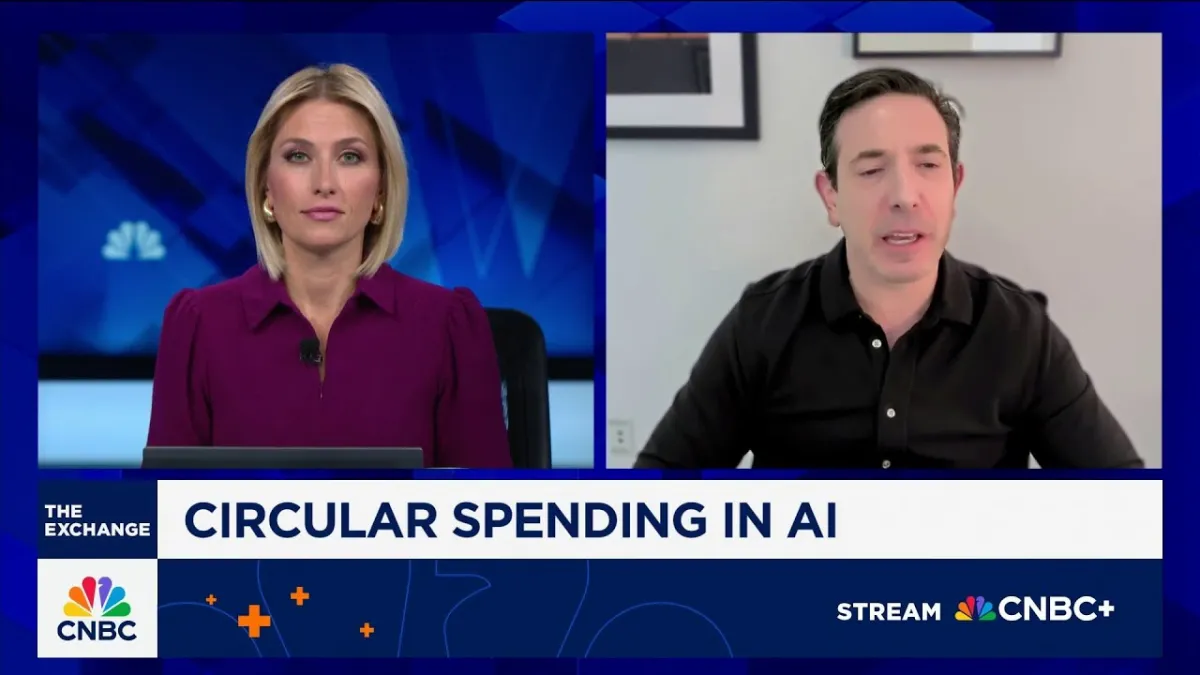
The current AI investment landscape, characterized by a "circular economy" of spending between chip providers, platforms, and major tech companies, is undeniably powerful yet fraught with considerable risk. Bradley Tusk, founder and CEO of Tusk Ventures, engaged with CNBC's 'The Exchange' to dissect this frenetic activity, addressing concerns that the staggering capital outlays could be inflating a dangerous bubble. His commentary offered sharp insights into the necessary, albeit expensive, infrastructure build-out and proposed strategic approaches to de-risk the burgeoning AI sector.
Tusk’s discussion with the CNBC interviewer centered on the unprecedented deal-making frenzy across the AI ecosystem. Meta Platforms' recent multi-billion dollar commitments for AI data centers and computing capacity, including a $14.2 billion deal with CoreWeave, a company that itself rents Nvidia chips, exemplifies the intricate and interconnected web of investments. This circular flow of capital raises questions about the true underlying demand versus speculative momentum. Tusk acknowledges the scale of investment, stating, "I assume that when these companies say, we need to invest $10 billion, $100 billion, $500 billion into infrastructure for AI compute and the energy for it, that they're not just throwing away the money for no reason. They truly believe that for the various plans they have to come to fruition, that amount of compute is necessary, that amount of data centers is necessary."
However, he quickly pivots to the inherent fragility of this concentrated investment. The market is currently driven by "about a dozen companies" making massive investments and taking on "incredible amounts of debt." This concentration of risk is a significant concern. If their projections for AI's rollout prove inaccurate or timelines diverge from expectations, the economic fallout could be substantial. The reliance on a handful of players to bear both the upside and downside of such monumental investments creates a precarious situation for the broader economy.
One core insight Tusk offers for mitigating this risk involves leveraging international partnerships. He suggests that the United States should tap into existing commitments from allied nations, drawing on precedents set by past trade agreements. Countries like the UAE, with its $1.4 trillion commitment, and Japan, with $550 billion, have previously demonstrated a willingness to invest in the U.S. tech ecosystem. Tusk argues, "Why don't we start including them in these deals and start spreading out the risk so it's not all on American companies, all not ultimately on the American economy and American consumers?" This approach would diversify the financial burden and foster a more robust, globally supported AI infrastructure.
Beyond capital, Tusk emphasizes the critical role of policy in shaping the future of AI. He envisions an "axis of good on AI", a coalition of countries that value innovation, investment, and "sensible regulations," steering clear of both China's state-controlled model and the EU's potentially overly prescriptive approach. Such a collaborative framework would not only attract more diverse investment but also establish shared ethical and developmental guidelines, fostering a more stable and responsible global AI landscape. This proactive policy engagement is essential to avoid regulatory fragmentation and ensure that the benefits of AI are broadly distributed.