

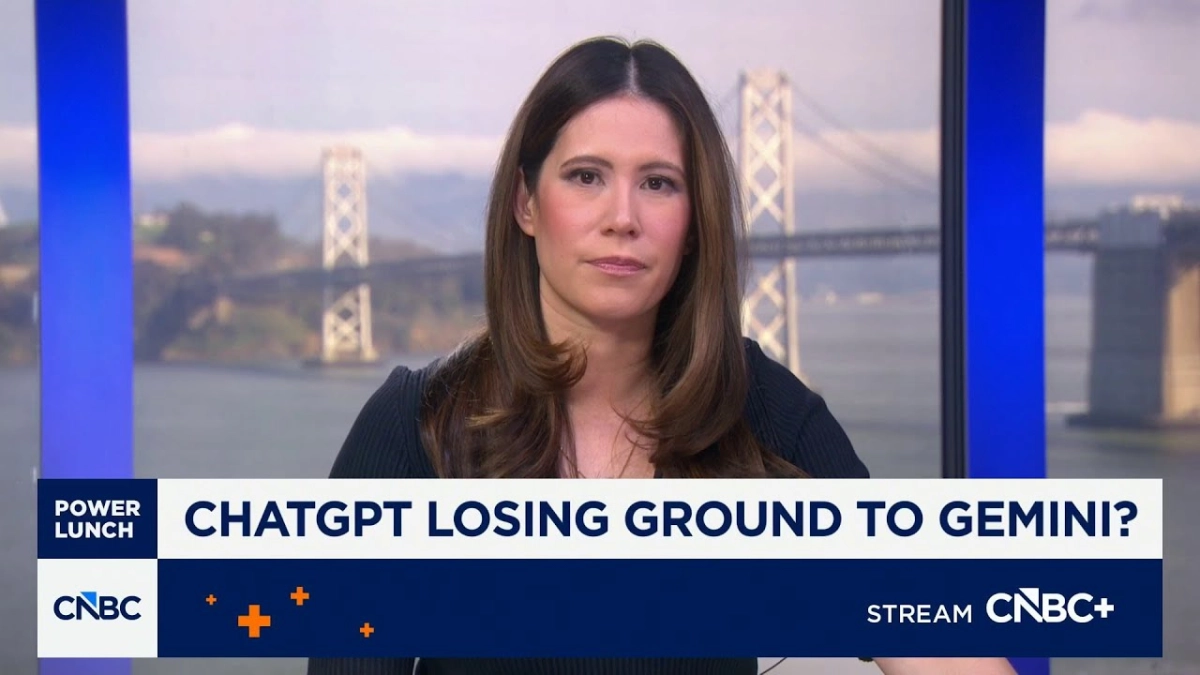
The undisputed lead held by OpenAI’s ChatGPT is facing its first significant statistical challenge, suggesting the generative AI war is shifting from a technological race to a battle for distribution and user retention. CNBC’s Deirdre Bosa, reporting on the competitive landscape, highlighted third-party data indicating that while ChatGPT remains the dominant force, Google’s Gemini is rapidly converting its massive internal distribution into tangible user gains, threatening the market pioneer's momentum.
Bosa spoke with the CNBC anchors, referencing data from Similarweb, about the shifting metrics in the generative AI space, specifically focusing on desktop and mobile visits worldwide for the two leading models. The data reveals a clear inflection point coinciding with Google’s major model release. ChatGPT visits, which had surged 50% throughout 2023, peaked in October and subsequently dropped 11% by December. Conversely, Gemini’s usage started its sharp upward trajectory in November, right around the time the Gemini 3 model was released.
The stark contrast in December growth rates underscores this shift: the percentage gains for Gemini were "nearly 30% versus OpenAI's traffic which decreased about 6%." While the law of large numbers dictates that OpenAI’s sheer size makes its growth look milder, the signal is clear: market momentum is shifting. ChatGPT still holds an enormous base, but the velocity of new user adoption and engagement is increasingly favoring Google. This dynamic suggests that the initial novelty of generative AI is fading, and users are now gravitating toward models integrated into their existing workflows.
The core takeaway, Bosa argued, is not that OpenAI is actively losing market share, but that Google may finally be "converting distribution into usage." This capability is Google’s structural superpower. Unlike OpenAI, which must rely on external growth strategies and partnerships, Google can seamlessly embed Gemini across its ecosystem—Search, Gmail, and Google Docs—instantly activating billions of existing users. This vertical integration, which includes custom AI chips, creates a highly defensible moat and offers a fundamentally different investment proposition compared to the OpenAI/Microsoft alliance.
The strategic conversation around AI is also evolving, moving away from the purely theoretical race toward Artificial General Intelligence (AGI), which Sam Altman frequently emphasized as the ultimate prize. The immediate battleground is product stickiness and enterprise integration. The next battle is less about raw model superiority and more about embedding AI where users already work.
Bosa noted that the internal "Code Red" talks at OpenAI reflect this pivot, emphasizing the need for robust product development to ensure "ChatGPT usage is able to retain its users." This focus is highly strategic, mirroring Google’s inherent strengths in productizing AI across enterprise platforms. The challenge for OpenAI is that Google already possesses a massive, pre-existing distribution advantage that bypasses the need for users to seek out a separate chat interface. This built-in accessibility is proving to be a powerful counterweight to OpenAI’s early lead in capability.
Furthermore, early indicators of engagement suggest that the sticky factor might be moving toward Gemini. Bosa pointed to similar web data indicating that people are actually "spending more time on Gemini." If this trend holds, it validates the idea that seamless integration across daily applications is more valuable than standalone technological prowess. The market is increasingly asking whether technological leadership alone is sufficient to maintain dominance against a competitor that controls the access points to billions of users. The fundamental question now is whether OpenAI can successfully transition from being the pioneer to establishing lasting product loyalty, or if it will ultimately be relegated to a historical footnote.



