

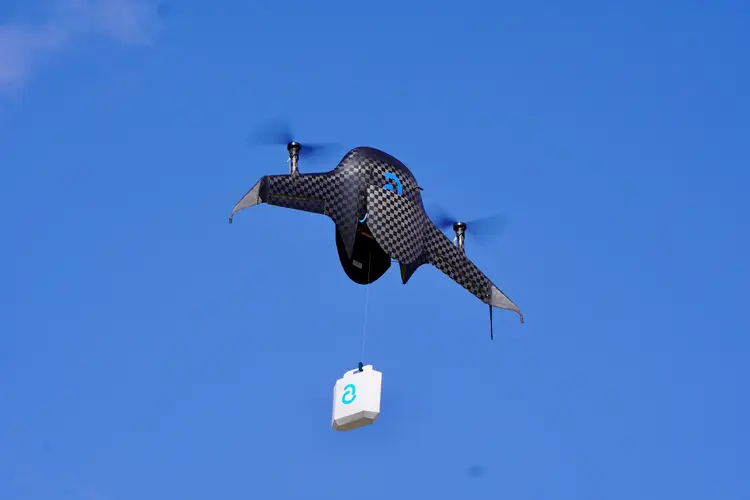
Airbound, an innovative drone technology startup, emerged from stealth with a $1.7 million seed funding round led by Lightspeed.
This capital will support the development of Airbound's highly efficient delivery drone, designed to revolutionize logistics by significantly reducing delivery costs. Leveraging its proprietary blended wing body tailsitter design, named TRT, Airbound aims to cut delivery expenses by two orders of magnitude compared to conventional methods.
Drone delivery has long been hindered by regulatory complexity and high per-mile costs, preventing widespread adoption for last-mile logistics. Airbound’s TRT design addresses these challenges by creating the lightest and most cost-effective delivery drone in the market, bringing delivery costs down to just a few cents per mile.
"We’ve developed not only a leading delivery drone but also a scalable, efficient manufacturing process," said Naman Pushp, Founder and CEO of Airbound. "Every aspect of the drone was scrutinized to reduce weight, enhance safety, and maximize efficiency. We created new carbon fiber manufacturing techniques that reduced the drone's airframe weight from 6 pounds to just 400 grams. Our vision goes beyond building a great drone, we envision a world where delivery is virtually free."
Airbound’s journey began as a high school project for Naman Pushp, who turned down an offer to study at Carnegie Mellon University to pursue his passion for drone technology. Supported by gradCapital, he spent four years perfecting TRT, innovating in carbon composite manufacturing, aerostructure design, and advanced control systems. As a result, Airbound’s drone is three times lighter and four times more aerodynamically efficient than conventional alternatives, drastically reducing both upfront and operating costs.