

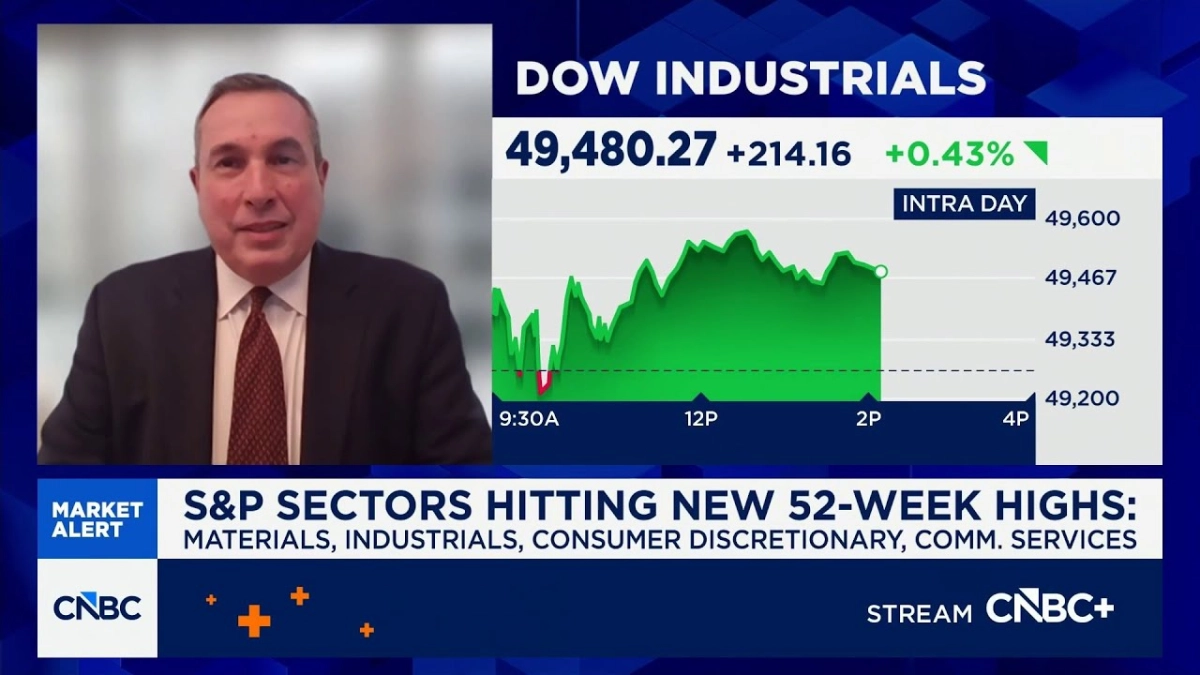
The technological revolution powered by artificial intelligence is not merely sustaining the market; it is poised to drive the S&P 500 to unprecedented heights, potentially reaching 7,750 by 2026. This aggressive forecast, laid out by Julian Emanuel, Senior Managing Director and Head of Equity Derivatives and Quantitative Strategy at Evercore ISI, hinges on the enduring strength and expanding influence of the core AI trade, which he asserts remains the engine of capital market activity.
Emanuel spoke with the CNBC “Power Lunch” team, detailing Evercore ISI’s bullish equity strategy. The conversation centered on the market’s surprisingly robust start to the new year, emphasizing that the momentum generated by technology leaders in 2023 is far from exhausted. While acknowledging that some market participants felt cautious or even frustrated by December’s volatility, Emanuel explained that the underlying trend remains intact: the names and themes that have led the market for the past three years—specifically Communication Services, Consumer Discretionary, and Infotech—are expected to continue their dominance.
The rationale for this continued leadership is straightforward: these sectors are the direct beneficiaries and enablers of the ongoing AI infrastructure buildout. Historically, bull markets are characterized by continuity, not sudden rotation. "The historical tendency is that capital markets are led by the names and themes that got you here in the first place, and we think that’s the AI trade," Emanuel noted, confirming that the initial skepticism surrounding the concentration of market gains has largely dissipated as the fundamental earnings power of these giants materializes.
Emanuel pointed out that recent capital market activity, while vigorous, still has substantial room for expansion relative to overall market capitalization. This suggests that the current valuation spike is not an unsustainable frenzy but rather a necessary recalibration reflecting extraordinary technological shifts and immense corporate investment. The enthusiasm surrounding AI is translating directly into significant capital expenditure (CapEx) commitments from the hyperscalers—the foundational cloud and infrastructure providers—who are constantly acquiring more power capacity and computing resources to meet soaring demand for generative AI models and services. This CapEx cycle feeds directly into the earnings and growth outlooks for the semiconductor and enabling hardware companies.
Looking ahead to the upcoming earnings season, the expectation is that these technology stalwarts will continue to exceed guidance. The high beat rates seen throughout the prior cycle are anticipated to persist, driven by both operational efficiency and the deployment of AI-driven products. "We think when the full year comes around, high single digits is going to be sufficient to drive these names," Emanuel stated, underscoring that even moderate growth rates on massive revenue bases provide compelling momentum. What Evercore ISI is keenly watching, however, is not just the quarterly numbers, but the forward-looking commentary. Specifically, they are monitoring "how the hyperscalers, how the enablers, talk about the future," seeking confirmation that the multi-year runway for AI-related CapEx remains robust and unimpeded. There does not appear to be a peak in the appetite for CapEx yet.
Despite the firm conviction in the AI-led rally, Emanuel outlined key risks that could derail the trajectory toward the 7,750 target. These risks are predominantly macro in nature, centering on the Federal Reserve and the potential for monetary policy missteps. The near-term volatility indicator (the VIX) is trading at relatively low levels, suggesting complacency among investors regarding geopolitical and economic risks.
Emanuel suggests the Fed may be "over-stimulative." This potential for excessive ease, coupled with strong growth, introduces the largest threat to the equity market's momentum.
A significant concern is a material move higher in long-term rates. If the 10-year Treasury yield were to climb toward 4.50% or 4.75%—a move that hasn't occurred yet—it would act as a punitive discount factor, disproportionately harming the valuations of high-growth technology companies whose future cash flows are highly sensitive to interest rate fluctuations. While Evercore ISI currently places only a 30% chance on a true "bubble" scenario—which they define mathematically as the S&P 500 trading at 30 times $300 in earnings, or 9,000—the primary caution remains tethered to the bond market and the possibility of a policy error that pushes long-term borrowing costs sharply higher. For now, however, the AI trade is deemed sufficiently powerful to overcome current consensus hurdles and propel markets to new records.



