
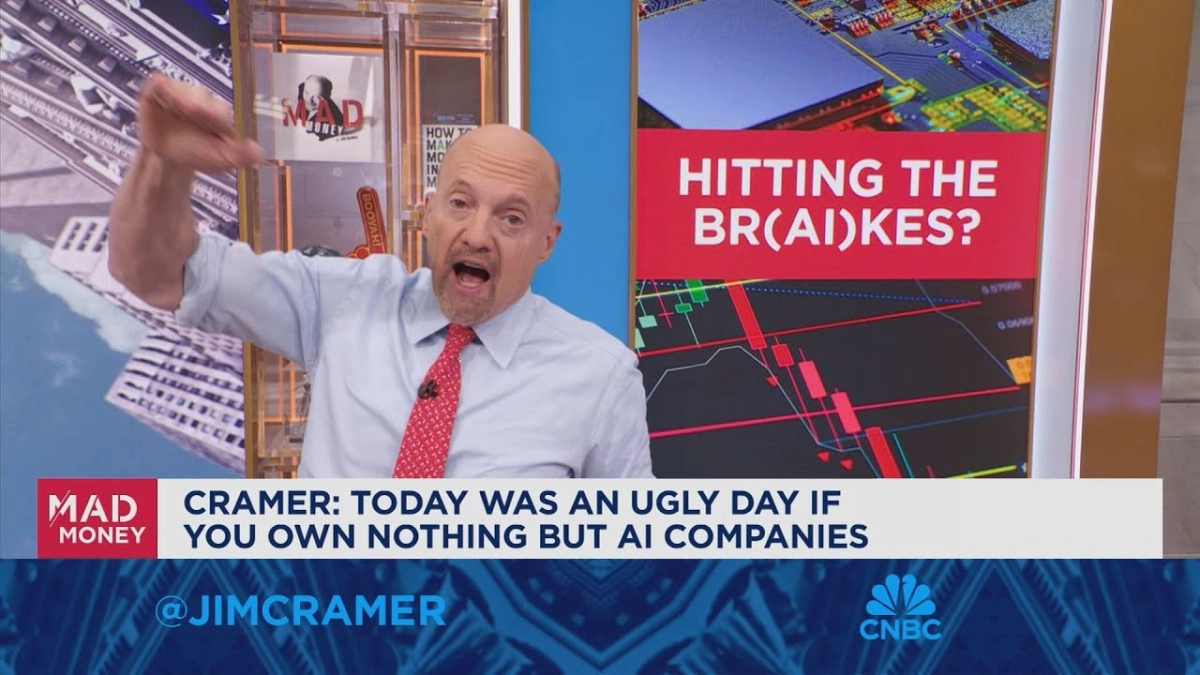
Jim Cramer, host of CNBC's "Mad Money," delivered a stark assessment of the market’s recent performance, declaring it an "ugly day if you own nothing but AI companies." This pointed commentary, delivered on his program, highlighted a significant downturn in the tech-heavy Nasdaq, a stark contrast to a "normal, decent day if you own anything else." Cramer’s analysis, aimed at a broad investor base but resonating deeply with tech insiders, founders, and venture capitalists, underscored a palpable shift in market sentiment away from the previously unbridled enthusiasm for artificial intelligence stocks.
Cramer spoke with his audience on "Mad Money" about the pronounced market downturn affecting AI stocks and the underlying reasons for this sudden shift. He posited that the market was experiencing "the revenge of the plain vanilla companies that got left by the wayside as the high-flying, soaring AI stocks moved into the stratosphere via parabolic." This observation suggests a critical insight for the startup ecosystem: while innovation drives long-term value, market cycles and investor behavior can lead to sharp, often painful, corrections when valuations outpace tangible, immediate returns or when alternative, less speculative investments begin to look more attractive. The parabolic rise of AI stocks, fueled by speculative fervor and a belief in their transformative power, has seemingly reached an inflection point where gravity is reasserting itself.
The numbers presented a grim picture for AI-centric portfolios. The Dow Industrials dipped 245.96 points, a 0.51% decline, while the S&P 500 plunged 73.59 points, or 1.07%. Most significantly, the Nasdaq Composite, heavily weighted with technology and AI companies, shed 398.69 points, a substantial 1.69% drop. This broad-based decline was exemplified by companies like Broadcom, whose stock "collapsed" by 11.43% after what Cramer described as a "good but poorly received quarter." Such a sharp reaction to a seemingly positive earnings report indicates that the market's bar for AI companies has been set incredibly high, demanding not just growth, but extraordinary, almost impossible, levels of performance to justify their elevated valuations.
Cramer did not mince words, stating, "I think we now have a true rout in the AI data center stocks." This pronouncement carries significant weight for founders and VCs operating in the AI infrastructure space. The data center sector, a foundational pillar of the AI revolution, has been a primary beneficiary of the AI boom, with companies like Nvidia seeing unprecedented demand for their high-performance GPUs. A "rout" in this core segment signals that investors are scrutinizing the sustainability of this demand and the capital expenditure required to meet it. The market is beginning to differentiate between genuine, sustainable growth and speculative bubbles, forcing a re-evaluation of investment theses across the AI value chain.
The abruptness of the rotation is striking. Investors are moving from red-hot sectors into "cold ones like the foods or the drugs," where even the "worst food stock outperforms the best AI play." This capital reallocation underscores a shift towards more defensive, value-oriented investments, a stark reminder that market sentiment can pivot swiftly and decisively. For founders, this means a potentially tighter funding environment and increased pressure to demonstrate clear paths to profitability and robust unit economics, rather than solely focusing on user growth or technological breakthroughs.
Despite the immediate market pain, Cramer maintained a long-term bullish stance on the underlying technology. "No matter what, I still believe in AI as the Fourth Industrial Revolution," he affirmed. This conviction is a crucial insight for the AI community. While the financial markets may experience volatility and corrections, the fundamental belief in AI's transformative potential for industries, economies, and society at large remains strong among thought leaders. This dichotomy between short-term market fluctuations and long-term technological vision is a constant challenge for those building and funding AI ventures. The current market action, while unsettling, does not negate the profound impact AI is poised to have.
His advice for investors holding AI stocks, particularly those in the spotlight like Nvidia, remained consistent: "own it, don't trade it." He reiterated that he is "not changing my tune," suggesting that for those with a long-term horizon, these companies still represent valuable assets. Cramer believes that "most of these stocks will be worth buying once their valuations come down to less lofty levels." This perspective offers a strategic roadmap for VCs and institutional investors: patience and a focus on intrinsic value will be paramount. The current correction could present opportunities for strategic acquisitions or for patient investors to enter positions at more reasonable price points, provided they believe in the long-term fundamentals of the underlying AI technologies and companies. The market is effectively demanding a re-calibration, shifting from a momentum-driven narrative to one more grounded in fundamental analysis and sustainable growth prospects.