
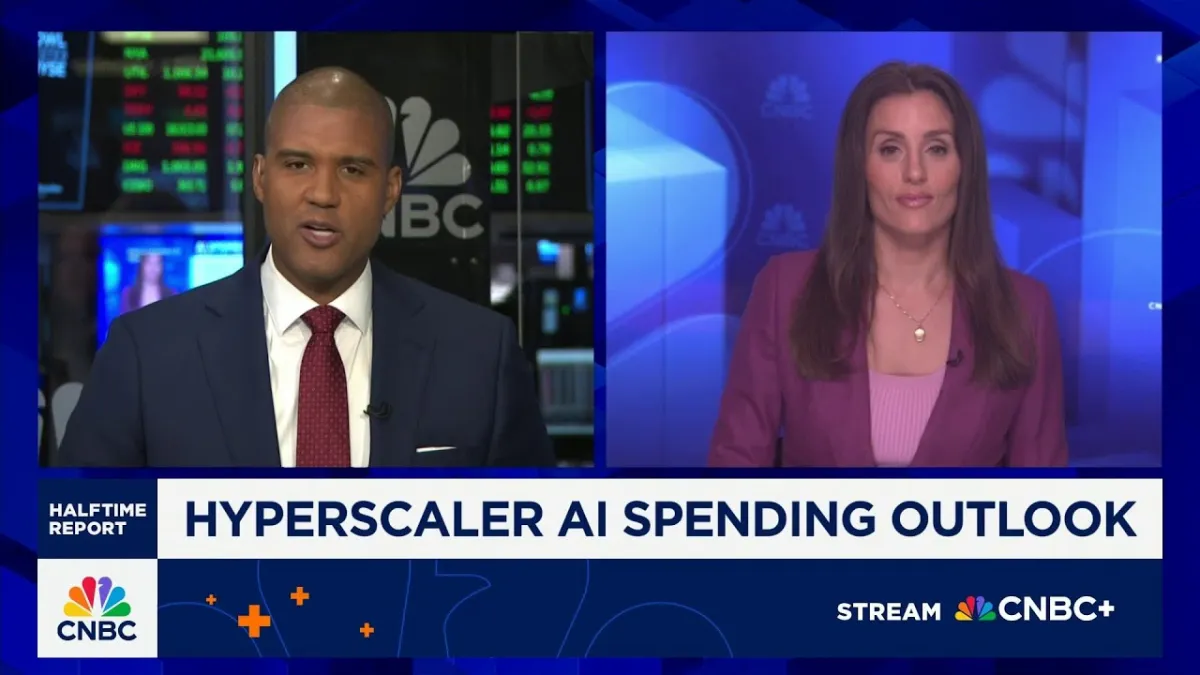
The fervent debate surrounding the sustainability of the artificial intelligence boom took center stage on CNBC’s “Halftime Report,” as the Investment Committee grappled with a new Barclays research note suggesting that the surge in AI-related capital expenditure might be peaking. Kristina Partsinevelos, reporting for CNBC Business News, laid out the core findings: while AI spending indeed boosted US GDP growth by about one percentage point in the first half of 2025, including Open AI’s significant outlays, this contribution is "set to peak this year and fade rapidly." This assertion immediately sparked a vigorous discussion among the panelists, challenging the prevailing narrative of an unending upward trajectory for AI investment.
Barclays’ analysis, which projected hyperscaler capital expenditures to increase by roughly 30% through 2027 to $510 billion, underscored a critical point: this seemingly massive figure represents a significant deceleration from the staggering 71% jump observed in 2025. When adjusted for inflation, the slowdown appears even more pronounced. The report further contended that the market is overestimating AI investment's aggregate impact, stating that even "hundreds of billions of dollars from tech giants is still relatively small" compared to the total annual US business investment of over $4 trillion. Furthermore, permanently lifting productivity growth by just one percentage point would require a 20% increase in overall business investment, a level of sustained spending last witnessed during the dot-com boom of the 1990s. The report concluded with a stark warning: while AI spending levels are impressive, "growth rates drive GDP," and "those rates are decelerating fast."
This bearish outlook was met with a robust counter-argument from the panel, emphasizing the broader and more diversified nature of AI investment beyond the tech giants. Stephanie Link, an ardent proponent of the AI revolution, acknowledged that the $400 billion from hyperscalers this year is likely a peak for that specific segment, but firmly believes in a sustained compound annual growth rate of approximately 25% for AI CapEx through 2030. Her comfort stems from the fact that it is "not just the hyperscalers that are spending on CapEx." She highlighted that utility companies are projected to spend $80 billion this year on AI, grid power, and data centers, with industrials allocating another $200 billion for similar purposes. This widespread adoption across various sectors, she argued, signifies a more resilient and deeply embedded investment cycle.
Joe Terranova echoed this sentiment, pointing to specific utility players like Vertiv, Constellation Energy, and Duke Energy, all of which have seen significant upward momentum, as evidence of this broadening investment base. He suggested that utilities could act as a crucial "replacement" in investor portfolios, especially given the current environment of lower oil prices and an administration that clearly favors affordable energy. The shift in CapEx is not merely about raw spending but about foundational investment in the infrastructure that will power the AI future.
Jim Lebenthal, while owning Nvidia, expressed no fundamental or technical concerns, noting that the backlog for Nvidia chips is "off the charts." He posited that the rally in AI stocks is likely to continue through year-end, driven by a "chase for performance" that will inevitably center on Nvidia, the "bellwether of the bellwether trade." This perspective suggests that market dynamics, particularly the scramble for year-end gains, will override any short-term concerns about decelerating growth rates.
Related Reading
- The AI Bubble: A Dot-Com Analogy with Broader Implications
- AI Cycle's Long Runway: Why It's Not Your Grandfather's Tech Bubble
- Dimon: AI Bubble Requires Granular Scrutiny, Job Shifts Inevitable
Liz Young reinforced the idea of continued CapEx, stating that investors are now seeking "justification of those valuations" through tangible revenue generation and real-world use cases. She pointed to software and cybersecurity as areas with significant opportunity, noting that the latter represents a long-term trade. The transition from pure capital expenditure to demonstrable financial returns will be key to sustaining investor confidence in the long run.
The core tension in the AI investment landscape, as illuminated by the debate, lies in reconciling the colossal, front-loaded spending by hyperscalers with the slower, yet broader, integration of AI across traditional industries. While the exponential growth rates seen in the initial phase of AI investment might indeed be moderating, the widespread adoption by diverse sectors like utilities and industrials suggests a more durable and fundamental shift in global capital allocation. This broad-based expenditure, coupled with the ongoing demand for specialized chips and robust cybersecurity solutions, paints a picture of an AI investment cycle that is maturing, not collapsing. The conversation is shifting from the sheer volume of investment to its efficacy and the tangible benefits it delivers, signaling a new, more discerning phase for founders, VCs, and tech insiders alike.