

AI's Productivity Paradox: More Than Just Automation?

AI's impact on productivity is a complex issue, with experts debating its true economic benefits and the future of work. Learn more from Alex Iontas on the Odd Lots podcast.

4 min read
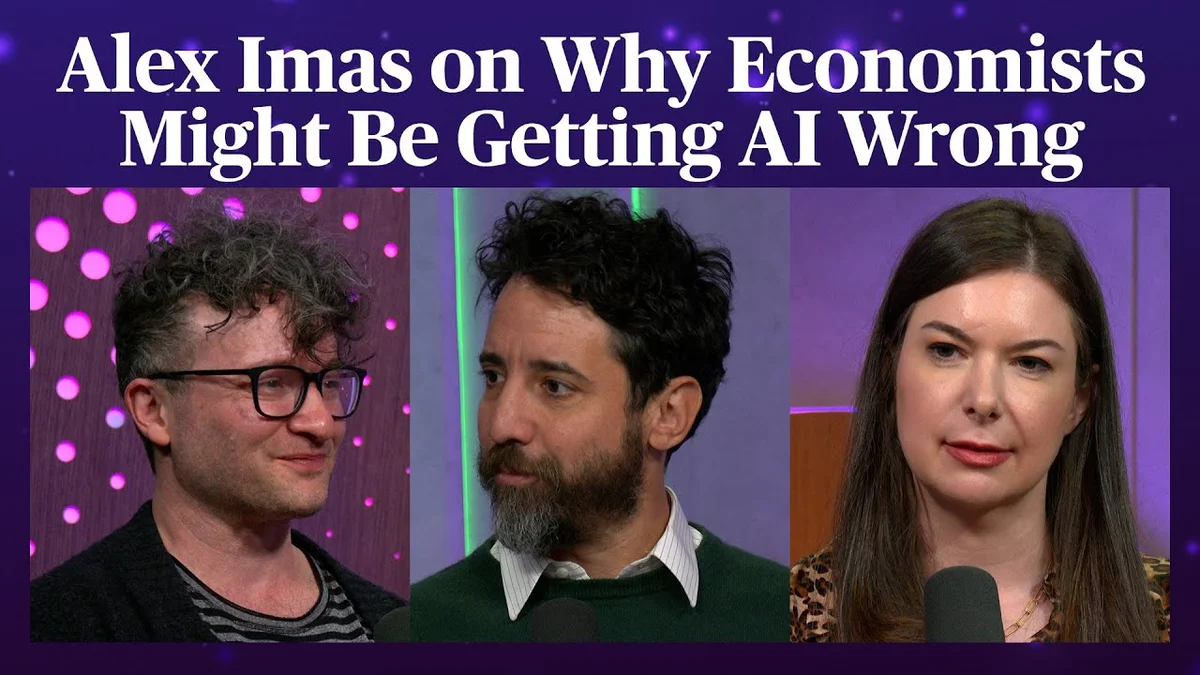
Joe Weisenthal and Tracy Alloway discussing AI and productivity on Bloomberg's Odd Lots podcast.
Image credit: Bloomberg Podcasts· Bloomberg Podcast

In a recent discussion on the Bloomberg "Odd Lots" podcast, hosts Joe Weisenthal and Tracy Alloway explored the intricate relationship between artificial intelligence and productivity. They questioned how much AI truly boosts output and what that means for the labor market and the broader economy. The conversation featured insights from Alex Iontas, a professor of behavioral science, economics, and applied AI at the University of Chicago, who shared his research on how AI is impacting work and the economy.

Understanding AI's Productivity Impact

Iontas began by highlighting the difficulty in precisely measuring AI's productivity gains. He noted that while AI models like ChatGPT can perform tasks efficiently, the real-world impact on overall economic productivity is not always straightforward. He referred to the concept of the "productivity paradox," where technological advancements don't always translate into immediate, measurable increases in economic output.

Iontas explained that AI's impact is often task-specific. While AI can automate certain tasks, it also creates new ones and enhances human capabilities. The challenge lies in quantifying these indirect effects and the time it takes for these new efficiencies to ripple through the economy. He pointed out that historical technological shifts, like the introduction of electricity, also faced similar measurement challenges.

The full discussion can be found on Bloomberg Podcast's YouTube channel.
Alex Imas on Why Economists Might Be Getting AI Wrong - Bloomberg Podcast
Alex Imas on Why Economists Might Be Getting AI Wrong — from Bloomberg Podcast

The Role of Complementary Tasks

A key theme of the discussion was the idea of "complementarity." Iontas argued that AI's true value comes not just from automating existing tasks, but from augmenting human skills and enabling new forms of work. He highlighted that AI can perform tasks that are either too simple or too complex for humans to do efficiently, thereby freeing up human workers to focus on more strategic or creative aspects of their jobs.

He cited research suggesting that AI can be highly effective in automating parts of jobs, but that the human element remains crucial for tasks requiring complex judgment, creativity, and interpersonal skills. The models are not yet capable of fully replacing human workers in many roles, but rather act as powerful tools that can enhance human performance.

AI and the Labor Market: Displacement vs. Creation

The podcast touched upon the ongoing debate about AI's impact on employment. While there is concern about job displacement due to automation, Iontas suggested that AI is also creating new job categories and transforming existing ones. He noted that the pace of AI development is rapid, making it difficult to predict the exact long-term effects on the labor market.

He emphasized that the nature of work is changing, and workers will need to adapt by acquiring new skills that complement AI technologies. This could involve learning how to work alongside AI systems, manage AI tools, or focus on tasks that require uniquely human capabilities.

The Case of Warehouse Workers and AI

The conversation then shifted to a specific example: warehouse workers. Iontas discussed how AI and robotics are transforming warehouse operations, leading to both increased efficiency and potential job displacement. He explained that while AI can automate tasks like picking and packing, human workers are still needed for tasks that require more complex decision-making or adaptability.

He noted that the research on this specific sector highlights how AI can augment human capabilities, allowing workers to be more productive. However, he also acknowledged that the transition may not be smooth, and some workers might need retraining or reskilling to adapt to the changing demands of the industry.

Measuring Progress and Future Outlook

Iontas stressed the importance of gathering more granular data to understand AI's impact on different jobs and industries. He believes that current macroeconomic data might not fully capture the nuances of how AI is changing the nature of work and productivity.

The discussion concluded with a forward-looking perspective. Both hosts and the guest agreed that AI's integration into the economy is inevitable and will continue to accelerate. The key challenge for policymakers, businesses, and individuals will be to navigate this transition effectively, ensuring that the benefits of AI are broadly shared and that society can adapt to the evolving landscape of work.

The podcast underscored that while AI offers immense potential for productivity growth, its full impact will depend on how well we understand its capabilities, manage its integration, and support the workforce through this transformative period.

© 2026 StartupHub.ai. All rights reserved. Do not enter, scrape, copy, reproduce, or republish this article in whole or in part. Use as input to AI training, fine-tuning, retrieval-augmented generation, or any machine-learning system is prohibited without written license. Substantially-similar derivative works will be pursued to the fullest extent of applicable copyright, database, and computer-misuse laws. See our terms.