

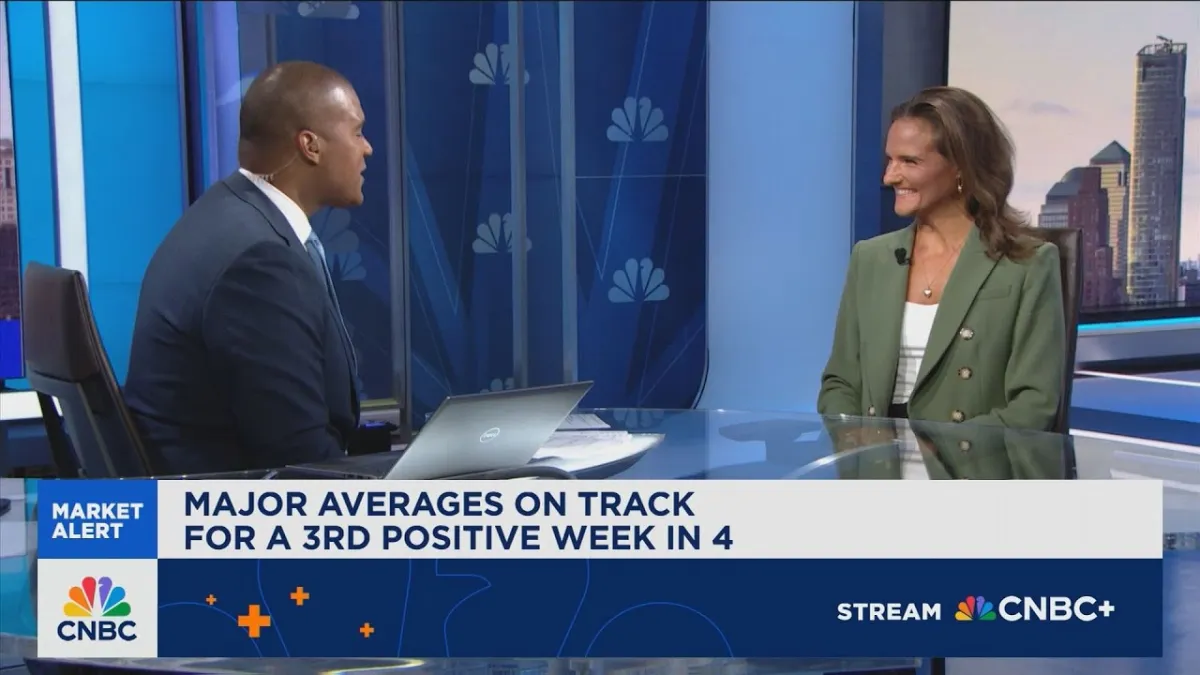
“We are not in an AI bubble in our opinion,” asserted Clare Pleydell-Bouverie, Co-Head of Global Innovation Team at Liontrust, during a recent CNBC interview. She posits that the prevailing narrative of an impending AI bubble is fundamentally flawed, arguing instead that the current surge in artificial intelligence represents a genuine "boom" driven by verifiable demand-supply imbalances and an accelerating return on investment (ROI) in compute infrastructure. This perspective challenges conventional market anxieties, suggesting a robust and sustainable growth trajectory for the sector.
Pleydell-Bouverie elaborated on this distinction, noting that bubbles are typically characterized by overbuild, oversupply, excessive investment, and inflated multiples—none of which, she contends, are present in the current AI landscape. Instead, the market is experiencing an "acute supply-constrained environment," a condition she anticipates will persist for the next three years. Evidence for this scarcity is already manifest in recent corporate earnings: Anthropic, for instance, reported a staggering 128% year-over-year growth in its data center revenues, while Vertiv’s orders surged by 60%. These figures underscore a profound, unmet demand for the computational resources essential to AI development and deployment.
The scale of the ongoing infrastructure investment further supports the "boom" thesis. Pleydell-Bouverie highlighted a projected $4 trillion data center infrastructure build-out through 2030, equating to 80 gigawatts of capacity, where each gigawatt represents a $50 billion opportunity. Remarkably, only a mere 6% of this monumental investment has been deployed to date. Even when accounting for all currently announced projects, the industry is only about 65% through its build-out by 2028, leaving a substantial 35% of future deployments yet to be unveiled. This substantial pipeline suggests a prolonged period of growth and investment, far from the speculative overextension typical of a bubble.
Crucially, the return on investment for accelerated compute is not merely stable but accelerating. Pleydell-Bouverie pointed to Nvidia’s Hopper architecture, which previously offered a 10x ROI, now being surpassed by the Blackwell architecture yielding a 15x ROI. This rapid increase in efficiency and profitability solidifies the economic justification for the massive capital expenditure. The enhanced ROI signals that the underlying technology is not just innovative but also economically viable and increasingly indispensable.
This technological transition is not just expanding the market; it is actively reshaping its competitive dynamics. Pleydell-Bouverie forecasts that "2025 marks the start of the changing of the guard, where we see new market leadership on the table." The established hyperscalers—Microsoft Azure, Amazon Web Services (AWS), and Google Cloud—are, in her view, losing market share for critical AI workloads. This erosion is attributed to the rise of specialized providers like CoreWeave and Oracle, whose infrastructures are "purpose-built for accelerated compute," offering superior performance and cost-efficiency for demanding AI applications. The implication is clear: general-purpose cloud platforms may struggle to compete with highly optimized, AI-centric alternatives.
Beyond cloud infrastructure, the impact of generative AI is poised to redefine entire industries, notably retail. Pleydell-Bouverie underscored that "agentic commerce is going to redefine the retail landscape." She argues that while much attention focuses on OpenAI’s challenge to Google’s search dominance, a more overlooked but equally significant threat looms for Amazon. Google’s paid search click-through growth is deteriorating for the first time in a decade, a direct consequence of generative AI’s ability to provide direct answers rather than links.
Related Reading
- Airbnb's AI Strategy: Application Over Aspiration
- AI's Gold Rush: Disruption, Data Centers, and the New Economic Calculus
- Why Creativity, Not Code, Defines AI’s Consumer Frontier
Amazon’s “walled garden” approach, where it maintains tight control over its platform, presents a vulnerability in this evolving landscape. Pleydell-Bouverie believes Amazon is "very, very unlikely to allow a third-party agent to crawl through their site," noting that the company is actively developing AI policies to restrict such access. This contrasts sharply with players like Shopify, which is strategically positioning itself as the "agentic rails for e-commerce." Shopify’s open ecosystem, combined with its robust inventory management, real-time price discovery, and industry-leading payment processing (boasting the highest converting checkout on the internet), makes it an ideal platform for generative AI agents. These agents can seamlessly interact with Shopify merchants, offering personalized shopping experiences and direct purchasing capabilities, bypassing traditional search and marketplace models.
The true determinant of success in this new era, Pleydell-Bouverie concluded, "is not about how big the company is... it's about the end-to-end technology stack and consumer intent." The shift favors companies that are AI-native from inception, built to leverage the full potential of generative AI to meet evolving consumer demands. This paradigm shift suggests that agility, specialized infrastructure, and a focus on integrated, AI-driven customer experiences will be paramount for future market leaders, rather than sheer size or legacy dominance.



