

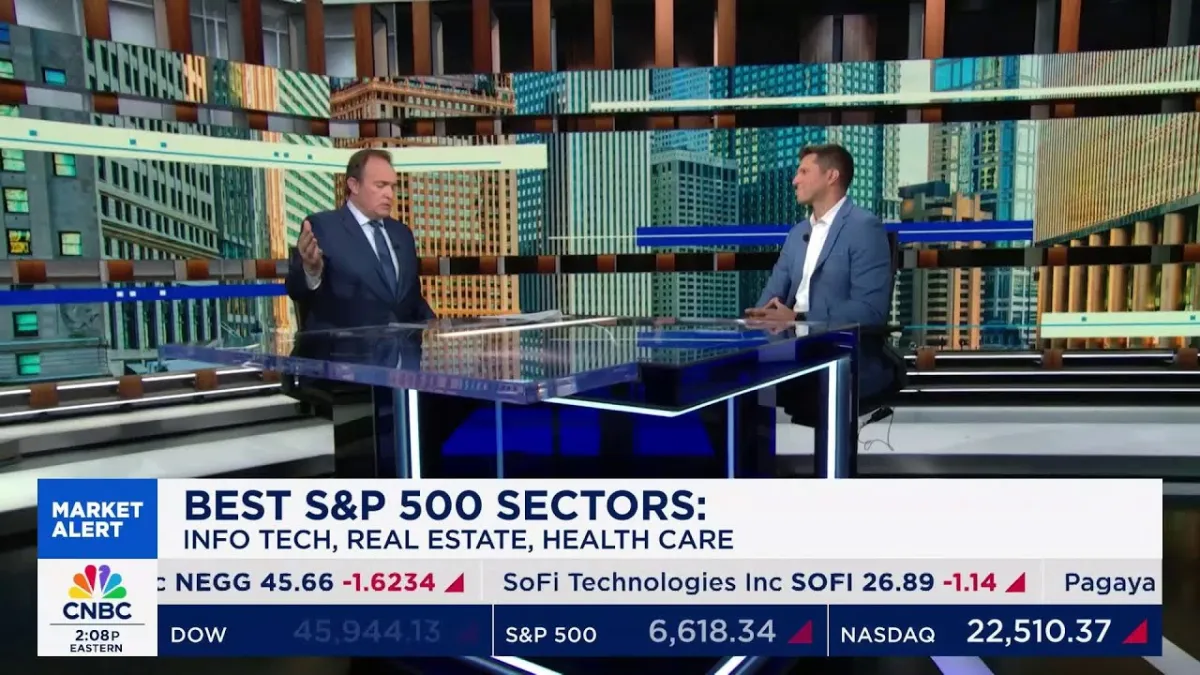
"Demand continues to far outweigh supply," asserted Tim Urbanowicz, Chief Investment Strategist at Innovator Capital Management, during a recent interview on CNBC's Power Lunch. This pithy observation encapsulates the prevailing sentiment in the artificial intelligence sector, where unprecedented investment is driving a scramble for the foundational components necessary to power the AI revolution. The conversation, hosted by Brian Sullivan, delved into strategies for capitalizing on these massive investments, highlighting a nuanced shift in where the most significant opportunities now lie.
Urbanowicz spoke with Sullivan about the staggering capital expenditures projected for AI data centers, with figures like $5.2 trillion by 2030 being bandied about. While acknowledging such long-term projections always carry a "big question mark," Urbanowicz emphasized the immediate reality: a voracious demand for AI infrastructure. He pointed to Meta's plans to increase spending by 50% next year and 35% in subsequent years as a concrete example of this insatiable appetite. The initial wave of easy money, he contends, has largely been made in the mega-cap hyper-scalers that have dominated headlines.
The strategist's core insight is that the smart money is now moving down the market capitalization ladder. Rather than chasing the already highly valued tech giants, investors should seek exposure to companies with market caps of $500 billion or less that are building the essential "skeleton" of the AI data center ecosystem. These are the unsung heroes providing the hardware, cooling, and power solutions without which the AI revolution cannot proceed. It is within this segment that Urbanowicz sees significant room for continued growth and outperformance.
One such company Urbanowicz highlighted is Celestica (CLS), a manufacturing partner for hyperscalers and a key player in white-box switching solutions. With a market capitalization of approximately $33 billion, Celestica provides the tangible components that enable the massive data flows and processing power required by AI. Another favored pick is Vertiv Holdings Co (VRT), a critical infrastructure supplier for data centers, specializing in power, traditional cooling, and increasingly, liquid cooling and heat rejection systems. Vertiv, with a market cap around $68 billion, addresses the fundamental challenge of managing the immense heat generated by AI compute, a non-negotiable aspect of scaling AI operations. Both companies, despite trading at around 40 times earnings, are seen as justified investments given the projected growth rates and the sheer volume of anticipated infrastructure spending.
Related Reading
- AI's Billion-Dollar Buildout Creates Bearish Jitters, Cramer Says
- ING's Treon: AI Spending is Real CapEx, Not a Bubble
- AI spending looks impressive but it's probably the peak, says Barclays' Jonathan Millar
The enthusiasm for AI, however, is tempered by broader market considerations. Urbanowicz acknowledged that valuations across the market, particularly in AI-related sectors, have run up significantly. While he clarified that high valuations alone are not a reliable timing tool for a market sell-off, they do imply a critical shift in investor expectations. "It takes a lot of good news, and significantly better news, to continue to propel stocks at the rate that we've seen over the last year," he stated. This means that even positive earnings or developments might not be enough to sustain current momentum if they don't exceed already elevated expectations.