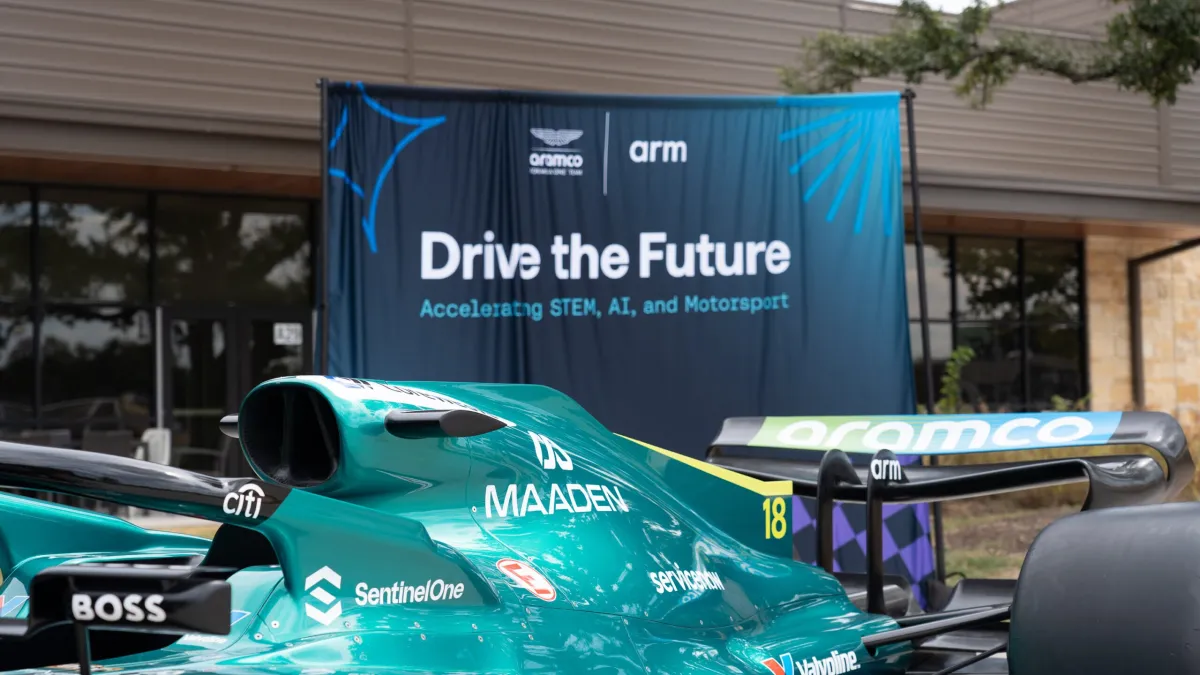
Arm and the Aston Martin Aramco Formula One Team recently hosted "Driving the Future: Accelerating Careers in STEM, AI and Motorsport" in Austin, Texas. This pivotal event, part of their "Equity in Action" partnership, directly addresses the critical need for a diverse talent pipeline in an increasingly AI-driven industry. It underscores a strategic pivot towards human capital development alongside technological advancement, moving beyond traditional sponsorships to cultivate future innovators.
The event brought together over a hundred high school and university students with industry leaders from Arm, Aston Martin F1, and Amazon Web Services. Discussions centered on resilience, confidence, and curiosity, fundamental traits for navigating the rapidly evolving tech landscape. Arm's presence, as a global engineering and technology hub, highlights its foundational role in the chips and software powering tomorrow's innovations, including those in high-performance motorsport. This collaboration extends beyond a typical brand exercise, focusing on tangible career pathways and hands-on AI exploration. According to the announcement
A core focus of the discussions illuminated how AI, data, and teamwork are fundamentally redefining performance in motorsport. Professional racing driver Jessica Hawkins detailed how advanced simulators and wearable sensors now precisely mirror real-world driving dynamics, a testament to sophisticated AI modeling. This integration moves beyond basic telemetry, enabling predictive analysis and real-time optimization crucial for competitive advantage on the track. Arm's SVP and GM of the Automotive Business, Dipti Vachani, emphasized that AI is accelerating everything, demanding unparalleled adaptability from new industry entrants. The rapid growth of AI means that foundational knowledge quickly gains value but also evolves at an unprecedented pace.
Cultivating Future Innovators in AI and Motorsport
This partnership signifies a broader industry recognition that the future of motorsport is inextricably linked to AI and a robust, diverse talent pool. Arm, as a key enabler of compute architectures, is strategically positioning itself at the intersection of high-performance computing and human development. By fostering early engagement with AI concepts and career paths, they are actively shaping the next generation of engineers and technologists. The initiative directly addresses the skills gap, ensuring a continuous flow of innovation into sectors like automotive and competitive racing.
The lessons from AI in motorsport extend far beyond the racetrack, influencing the development of AI-defined vehicles and edge computing solutions. The rapid iteration cycles and extreme performance demands of Formula One serve as an ideal proving ground for Arm's power-efficient architectures and advanced AI capabilities. This real-world application demonstrates how foundational chip design impacts everything from on-device intelligence to complex cloud-to-car integration. The emphasis on adaptability and continuous learning, highlighted by speakers, reflects the dynamic nature of the entire AI industry.