

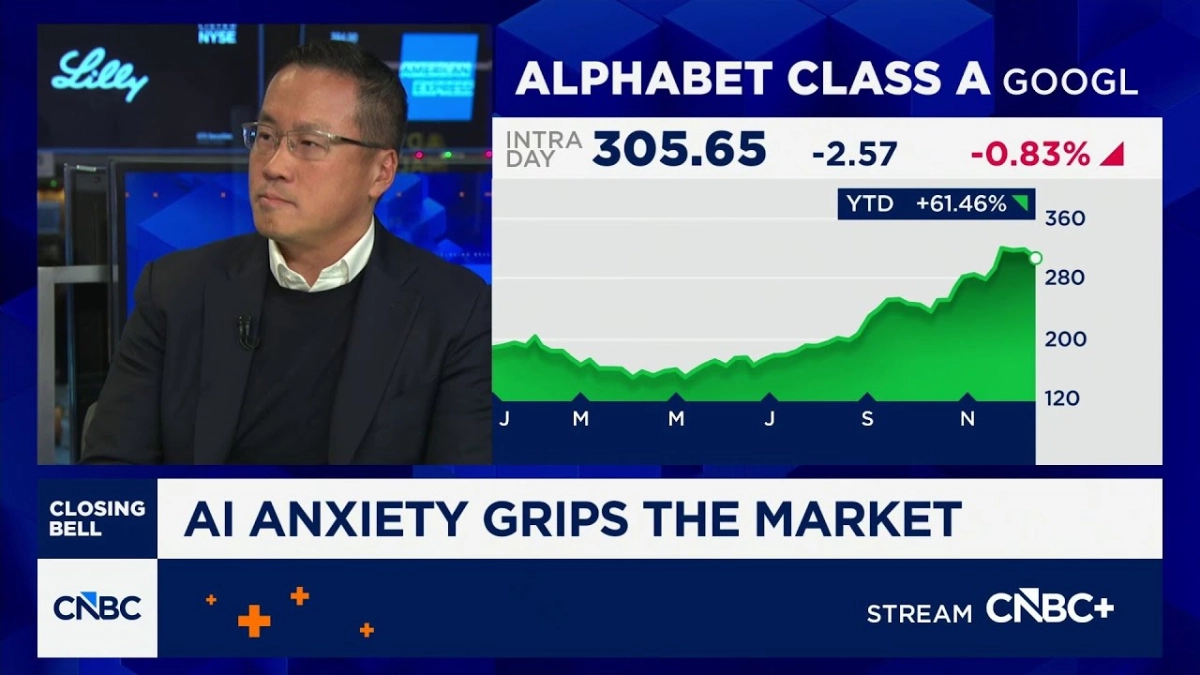
The prevailing market anxiety surrounding artificial intelligence funding, often fueled by dramatic shifts in corporate valuations and perceived vulnerabilities, is largely overstated. This was the central, reassuring message from Sung Cho, Co-head of Public Tech Investing and U.S. Fundamental Equity at Goldman Sachs Asset Management, during a recent discussion on CNBC's "Closing Bell" with Scott Wapner. Their conversation delved into the trajectory of the AI trade, the broader market outlook, and the foundational stability of the sector's capital structure, offering a nuanced perspective for founders, venture capitalists, and tech insiders navigating this transformative era.
Cho's core insight challenges the narrative of an impending AI bubble by dissecting the sources of capital fueling the current boom. He posits that the overwhelming majority of AI investment is not reliant on speculative debt, but rather on robust, internally generated cash flows from established tech giants. This distinction is critical for understanding the long-term resilience of the AI market.
Quantifying the immense capital flowing into AI, Cho stated, "If you think about the aggregate level of spend that we need, probably over the next couple years, we think it's about $700 billion to a trillion. And what should calm fears is that 90% of that is being funded by operating cash flows." This significant reliance on internal capital from highly profitable enterprises, rather than external debt, underscores a fundamental strength in the AI investment landscape, differentiating it from prior tech speculative cycles. The implications are profound: companies are funding their AI ambitions from a position of financial health, rather than leveraging themselves into precarious positions.
Furthermore, even the smaller portion of AI investment financed through debt is predominantly stable. Cho highlighted that a substantial share of this debt is being issued by highly-rated entities. He elaborated, "It's really only 10% that's being funded by debt. And do you know that majority of that debt is actually going to be issued by Meta, which actually has a rating that's better than the US government and is, the bonds are trading inside of US treasuries." This illustrates that the debt financing in AI is not concentrated in speculative ventures with shaky balance sheets but rather in established corporations with exceptional creditworthiness, further mitigating systemic risk.
Concerns surrounding specific companies like Coreweave and Oracle, which have experienced recent market turbulence, are also placed into perspective. Cho clarified that these instances do not signal a weakening in overall AI demand. Instead, they often reflect operational challenges or supply chain bottlenecks. "I don't think funding is going to be an issue going into 2026. And if you think about Coreweave and Oracle, I think what they're also, what you have to realize is that they're not facing a demand issue. There's a little bit of supply chain backup issues that they're dealing with," he explained. This distinction is vital for investors, suggesting that company-specific setbacks are not indicative of a broader industry downturn but rather transient, solvable operational hurdles.
A second crucial insight from Cho concerns the dynamic and inherently volatile nature of leadership in foundational AI models. The rapid succession of perceived frontrunners in the AI model space is a defining characteristic of this nascent market. What appears dominant today may be superseded tomorrow.
Cho pointed to the rapid shifts in investor sentiment and market capitalization among leading AI players. He observed, "Look at think about how much sentiment has changed around the different frontier model players over the course of 2025. If you look at the beginning of 2025, Meta was considered to be the dominant model... Six months later, OpenAI was viewed as the dominant frontier model... and then more recently, Google is taking the lead in the eyes of investors." This competitive fluidity, while generating headline-grabbing volatility for individual stocks, also signifies intense innovation and a race for technological supremacy rather than a market-wide collapse.
The financial ramifications of this "model volatility" are substantial. Google's recent surge in market value, for instance, is a direct consequence of this shifting perception. "That's why they've gained a trillion dollars in market cap in the last three months. It's because of this perception that Gemini is now taking the lead," Cho stated. This colossal market cap appreciation in a short period underscores how quickly investor confidence and capital can pivot based on perceived technological superiority.
This dynamic environment is set to continue, with new advancements constantly reshaping the competitive landscape. The impending arrival of next-generation AI models, such as those trained on Nvidia's Blackwell architecture in early 2026, promises to inject further volatility and potential shifts in leadership. Consequently, market participants should anticipate ongoing shifts in perceived dominance, as innovation cycles accelerate and new capabilities emerge. The market is not stagnant; it is evolving at an unprecedented pace.
Ultimately, Cho’s analysis paints a picture of an AI market that is fundamentally well-capitalized, primarily through sustainable operating cash flows, rather than precariously leveraged. While competitive dynamics among leading AI model developers will remain fiercely volatile, these shifts are a natural outcome of intense innovation, not an indicator of systemic financial weakness. The anxieties, while palpable, appear largely overstated when viewed through the lens of underlying financial health and demand.



