

AI Dominates VC Funding, Top 5 Firms Capture 73%

Kyle Stanford of PitchBook discusses how AI companies are dominating VC funding, with the top 5 firms capturing 73% of total value in Q1 2026.

4 min read
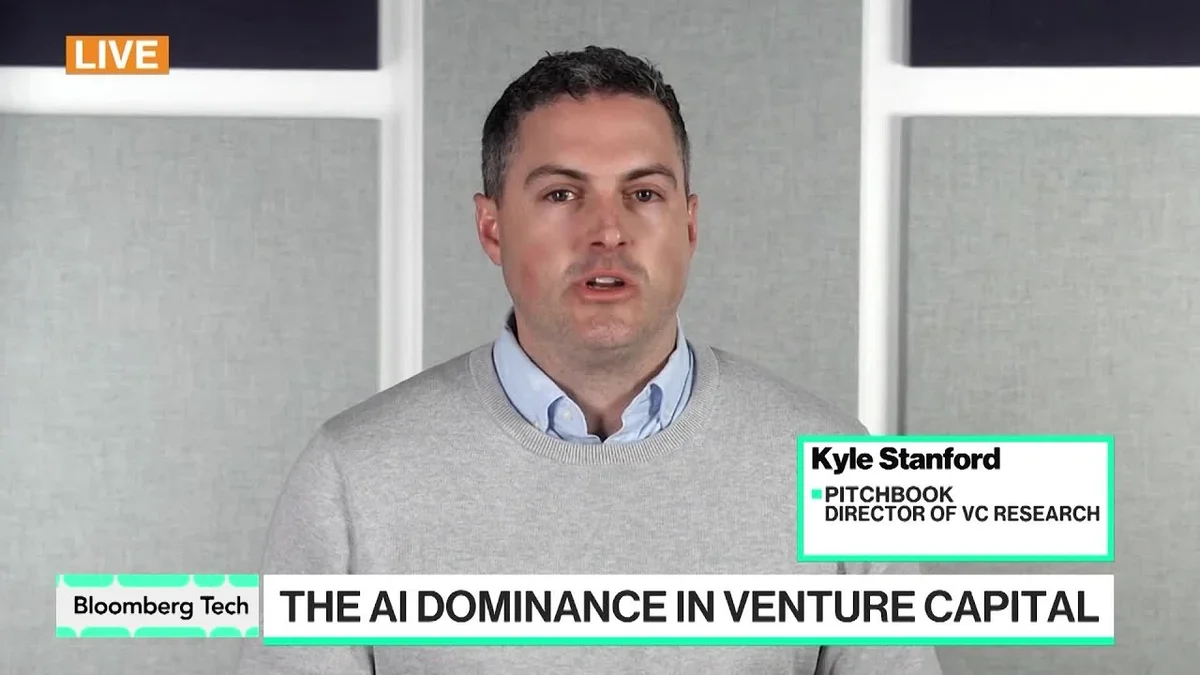
Kyle Stanford and host discussing AI dominance in venture capital funding.
Image credit: StartupHub.ai· Bloomberg Technology

In the first quarter of 2026, the venture capital world saw an unprecedented concentration of funding within the artificial intelligence sector. The top five AI firms alone captured a staggering 73% of the total value raised, highlighting a significant consolidation of investment in a select group of companies. This trend indicates a strong investor appetite for AI, but also raises questions about the flow of capital to emerging players and the long-term viability of startups not backed by major AI players.

The full discussion can be found on Bloomberg Technology's YouTube channel.
VC Dealmaking Sets Record, But Nearly All Funds Go to AI - Bloomberg Technology
VC Dealmaking Sets Record, But Nearly All Funds Go to AI — from Bloomberg Technology

The AI Funding Frenzy

The data reveals a dramatic shift in venture capital allocation towards artificial intelligence. Kyle Stanford, Director of VC Research at PitchBook, noted the extraordinary nature of this concentration. He stated, "It's extraordinary how much money is being raised and how much money is being spent on just a few companies." This suggests that while overall AI investment is booming, the vast majority of capital is flowing to a handful of established leaders.

Related startups

Concentration of Capital

Stanford elaborated on the distribution of this funding. He explained that while the overall data looks strong, "it really depends on where you're at." He further detailed that in Q1 2026, 91% of capital went into deals of $100 million or larger, with 73% of that total going to just five companies. This means a substantial portion of venture capital is being funneled into a very small number of AI companies, leaving less for others. He also pointed out that "73% of that goes to five companies, and if you include data breaks in there, you have investors that want exposure to AI and LPs that want exposure to AI."

The Challenge for Other Startups

This concentration poses a challenge for startups outside the top tier. Stanford observed, "What's getting left behind is the non-AI companies, whether it be your traditional enterprise SaaS, which was hot in 2021 and 2022, or other business models that are just not harnessing or are not AI-native like everyone wants." This implies that companies not directly involved in AI development may struggle to attract investment, even if their business models are otherwise sound.

Zombie Companies and Funding Droughts

The conversation then shifted to the fate of companies that are not attracting significant AI-related funding. The question was posed: "Are there these zombie companies out there?" Stanford confirmed this concern, stating, "Definitely. I mean, there's 25% of the unicorns, you know, about 900 unicorns now in the US, 25% of those haven't raised since 2022." These companies are in a difficult position, as the market's focus has shifted. He added that these are the companies "that were strong and hot in the next big company in 2021 and 2022, and haven't raised since."

The Path to Going Public

The discussion also touched upon the implications for companies aiming for an Initial Public Offering (IPO). Stanford suggested that the current market conditions mean that "those companies that have access and exposure to companies that are then 15 years old and raising another private round are going to want to get into those companies again and continue to keep their stakes high." He further noted that "VCs want that exposure to the Anthropic, the OpenAI, the Databricks, the SpaceX, the Stripe." This desire for exposure to leading AI firms influences how VCs allocate capital and can make it harder for less prominent companies to secure funding or go public.

The Role of LPs and IPO Market

Limited Partners (LPs) are also driving this trend, as they seek returns from the booming AI sector. Stanford explained, "It also tells me that LPs want that exposure to companies that are then 15 years old and raising another private round." This demand from LPs pressures VCs to invest in the most promising AI companies, further concentrating capital. The current IPO market also reflects this, with many companies delaying their public debuts. Stanford mentioned, "We have seen Discord file confidentially in January but hasn't gone in movement. There's not really a backlog or a pipeline of VC-backed IPOs because everyone's waiting for these big companies to go public."

The Future of AI Investment

The conversation concluded with a look at the future of AI investment. Stanford highlighted that while some companies like Figment are going public, the broader trend is towards continued private funding for AI giants. He noted, "You see how Figma has traded today, after Anthropic announced their design studio. That's the worry of a lot of these VC-backed companies, they're going to go public and then have to contend with Anthropic and OpenAI launching something competitive." This suggests that the intense competition and rapid innovation in AI will continue to shape investment strategies and market dynamics for the foreseeable future.

© 2026 StartupHub.ai. All rights reserved. Do not enter, scrape, copy, reproduce, or republish this article in whole or in part. Use as input to AI training, fine-tuning, retrieval-augmented generation, or any machine-learning system is prohibited without written license. Substantially-similar derivative works will be pursued to the fullest extent of applicable copyright, database, and computer-misuse laws. See our terms.