
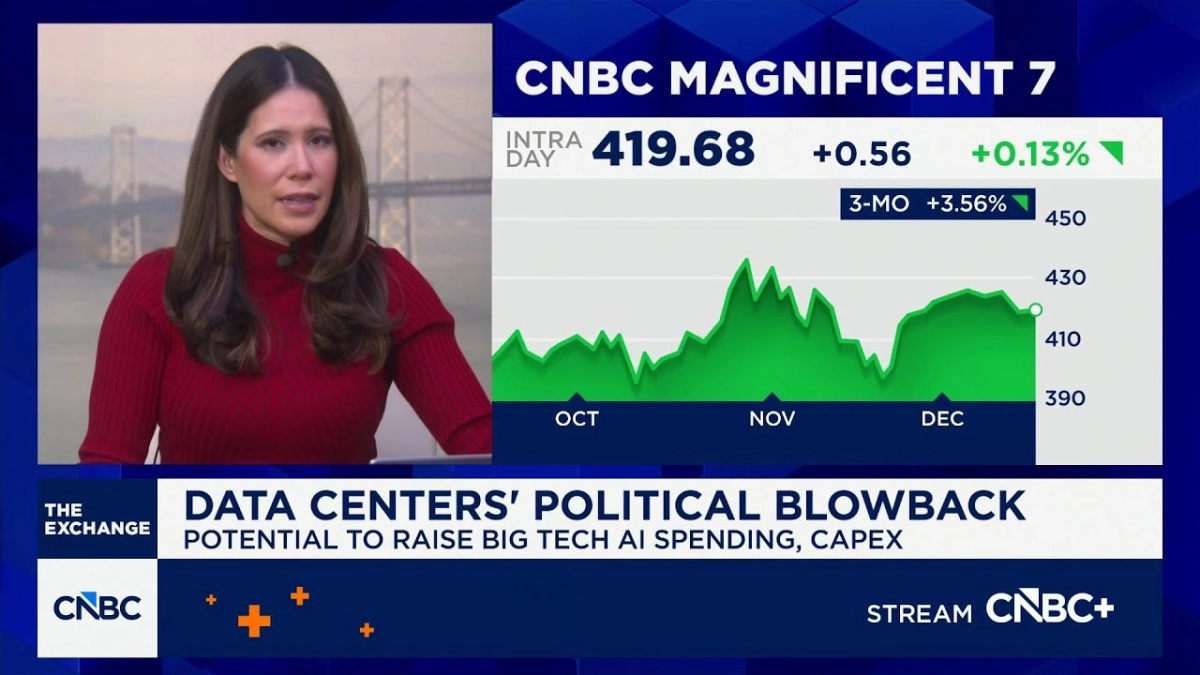
The burgeoning demand for artificial intelligence infrastructure is colliding with a formidable, rapidly evolving political headwind: the escalating energy consumption of data centers and its direct impact on household utility costs. This friction, highlighted in a recent CNBC discussion between TechCheck Anchor Deirdre Bosa and anchor Kelly Evans, underscores a critical shift in how the AI industry's physical footprint is perceived and regulated. Unlike previous tech skirmishes centered on market power, this new battle is deeply rooted in local politics and the everyday financial burden on citizens, promising swifter and more tangible consequences for Big Tech's capital expenditure plans.
Deirdre Bosa, speaking with Kelly Evans on CNBC's "The Exchange," reported on the growing political pressure exerted by Democratic senators on major tech companies like Google, Amazon, Microsoft, and Meta, alongside key data center operators. The core concern articulated by Senators Elizabeth Warren, Chris Van Hollen, and Richard Blumenthal is that the rapid expansion of AI data centers necessitates billions in grid upgrades, with the financial burden disproportionately falling on ordinary households rather than the tech giants themselves. This dynamic, Bosa noted, ties AI infrastructure costs directly to inflation, a politically sensitive issue that resonates deeply with voters.
This emerging regulatory challenge represents a distinct departure from the antitrust battles that have historically engaged Big Tech. Those protracted legal skirmishes often played out over years in courts, revolving around abstract concepts of market dominance and competition. In contrast, the current scrutiny of data centers is immediate and local, manifesting through state politics and municipal regulators. Bosa emphasized, "This one hits a lot faster, runs through state politics, local regulators, and it can raise costs before any law ever even changes." This accelerated timeline means that the financial implications for AI development and deployment could materialize much quicker than previously anticipated, impacting capital allocation and operational strategies.
The sheer scale of electricity consumption by AI data centers is staggering, projected to surge from 4% of total U.S. electricity use in 2023 to a potential 12% by 2028. This exponential growth translates into substantial demands on existing power grids, necessitating costly upgrades and potentially leading to higher utility rates for all consumers. The political pushback is not merely theoretical; Bosa cited instances, such as a unanimous vote by local politicians in an Arizona suburb against building a new data center, demonstrating that communities are already actively resisting these developments.
The market, according to Bosa, has historically been "complacent on tech regulatory risk." However, the direct link between data center expansion and rising electricity bills for residents presents a different calculus. Kelly Evans underscored this point, stating, "If electricity bills continue to go higher and there are problems because of data centers, 100% you're going to get the public pushback and the political pushback." This sentiment highlights a crucial vulnerability for tech companies: the perceived social cost of their innovation. When the pursuit of advanced AI leads to tangible economic pain for the average citizen, political intervention becomes not just probable, but inevitable.
For founders, VCs, and AI professionals, this signals a need for proactive engagement with local and state governments, moving beyond traditional lobbying efforts in Washington D.C. The ability to secure favorable energy contracts, navigate complex zoning regulations, and mitigate local community opposition will become paramount. This new landscape demands a more nuanced understanding of regional energy markets, environmental impact assessments, and public relations strategies. Companies must prepare for increased capital expenditures, not just in hardware and talent, but in infrastructure development, grid contributions, and potentially, direct community benefits to offset rising utility costs.
The conversation even veered into provocative solutions, with Evans suggesting that tech companies could offer "dividends" to households to help cover electricity bills. While perhaps a dramatic proposal, it illustrates the growing expectation that Big Tech, given its immense profits, should bear a greater share of the societal costs associated with its rapid expansion. The $3 billion figure Evans floated for Indiana households, while significant, was dismissed as "nothing" for a major tech company, emphasizing the disproportionate financial power at play.
Ultimately, the political pressure surrounding AI data centers is not just a regulatory hurdle; it's a fundamental challenge to the industry's growth model. The era of unbridled expansion, where the externalities of massive energy consumption were largely overlooked, is drawing to a close. Tech companies must now contend with a highly localized, politically charged environment where the cost of innovation is increasingly being assessed through the lens of public utility and household budgets. Adapting to this new reality will require strategic foresight, community engagement, and a willingness to internalize costs that have historically been externalized.