

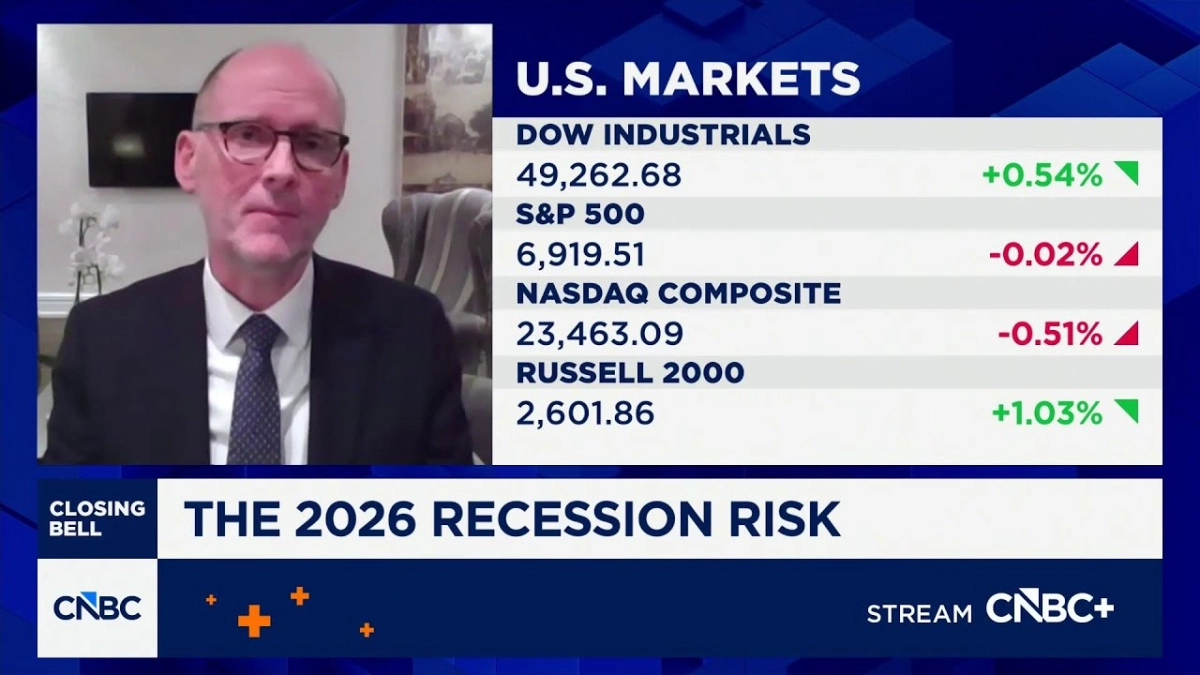
"AI could be both the biggest downside and upside risk," stated Torsten Slok, Partner and Chief Economist at Apollo, during his interview on CNBC's "Closing Bell." Slok spoke with the program's hosts about the firm's economic outlook for 2026, focusing heavily on employment data, fiscal policy, and the transformative, yet uncertain, impact of artificial intelligence.
The conversation centered on interpreting current economic signals, particularly the upcoming December jobs report. Slok projected a strong job number, expecting payroll additions to hit 70,000, rebounding to 98,000 after accounting for the prior month's government shutdown distortions. This upward revision suggests underlying labor market strength, despite recent volatility. He noted that the December data would likely be a "better reading than what we have had in previous months" affected by the shutdown ending on November 12th.
A significant tailwind supporting this positive view on the labor market stems from several factors. Slok pointed to falling oil prices and increased supply from the Middle East, which he believes will exert downward pressure on energy costs, positively influencing the outlook. Furthermore, the ongoing capital expenditure boom in AI and data centers is driving demand. He observed that this investment surge is forcing companies to accelerate their CapEx decisions this year, with many opting to front-load spending rather than deferring it over several years.
Slok then pivoted to the surprising element of Apollo's 2026 forecast: the recession probability. Apollo projects a 30% chance of recession in 2026, a figure Slok admitted was "surprisingly high when you look at it from a consensus perspective." He elaborated that this elevated risk stems from the persistent challenge of inflation remaining "at two high levels at around 3%," significantly above the Federal Reserve's 2% target. This inflation overhang creates a difficult environment for policymakers.
The economist highlighted the core tension in the macroeconomic landscape: the desire for robust growth versus the need to tame inflation. He noted that the economy is currently seeing growth "purely from fiscal policy," with GDP growth significantly above the normal 2% baseline. This fiscal stimulus, coupled with the productivity gains from AI, suggests strong near-term momentum. However, the risk remains that this overheating could necessitate a sharper correction later.
Slok sees AI as the central axis around which this economic uncertainty revolves. He posited that if AI fails to deliver the expected productivity gains—the gains that are currently "priced into markets"—the positive effects underpinning current optimism could vanish. Conversely, if AI surpasses expectations, it could be the "biggest upside" factor, fueling growth while potentially solving the inflation problem through efficiency gains. This dichotomy makes AI the ultimate wildcard for the 2026 outlook.
Regarding monetary policy and the yield curve, Slok pointed out that the 10-year Treasury yield, hovering near 4.183%, remains a tailwind, as it is lower than the prior 12-month period. He also mentioned that the consensus view among markets is that a recession is unlikely in the immediate future, contrasting with Apollo's elevated 30% probability for 2026. The current environment, characterized by high inflation and strong fiscal support, leads Slok to believe that the economy is set to "run it hot" in the near term, despite the looming longer-term risks.
The structural shift caused by technology is undeniable. Slok observed that the market is beginning to price in the "productivity gains" associated with AI, but the risk is that these gains might not materialize fast enough to offset inflation pressures. This places immense pressure on corporate investment decisions; companies are front-loading spending now, which is artificially boosting near-term economic figures.



