

The quest to understand Earth's climate future just got a significant boost, and it comes with a dramatic reduction in AI energy consumption. Researchers at Ai2, in collaboration with NYU, Princeton, M2LInES, and NOAA’s GFDL, have unveiled SamudrACE, an AI emulator capable of simulating 1,500 years of global climate in a single day on an NVIDIA H100 GPU. This breakthrough promises to accelerate climate science by orders of magnitude, fundamentally changing how scientists explore complex climate scenarios.
For decades, climate scientists have relied on physics-based Global Climate Models (GCMs), which are powerful but notoriously slow. Running a single 100-year projection can consume weeks of supercomputer time, limiting the number of simulations researchers can perform. SamudrACE directly addresses this bottleneck, offering a 3,750-fold reduction in energy usage compared to traditional GCMs like GFDL Climate Model v4 (CM4), which requires thousands of CPU cores for a much slower simulation rate. This efficiency gain is critical as the computational demands of AI continue to rise, making the optimization of AI energy consumption a paramount concern.
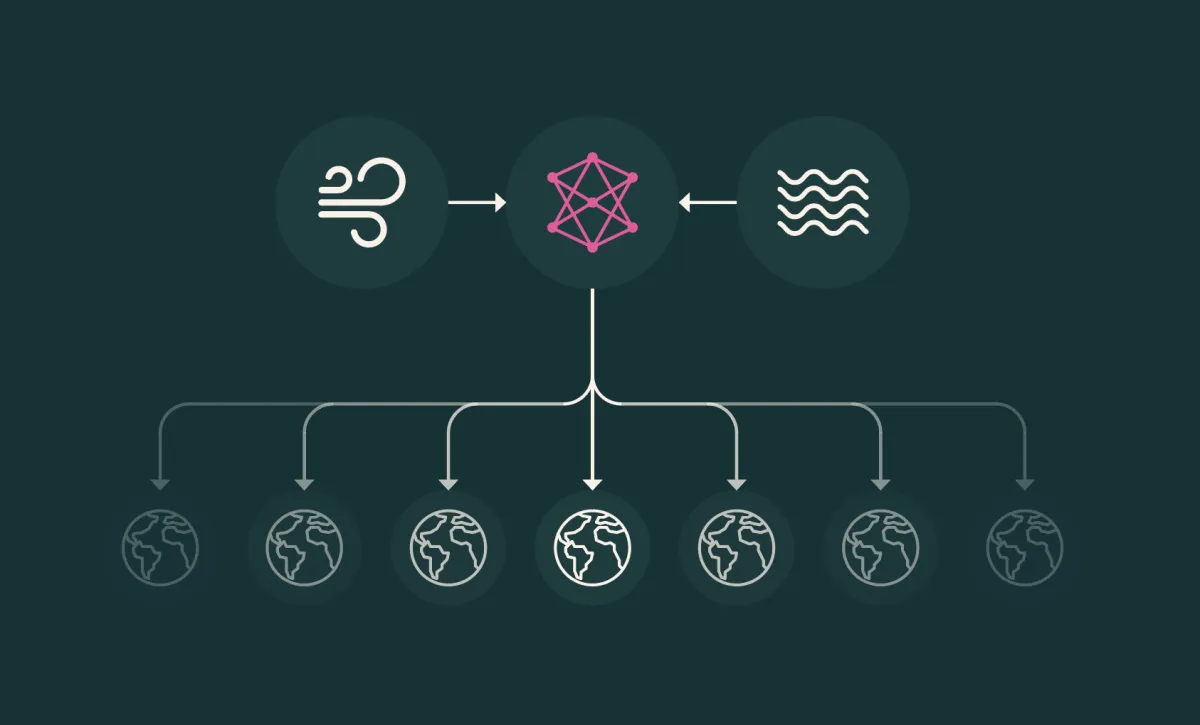
SamudrACE's core innovation lies in its ability to realistically couple 3D models of both the ocean and atmosphere. Previous AI emulators often struggled with this intricate interplay, failing to capture emergent behaviors like the El Niño-Southern Oscillation (ENSO), which significantly impacts global weather patterns. By linking specialized emulators, ACE2 for atmosphere/land and Samudra for the ocean, SamudrACE creates a stable, physics-informed feedback loop, accurately simulating these complex interactions.
Redefining Climate Modeling Efficiency
This dramatic improvement in speed and efficiency, coupled with maintained accuracy, unlocks unprecedented opportunities for climate research. Scientists can now run vast ensembles of simulations, better quantifying uncertainty and exploring a wider spectrum of potential climate outcomes. Questions about the impact of volcanic eruptions or the probability of multiple extreme El Niño events, previously computationally prohibitive, become feasible. The implications for policy-making and disaster preparedness are substantial, providing more robust data faster.
SamudrACE represents a powerful proof-of-concept for data-driven models emulating the most complex aspects of our climate system. While the current version is trained on pre-industrial conditions, the roadmap includes training on future climate states with elevated carbon dioxide levels. This ongoing development underscores a paradigm shift in scientific computing, where AI not only accelerates discovery but also drastically reduces the environmental footprint of high-performance research.