

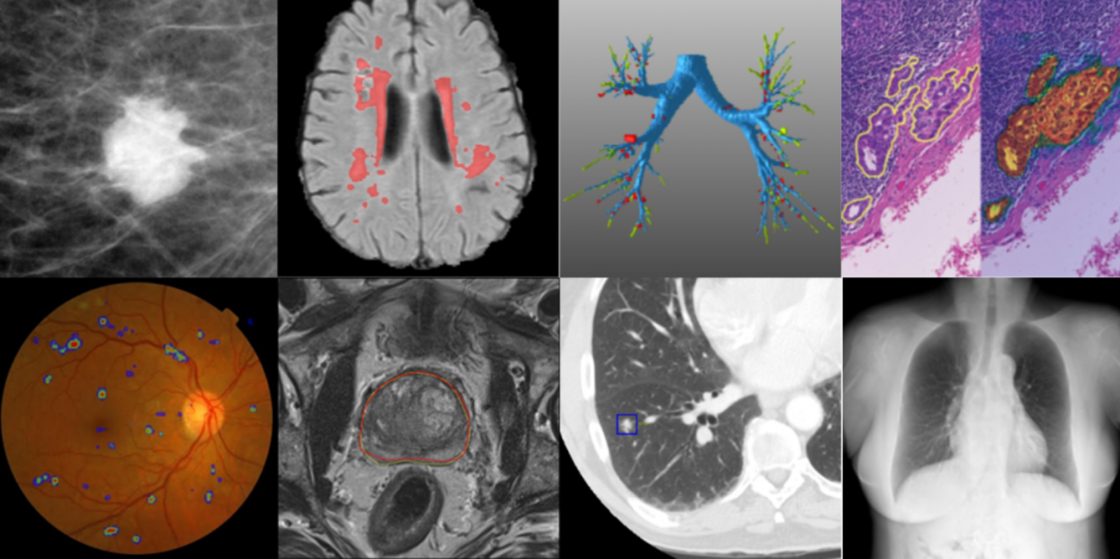
Medical imaging is the process of capturing the structure of an inner organ or tissue. These images can assist medical staff with diagnostics, treatment, and monitoring of patients. It can also prevent any unnecessary invasive procedures.
The global AI healthcare market is expected to grow from 4.9 billion USD in 2020 to 45.2 billion USD by 2026. This rapid growth rate can be explained by the many advantages AI has to offer.
One of the main advantages is AI’s ability to process large amounts of data faster than a human can. For example, a pathologist may need up to 30 hours to examine a 10GB tissue slice whereas AI can process the same amount of information in seconds. In addition, in these kinds of tedious tasks, AI accuracy is far greater and there is much less chance of errors. These are just some of the many reasons AI should be used as a first screening and diagnostic tool.
AI platforms can also detect abnormalities in early stages that in turn enable early treatment and recovery. One of the growing usages of AI is for the purpose of non-invasive radiometric biomarkers. The development of such biomarkers enables us to measure and quantify organs and lesions automatically and compare them to an existing normal database. This allows physicians to accurately and reproducibly monitor the progress of a diagnosis or a given treatment and to avoid, in some cases, the need for an invasive procedure like a biopsy.
Another great advantage is the ability to incorporate AI at early stages of image acquisition. Among other things, this enables us to reduce the amount of radiation needed to acquire a high-resolution CT or shorten the duration needed for an MRI scan. And this leads to patient welfare improvements as well as healthcare cost reductions.