

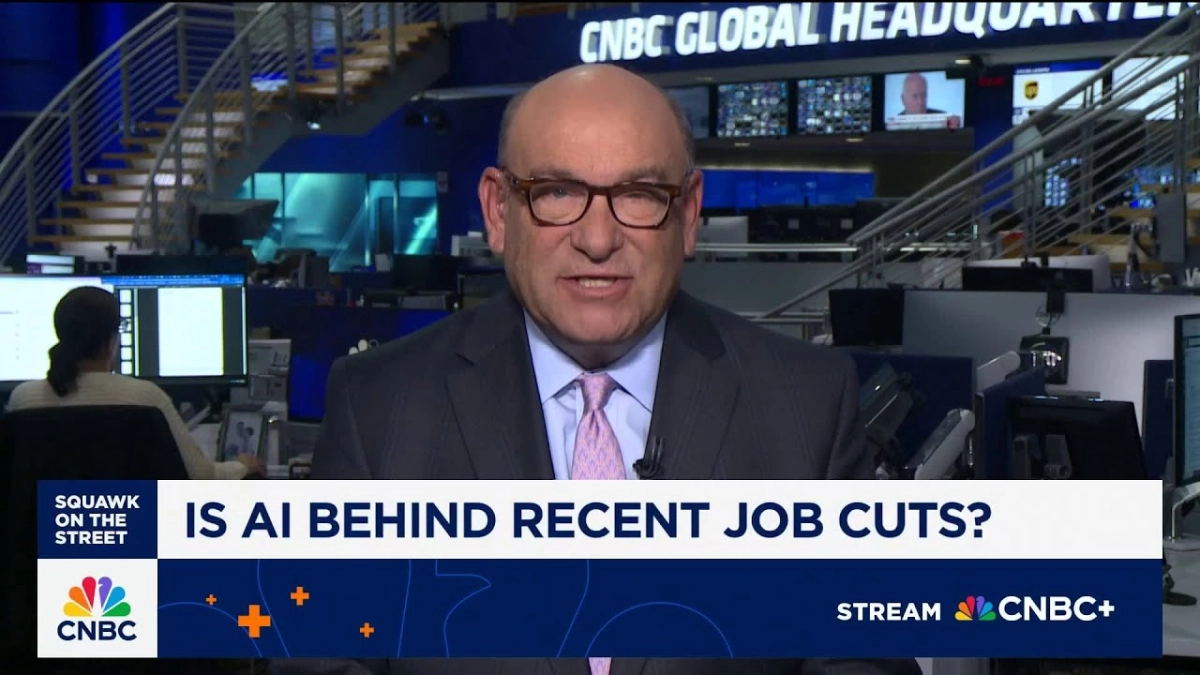
The narrative of artificial intelligence as the primary driver behind recent corporate layoffs is, for the moment, a convenient oversimplification. While fear circulates that AI is already displacing workers en masse, a recent discussion on CNBC's 'Squawk on the Street' featuring Senior Economics Reporter Steve Liesman, alongside anchors David Faber and Sara Eisen, brought much-needed skepticism to this burgeoning belief. The consensus emerging from the conversation suggests that many recent job cuts, while significant, are more likely rooted in traditional business dynamics, with AI often serving as a modern, albeit misleading, justification.
David Faber spoke with Steve Liesman on CNBC's 'Squawk on the Street' about the underlying causes of recent corporate layoff announcements, specifically addressing whether artificial intelligence is truly to blame. Liesman, joined later by Peter Cappelli, a Professor of Management at the Wharton School, offered a nuanced perspective, urging caution against attributing widespread job losses solely to AI’s immediate impact. Their analysis delved into the complex interplay of economic cycles, post-pandemic adjustments, and corporate messaging, revealing that the picture is far more intricate than a simple AI-driven displacement.
Liesman began by listing several high-profile layoff announcements—48,000 at UPS, 14,000 at Amazon, 1,800 at Target—acknowledging the immediate concern these numbers generate regarding AI's influence. However, he quickly introduced the concept of "AI washing," suggesting that companies might be leveraging the buzz around artificial intelligence to mask more conventional business challenges, such as economic downturns or necessary restructurings. This initial insight challenges the prevailing media narrative, prompting a deeper look into corporate transparency and the true motivations behind workforce reductions.
UPS, for instance, in its earnings report, stated, "We launched our Efficiency Reimagined initiatives to undertake the end-to-end process redesign effort which will align our organizational processes to the network reconfiguration." Liesman was openly critical of such corporate jargon, questioning its true meaning and implying it could be a smokescreen. Similarly, Amazon CEO Andy Jassy had to clarify that Amazon’s layoffs were "not really financially driven, and it's not even really AI driven, not right now. It's culture." This highlights the potential for companies to either inadvertently or intentionally create an impression of AI-driven efficiency when other factors are at play.
Peter Cappelli from the Wharton School further supported this skeptical view, stating that there is "little evidence so far that companies are even able to replace workers now at scale." He underscored the immense complexity of integrating AI into existing operations, noting that "using AI and introducing it to save jobs, turns out to be an enormously complicated and time-consuming exercise." The widespread perception that AI implementation is "simple and easy and cheap to do" is, according to Cappelli, largely inaccurate, revealing a significant gap between public expectation and operational reality.
The actual AI-related job losses observed to date are primarily concentrated in low-skilled, entry-level positions, with some impact on certain white-collar roles, but crucially, "not in large numbers." This suggests that while AI is indeed beginning to automate routine tasks, it is not yet leading to the mass displacement of an entire workforce. The current stage of AI adoption appears to be more about augmenting human capabilities or streamlining specific processes rather than wholesale replacement across diverse job functions.
Another critical insight from the discussion was the distinction between automation and artificial intelligence. Liesman pointed out that automation has been a continuous process throughout industrial history, long predating the current AI boom. Confusing the two risks misinterpreting the current labor market shifts. Many of the efficiencies companies are pursuing might simply be the next phase of traditional automation, rather than the revolutionary impact of generative AI.
The conversation also touched upon the "post-COVID hoarding" phenomenon, where companies over-hired during the pandemic's online shopping boom and are now rightsizing their staff levels as demand normalizes. This economic adjustment, coupled with a cautious approach to new hiring in an uncertain economic climate, accounts for a significant portion of the reported job cuts and slowdowns. Sarah Eisen added that the impact of AI is "less in the layoffs and more in the lack of new hiring," as companies pause to assess how AI might reshape future workforce needs before committing to new positions.
Ultimately, the enthusiasm surrounding AI, particularly in investment circles and stock markets, creates an environment where there's a strong desire to "see the results" and attribute positive outcomes, including efficiency gains and cost savings, directly to AI. Liesman warned against this "over-exuberance," emphasizing the need for skepticism when companies claim immediate, large-scale AI-driven workforce reductions. While the long-term impact of AI on labor markets is undoubtedly significant and warrants continued monitoring, the present reality suggests a more measured and less dramatic shift than widely portrayed.



