


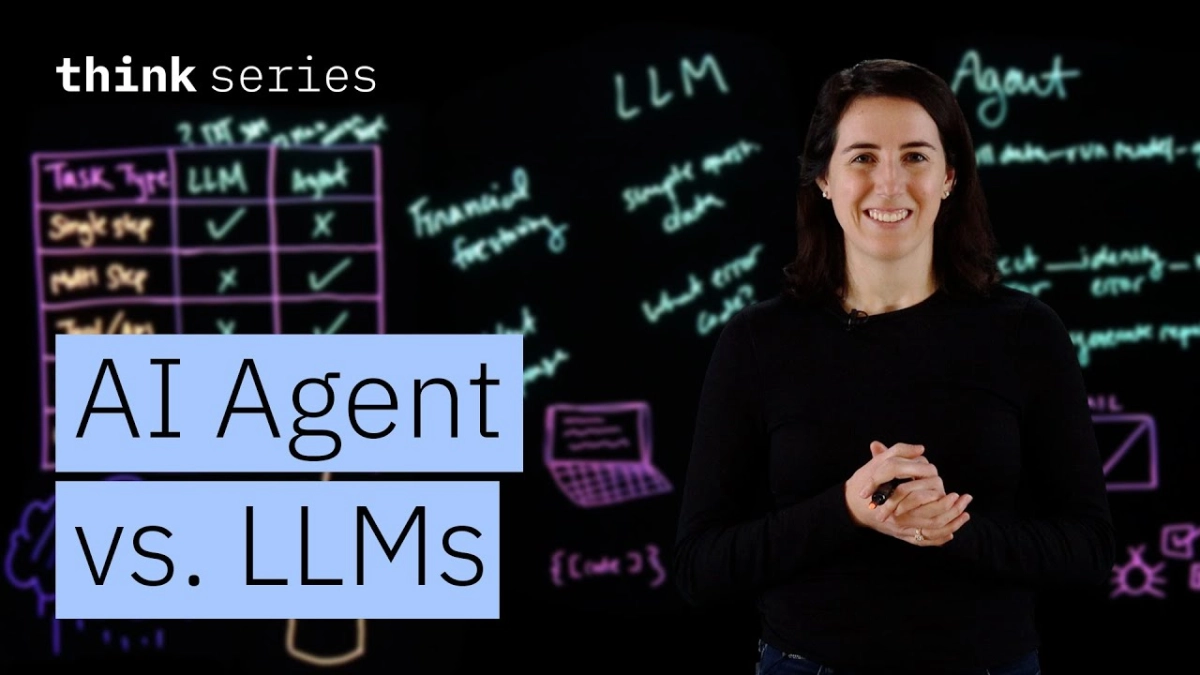
The central challenge in modern enterprise AI development is often not capability, but selection: determining the optimal architecture for a given task. As Brianne Zavala, Sr. Data & AI Technical Specialist at IBM, explained in her recent presentation, the distinction between a bare Large Language Model (LLM) and a fully configured AI Agent is critical to efficient workflow automation and resource allocation. The difference, she posits, can be understood simply: an LLM is optimized for speed and simplicity, while an Agent is built for complexity and autonomous orchestration.
Zavala frames this core concept using a relatable analogy: ordering a coffee. An LLM approach is like telling the barista, "I'd like something warm, not too sweet, and good for a rainy day." The LLM (the barista) instantly suggests a Chai Latte, completing the task in a single step based on inference and generalized knowledge. An agent, however, is the barista who asks a series of detailed, multi-step questions—Do you want dairy? What size? What temperature?—before arriving at a specific, customized solution. As Zavala noted, "We sometimes build these elaborate agents... when a simple LLM prompt would have done the job faster and cleaner. Sometimes, simple is better." This highlights the first core insight for AI professionals: unnecessary complexity introduces latency and overhead.
LLMs, such as those powering popular generative interfaces, are powerful, single-step performers. They excel at rapid tasks like summarizing documents, translating text, generating preliminary code snippets, or answering simple questions about a dataset. These are tasks requiring little to no external interaction or sequential decision-making. The low complexity and high speed of the LLM make it the ideal choice when the requirement is a direct response with minimal need for external validation or complex planning. When speed matters, the LLM provides the fastest result without the overhead required for multi-step reasoning.
The AI Agent, in contrast, is an architectural framework built around an LLM, transforming it from a powerful language processor into an autonomous system capable of planning, reasoning, and tool use. Agents shine when a task requires "multi-step reasoning," decision-making, and interaction with external systems. This is where the Agent truly earns its place in the enterprise stack. Agents integrate tools—APIs, databases, and external enterprise systems—allowing them to execute a sequence of actions that a standalone LLM cannot. This tool integration is a non-negotiable requirement for complex automation, as Zavala demonstrated in her comparison table, where LLMs received an 'X' for tool use while agents received a 'check.'
Consider a common financial forecasting scenario. An LLM could answer a simple question about performance trends in a data set, summarizing results it was fed directly. However, an Agent can perform the full, complex workflow: pulling data from a SQL database, running a proprietary forecasting model, generating a specific chart based on the model output, and then emailing that chart and an explanatory narrative to an executive or client. This orchestration process—pull data, run model, generate chart, email executive—is inherently multi-step and requires interfacing with multiple distinct enterprise tools.
Another compelling use case for agents is automated incident response. When a system failure occurs, the task is not a single query; it is a complex sequence of actions: detect the error, identify the root cause, resolve the error, notify the operations team, and finally, generate a post-mortem report. An LLM could likely explain what a specific error code means, but it cannot take action. An Agent, acting as a "mini project manager," autonomously executes these steps, leveraging different external tools (monitoring systems, ticketing software, notification platforms) to complete the entire remediation workflow. This ability to handle complex, high-autonomy workflows marks the transition from simple AI assistance to full-scale AI workflow automation. For those building mission-critical systems, understanding this distinction is paramount to building resilient, effective solutions that scale across the organization.


