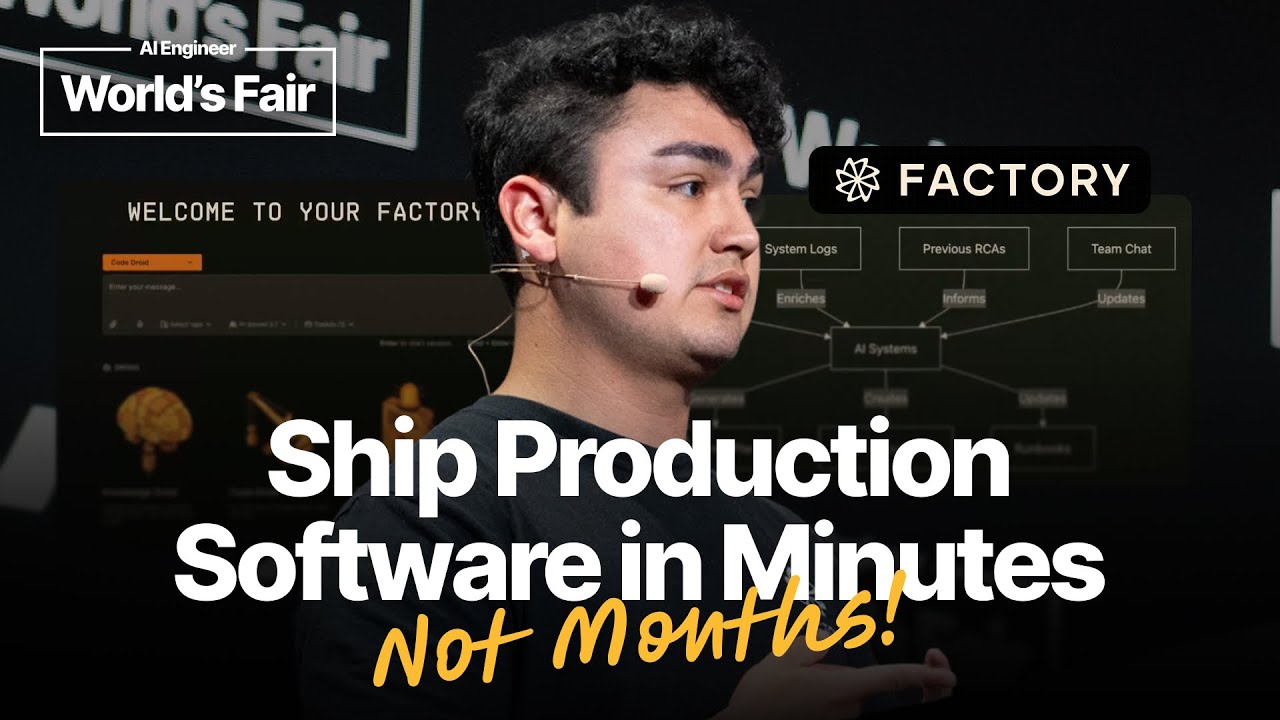
Eno Reyes, co-founder and CTO of Factory, took the stage at the AI Engineer World's Fair in San Francisco, asserting a profound shift in software engineering: the transition from human-driven to agent-driven development. His presentation underscored Factory’s mission to accelerate enterprise software production by orchestrating autonomous AI agents across the entire software development lifecycle (SDLC), from planning and coding to testing and incident response.

Reyes posited that the current paradigm, where AI tools are merely sprinkled onto existing human-centric workflows, represents an incremental improvement rather than a fundamental transformation. He declared, "We're transitioning from the era of human-driven software development to agent-driven development." This pivotal shift, he argued, will unleash the true power of AI, enabling teams to delegate the majority of their tasks to intelligent agents.
A core insight from Reyes's talk, dubbed "The Context Principle," emphasizes that "AI tools are only as good as the context that they receive." He highlighted that missing crucial information is the primary reason for AI failure, accounting for a staggering 90% of errors. Factory’s solution centralizes comprehensive context from all engineering tools and data sources, allowing agents to ground themselves in the environment and operate effectively. This approach fundamentally changes the interaction pattern, moving beyond simple "vibe coding" to a more robust, agent-native development.
For complex tasks like planning and design, AI agents become invaluable collaborators. Instead of merely generating a product roadmap, agents can delve into user interviews, technical documentation, and product goals, identifying patterns and suggesting technical constraints. This collaborative discovery process offloads the extensive groundwork and research to AI, freeing human engineers to focus on strategic decisions and iterative refinement of ideas.
The impact of agent-native development extends powerfully into site reliability engineering (SRE) and incident response. Reyes demonstrated how a "Reliability Droid" could ingest a Sentry incident, then autonomously gather context from system logs, previous root cause analyses (RCAs), and team discussions from Slack. The agent systematically diagnoses the issue, identifies the root cause, and generates a comprehensive mitigation plan, complete with code fixes and hardening recommendations. Every incident, in this model, makes the Droids smarter, ultimately enabling teams to shift from reactive to predictive operations.