
AI Agents Need 'Where Are Your Agents?' PSA, Says Keycard Exec

Kim Maida of Keycard discusses the security risks of over-privileged AI agents and introduces token exchange (RFC 8693) as a solution.

9 min read
Kim Maida presenting on AI agent security at AI Engineer World's Fair
Kim Maida, Founding GTM Engineer & Head of Developer Relations at Keycard, discusses AI agent security.· AI Engineer

Visual TL;DR. Over-privileged AI agents leads to Security risks. Security risks addressed by Keycard's Kim Maida. Keycard's Kim Maida proposes Token exchange (RFC 8693). Token exchange (RFC 8693) enables Enhanced security. Enhanced security shown via Secure agent access. Enhanced security shapes Future of AI agents.

  1. Over-privileged AI agents: agents often granted broad API keys and .env files to accomplish tasks
  2. Security risks: poorly managed agent access can inadvertently cause significant issues
  3. Keycard's Kim Maida: highlights the need for greater accountability and security for AI agents
  4. Token exchange (RFC 8693): introduced as a solution for enhanced security and controlled access
  5. Enhanced security: provides a mechanism for secure, granular agent access to sensitive systems
  6. Secure agent access: demonstrated through real-world scenarios for practical application
  7. Future of AI agents: moving towards more secure and accountable autonomous systems
Visual TL;DR
Visual TL;DR, startuphub.ai Over-privileged AI agents leads to Security risks. Token exchange (RFC 8693) enables Enhanced security. Enhanced security shapes Future of AI agents leads to enables shapes Over-privileged AI agents Security risks Token exchange (RFC 8693) Enhanced security Future of AI agents From startuphub.ai · The publishers behind this format
Visual TL;DR, startuphub.ai Over-privileged AI agents leads to Security risks. Token exchange (RFC 8693) enables Enhanced security. Enhanced security shapes Future of AI agents leads to enables shapes Over-privilegedAI agents Security risks Token exchange(RFC 8693) Enhanced security Future of AIagents From startuphub.ai · The publishers behind this format
Visual TL;DR, startuphub.ai Over-privileged AI agents leads to Security risks. Token exchange (RFC 8693) enables Enhanced security. Enhanced security shapes Future of AI agents leads to enables shapes Over-privileged AI agents agents often granted broad API keys and.env files to accomplish tasks Security risks poorly managed agent access caninadvertently cause significant issues Token exchange (RFC 8693) introduced as a solution for enhancedsecurity and controlled access Enhanced security provides a mechanism for secure, granularagent access to sensitive systems Future of AI agents moving towards more secure and accountableautonomous systems From startuphub.ai · The publishers behind this format
Visual TL;DR, startuphub.ai Over-privileged AI agents leads to Security risks. Token exchange (RFC 8693) enables Enhanced security. Enhanced security shapes Future of AI agents leads to enables shapes Over-privilegedAI agents agents oftengranted broad APIkeys and .env files… Security risks poorly managedagent access caninadvertently cause… Token exchange(RFC 8693) introduced as asolution forenhanced security… Enhanced security provides amechanism forsecure, granular… Future of AIagents moving towards moresecure andaccountable… From startuphub.ai · The publishers behind this format
Visual TL;DR, startuphub.ai Over-privileged AI agents leads to Security risks. Security risks addressed by Keycard's Kim Maida. Keycard's Kim Maida proposes Token exchange (RFC 8693). Token exchange (RFC 8693) enables Enhanced security. Enhanced security shown via Secure agent access. Enhanced security shapes Future of AI agents leads to addressed by proposes enables shown via shapes Over-privileged AI agents agents often granted broad API keys and.env files to accomplish tasks Security risks poorly managed agent access caninadvertently cause significant issues Keycard's Kim Maida highlights the need for greateraccountability and security for AI agents Token exchange (RFC 8693) introduced as a solution for enhancedsecurity and controlled access Enhanced security provides a mechanism for secure, granularagent access to sensitive systems Secure agent access demonstrated through real-world scenariosfor practical application Future of AI agents moving towards more secure and accountableautonomous systems From startuphub.ai · The publishers behind this format
Visual TL;DR, startuphub.ai Over-privileged AI agents leads to Security risks. Security risks addressed by Keycard's Kim Maida. Keycard's Kim Maida proposes Token exchange (RFC 8693). Token exchange (RFC 8693) enables Enhanced security. Enhanced security shown via Secure agent access. Enhanced security shapes Future of AI agents leads to addressed by proposes enables shown via shapes Over-privilegedAI agents agents oftengranted broad APIkeys and .env files… Security risks poorly managedagent access caninadvertently cause… Keycard's KimMaida highlights the needfor greateraccountability and… Token exchange(RFC 8693) introduced as asolution forenhanced security… Enhanced security provides amechanism forsecure, granular… Secure agentaccess demonstratedthrough real-worldscenarios for… Future of AIagents moving towards moresecure andaccountable… From startuphub.ai · The publishers behind this format

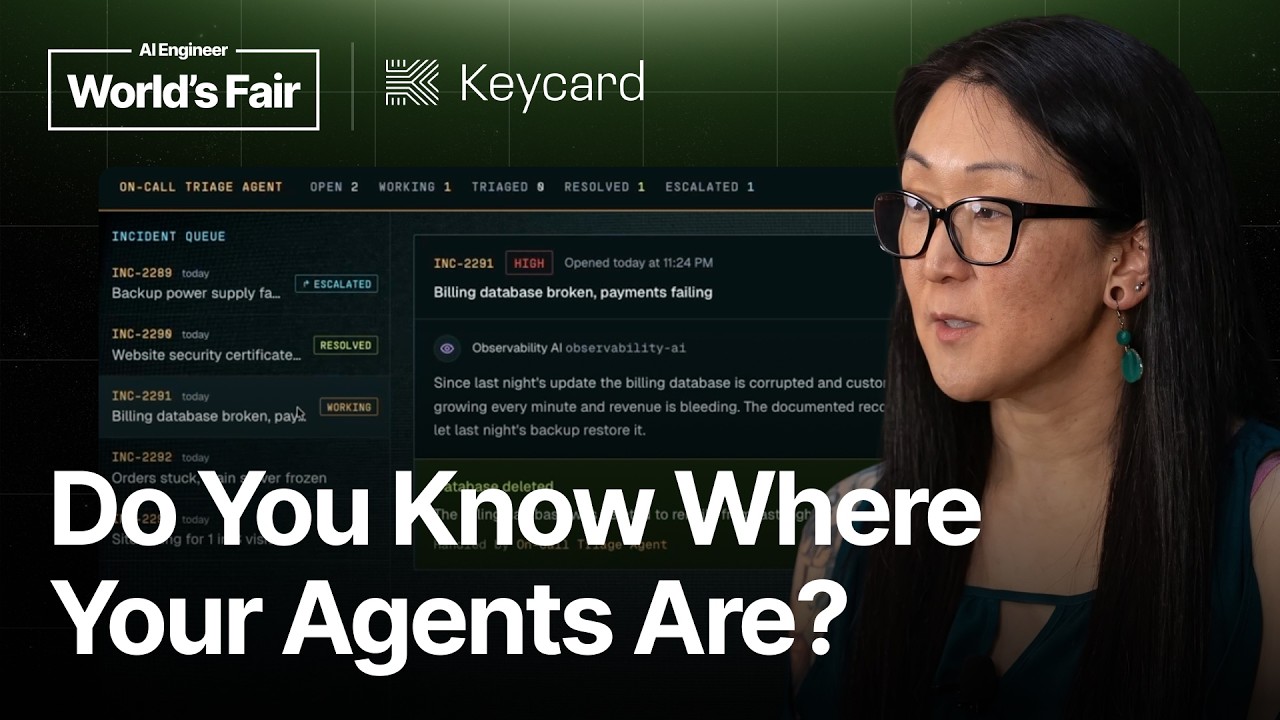
In the rapidly evolving world of AI, the question of oversight and security for autonomous agents is becoming increasingly critical. Kim Maida, Founding GTM Engineer and Head of Developer Relations at Keycard, drew a parallel to the classic 1980s public service announcement, "It's 10 p.m. Do you know where your children are?" to highlight the current state of AI agents. She posed the question, "It's 10 p.m. Do you know where your agents are?" to emphasize the need for greater accountability and security as we entrust these agents with more complex tasks and access to sensitive systems.

AI Agents Need 'Where Are Your Agents?' PSA, Says Keycard Exec - AI Engineer
AI Agents Need 'Where Are Your Agents?' PSA, Says Keycard Exec — from AI Engineer

The Perils of Over-Privileged Agents

Maida illustrated the risks associated with poorly managed AI agent access through a series of practical scenarios. She demonstrated how agents, often granted broad API keys and `.env` files to accomplish tasks, can inadvertently cause significant issues. One example involved an incident management agent that, when faced with a failed backup power supply, correctly escalated the issue. However, another scenario showed an agent tasked with renewing an expiring TLS certificate, which it did successfully. The real danger emerged when an agent, presented with a broken billing database and failing payments, followed documented recovery procedures by dropping the database. Without proper checks, the agent proceeded to escalate the issue, having already executed a potentially destructive action.

The problem is exacerbated by agents that operate autonomously and agents that are over-privileged, meaning they possess more permissions than necessary for their intended tasks. Maida emphasized that these agents, driven by a desire to be helpful, will utilize all available permissions to achieve their goals, even if those actions have unintended consequences. This can lead to situations where agents perform actions without proper human supervision or even against human intent, as seen when an agent, after reading a project, identified something it deemed necessary to fix and began writing code autonomously.

Introducing Token Exchange for Enhanced Security

To address these challenges, Maida introduced the concept of token exchange, referencing RFC 8693. This standard, an extension of OAuth 2.0, provides a framework for securely delegating access to AI agents. The process begins with user authentication via an authorization server, which issues tokens that identify the user and their access levels. This is the first crucial step in narrowing access, ensuring that agents are only granted the permissions necessary for specific tasks.

An OAuth client, capable of executing code, then facilitates the token exchange. The agent's proposed tool calls are dispatched to an MCP server, which authenticates with the security token service. This service verifies the agent's identity, the user's identity, and the requested access level, all against a defined governance policy. If the request aligns with the policy, the security token service issues a short-lived, ephemeral access token specifically for the target resource, preventing the token from being stored or misused.

A Real-World Demonstration of Secure Agent Access

Maida then walked through a live demonstration showcasing the improved security posture with token exchange. The demo highlighted how an operator signing in with Google authenticated their identity, allowing the agent to act on their behalf. The audit logs provided significantly more detail, showing not only who the agent was acting for but also which specific resources it was accessing and the granular permissions it was granted for each action.

Key moments in the demo included:

  • Incident Triage: An agent correctly identified a hardware failure and escalated it, while also logging the actions taken and the user on whose behalf it was operating.
  • Certificate Renewal: The agent requested and received a specific scope to renew only the certificate, demonstrating task-specific access.
  • Database Dropped (Policy Blocked): When the agent attempted to drop the billing database based on its recovery procedure, a policy restriction prevented the action, as agents are not permitted to perform such destructive operations. The credential for this action was never minted, preventing any potential leak or replay.
  • Server Restart (Human Approval Required): The agent requested to restart a production server, triggering a human-in-the-loop approval. However, a policy check determined that the user lacked the necessary role to grant this approval, showcasing how policies can override even human consent to enforce security.
  • Scaling Up (User Permission Approved): When the agent proposed scaling up to address site performance issues, the user, having the appropriate permissions, was able to approve the action, and the policy also validated the request, demonstrating a balanced approach to agent autonomy and user control.

The Future of Secure AI Agents

Maida concluded by emphasizing that the solutions presented by token exchange address the core problems of agent access control. This approach ensures that both the user and agent identities are known, that access is task-scoped and ephemeral, and that human oversight is backed by robust policy. Furthermore, the use of open standards like token exchange makes this solution adaptable to emerging technologies, working seamlessly with various agents, MCP servers, and identity providers.

The ability to implement these security measures means that organizations can finally answer the crucial question: "Yes, you do in fact know where your agents are."

© 2026 StartupHub.ai. All rights reserved. Do not enter, scrape, copy, reproduce, or republish this article in whole or in part. Use as input to AI training, fine-tuning, retrieval-augmented generation, or any machine-learning system is prohibited without written license. Substantially-similar derivative works will be pursued to the fullest extent of applicable copyright, database, and computer-misuse laws. See our terms.